

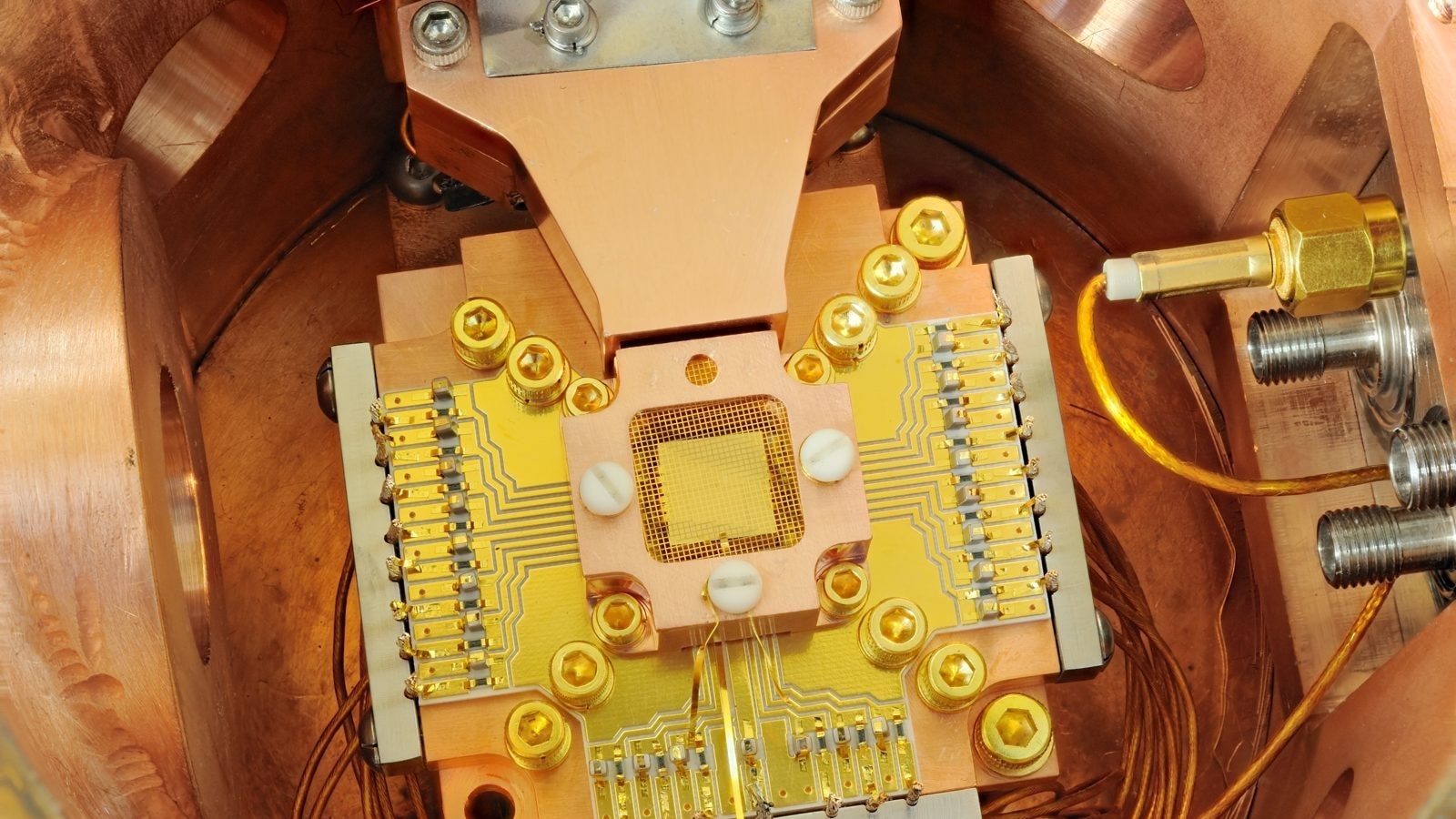
Quantum computing has spent years trapped in a numbers problem of its own making. A company announces a machine with more qubits. Another company answers with a larger number. The headline travels faster than the explanation that those qubits are fragile, noisy, architecture-dependent and often incapable of sustaining the depth of computation people imagine when they hear the word "quantum."
The Department of Energy's new Quantum Genesis Q Competition is interesting because its central number is harder to game.
DOE announced on Sept. 17 that it plans to make up to $215 million available in a milestone competition aimed at demonstrating what it calls a fault-tolerant, scientifically relevant quantum computer. Applicants are being asked to deploy machines with at least 100 logical qubits, perform hundreds of millions of fault-tolerant operations and run scientific demonstration programs. Separate funding is planned for national-laboratory testbeds that can characterize and validate the machines across the stack.
That specification changes the argument. A physical qubit is a device. A logical qubit is an information system built from devices, control, measurement, error detection, decoding and repeated correction. Counting the latter tells us more about whether the machine can keep a computation alive long enough to matter.
A logical qubit is what survives the noise
Physical quantum bits are vulnerable to their environment and to imperfections in control. Their state can be disturbed by noise, calibration drift, unwanted interactions, imperfect gates and measurement errors. Classical computers also experience errors, but a classical bit can be copied freely and protected with mature redundancy techniques. Quantum information is constrained by the physics of measurement and no-cloning, so error correction has to be built differently.
The basic move is to encode one unit of useful quantum information across multiple physical qubits. Measurements are designed to reveal information about errors without simply measuring and destroying the encoded quantum state. A decoder interprets those error signals. Control logic then keeps the encoded state on track while computation continues.
NIST describes the idea in straightforward terms: individual physical qubits are fragile, so researchers entangle multiple physical qubits to form a logical qubit in which the information is distributed rather than entrusted to one component. Modern error-correction research then asks whether increasing the strength or distance of that code actually suppresses the logical error rate.
That last step is the threshold that matters. If protecting the qubit requires more hardware but the protected information fails just as often, the architecture is only moving the noise around. Useful error correction should make the logical object more reliable as the protection is strengthened.
One hundred is not large in the classical sense
A hundred logical qubits sounds microscopic beside billions of transistors in a conventional processor. That comparison is misleading because a quantum computer is not trying to replace every classical instruction with a quantum equivalent. The goal is to exploit quantum structure on specific problems where the state space or algorithmic path becomes difficult for classical machines.
At the same time, 100 logical qubits should not be treated as a magic threshold where usefulness suddenly appears. The number of logical qubits is only one axis. The machine must also execute enough logical operations before accumulated error destroys the answer. Gates need to work across the required connectivity. Measurements and feed-forward need to happen fast enough. The control system must decode errors continuously. The algorithm has to fit the architecture. And the scientific problem has to be one for which a quantum method actually improves on the best available classical approach.
DOE appears to understand this, which is why the competition specification includes hundreds of millions of fault-tolerant operations and a scientific demonstration program rather than stopping at "100 logical qubits."
Depth matters. A machine that can preserve a hundred protected qubits for only a shallow sequence may be an excellent experiment and still fail to execute the scientific workloads used to justify the investment. The operation count is an attempt to force the claim past the showroom.
The overhead is the hidden machine
The most important number DOE has not fixed is how many physical qubits companies may need to produce those 100 logical qubits.
That is deliberate. Different hardware modalities and error-correcting codes trade physical resources in different ways. Superconducting circuits, neutral atoms, trapped ions, photonics and spin qubits have different strengths, error channels, connectivity and control requirements. DOE's accompanying roadmap explicitly argues for remaining technology-neutral and judging demonstrated scientific utility rather than locking the program to one hardware type.
But the physical-to-logical overhead will tell us a great deal about engineering maturity.
Quantum error correction is expensive because the protection itself requires hardware and operations. Extra qubits measure error syndromes. Gates used for correction can introduce new errors. Decoding has to keep pace with the quantum processor. Some architectures require many physical qubits per logical qubit; newer codes aim to reduce that burden. NIST research on neutral-atom systems, for example, has demonstrated dozens of logical qubits and key components of universal fault-tolerant architectures, while separate work explores codes designed to improve encoding efficiency.
Those are meaningful advances, but a competition machine has to integrate the whole stack at a larger scale. The hidden computer behind "100 logical qubits" includes lasers or microwave electronics, cryogenics or vacuum systems depending on modality, calibration software, classical processors, decoders, compilers, networking between control components, synchronization and a mountain of instrumentation.
The logical qubit is therefore a systems-engineering metric disguised as a physics metric.
Hundreds of millions of operations changes the thermal language of hype
Quantum announcements have often emphasized qubit counts because they are easy to photograph on a slide. Operation depth forces a more uncomfortable conversation. If DOE intends the phrase "hundreds of millions of fault-tolerant operations" literally at the logical layer, teams will have to demonstrate not merely encoded states but sustained protected computation.
That means error rates must be low enough that a long circuit can complete with an acceptable probability of success. It means correction cycles cannot collapse under their own overhead. It means classical decoding latency cannot become the bottleneck. It means error correlations, leakage and rare failure modes have to be controlled well enough that the logical abstraction remains trustworthy.
This is where the difference between a laboratory milestone and a computing platform becomes visible. A lab can demonstrate a beautiful logical gate. A platform has to do the boring version of that success repeatedly, across many qubits, while the user runs something useful.
There is a reason DOE is also planning $45 million for a Quantum High-Performance Computing Validation and Verification Testbed Lab Call. The agency says the testbed work is intended to characterize the stack from physical hardware and gates through logical architectures, algorithms, applications and classical controls. That is not decorative oversight. Once money and prestige attach to a milestone, measurement becomes part of the technology.
Verification is going to be ugly, which is good
A credible quantum competition needs independent ways to tell whether a machine did what its developer says it did. The problem gets harder as the target machine becomes interesting, because one definition of quantum advantage is that the classical system used to check the answer cannot cheaply reproduce the computation.
Scientific applications offer partial escape from that paradox. Some workloads can be designed around quantities that have independent physical structure, smaller instances with known answers, cross-checks against high-performance computing or experimental data. A useful validation program can also separate claims: logical error rates, gate fidelities, circuit depth, application accuracy and time-to-solution need not all be proven by the same test.
This is one reason DOE's science-first framing is healthier than a generic "quantum supremacy" race. Chemistry, materials, physics and applied mathematics provide domains where researchers can ask not only whether the circuit was difficult, but whether the answer advances a problem scientists actually care about.
The strongest future result would not be a press release saying that a machine crossed 100 logical qubits. It would be a reproducible case where the quantum system performs a scientifically relevant computation, the error-corrected stack is independently characterized, and the result compares favorably with the best practical classical route.
The money is milestone-shaped
The competition is structured in two phases. DOE says Phase I will provide fixed awards worth up to $1.5 million per awardee for early milestones. Phase II includes a $100 million general incentive pool for teams that demonstrate a first-generation system with at least 100 logical qubits, plus two $50 million bonus pools tied to demonstrations of 150 and 200 logical qubits.
The total planned competition funding is up to $215 million. DOE states that only part of that money is currently fiscal-year 2026 funding and that later-year funding is contingent on congressional appropriations. That qualifier matters. The headline number describes a planned incentive structure, not cash already sitting beside the machines.
The structure nevertheless reveals the desired behavior. DOE is not simply reimbursing research expenses. It is trying to create a ladder in which increasingly difficult technical demonstrations unlock increasingly large rewards.
That can concentrate attention. It can also distort it. Teams optimize for the metric that pays them. If the metric is poorly chosen, the industry learns to produce a machine that wins the benchmark. The inclusion of scientific demonstrations and independent validation is therefore essential. It gives the competition multiple dimensions that are harder to satisfy with a single spectacular trick.
The real inflection point is a change in nouns
For most of the public history of quantum computing, the noun has been "qubit." The competition is trying to change the noun to "logical qubit," then to "fault-tolerant operation," then finally to "scientific result."
That is how an immature technology becomes infrastructure. Components stop being the story. Reliability and work become the story.
Classical computing passed through similar transitions. Nobody buys a data center because it contains an impressive number of transistors. They buy throughput, latency, uptime, software compatibility, security and a result. Quantum machines are nowhere near that level of operational abstraction, but the DOE specification points in that direction.
The most revealing outcome may not be which company reaches the target first. It may be the resource table behind the demonstration: how many physical qubits were required, what logical error rate was sustained, how many correction cycles ran, what the wall-clock runtime was, how much classical computation supported the quantum layer and which scientific workload justified the effort.
Method, limits and falsification
This analysis treats DOE's competition language as a specification to be decomposed rather than as evidence that the requested machine already exists. The underlying technical explanation uses NIST material on logical processors, quantum error correction and fault-tolerant architectures. It does not assume one hardware modality will dominate.
The thesis that the competition represents a meaningful shift away from raw qubit counts would weaken if awards are ultimately made on nominal logical-qubit totals without transparent logical error rates, operation depth or scientific verification. It would strengthen if independent testbeds publish comparable measurements across competing architectures and if scientific demonstrations can be reproduced or cross-validated.
Watch five numbers when results appear: physical qubits per logical qubit, logical error rate, successful logical operation count, wall-clock time and application error relative to the best available classical reference. "100" means very little without the other four.
The useful part of Quantum Genesis Q is not the $215 million headline. It is that the target machine is described in terms of protected information, sustained fault-tolerant work and scientific output. Quantum computing will become consequential when the industry can stop asking us to admire the qubits and start handing researchers a machine whose errors are controlled well enough to trust the result.
Source trail
U.S. Department of Energy, Sept. 17, 2026 — Quantum Genesis Q Competition announcement
U.S. Department of Energy, Sept. 17, 2026 — science-first quantum roadmap
National Quantum Initiative, Sept. 17, 2026 — competition and validation-testbed summary
NIST — physical and logical qubits in quantum error correction
NIST, 2025 — fault-tolerant neutral-atom architecture
NIST / Nature — logical quantum processor based on reconfigurable atom arrays