

AMD's agreement to acquire World Labs is easy to flatten into a familiar headline: semiconductor company buys AI startup. The documents point to a more interesting transaction.
AMD announced on September 28 that it had entered a definitive agreement to acquire World Labs, the spatial-intelligence company led by Fei-Fei Li, in an all-stock transaction valued at approximately $8.2 billion. AMD's SEC filing says the merger agreement was signed September 26 and that the purchase price will be paid in AMD common stock, subject to customary adjustments.
The deal has not closed. AMD says it expects closing by the end of 2026, subject to regulatory approvals and customary conditions.
World models create different compute pressure
World Labs develops models that generate, reconstruct and simulate interactive three-dimensional environments from text, images and video, alongside technology for robotic learning and simulation. Those workloads are not simply another chat interface with prettier output. They combine geometry, temporal consistency, rendering, simulation, perception and interaction.
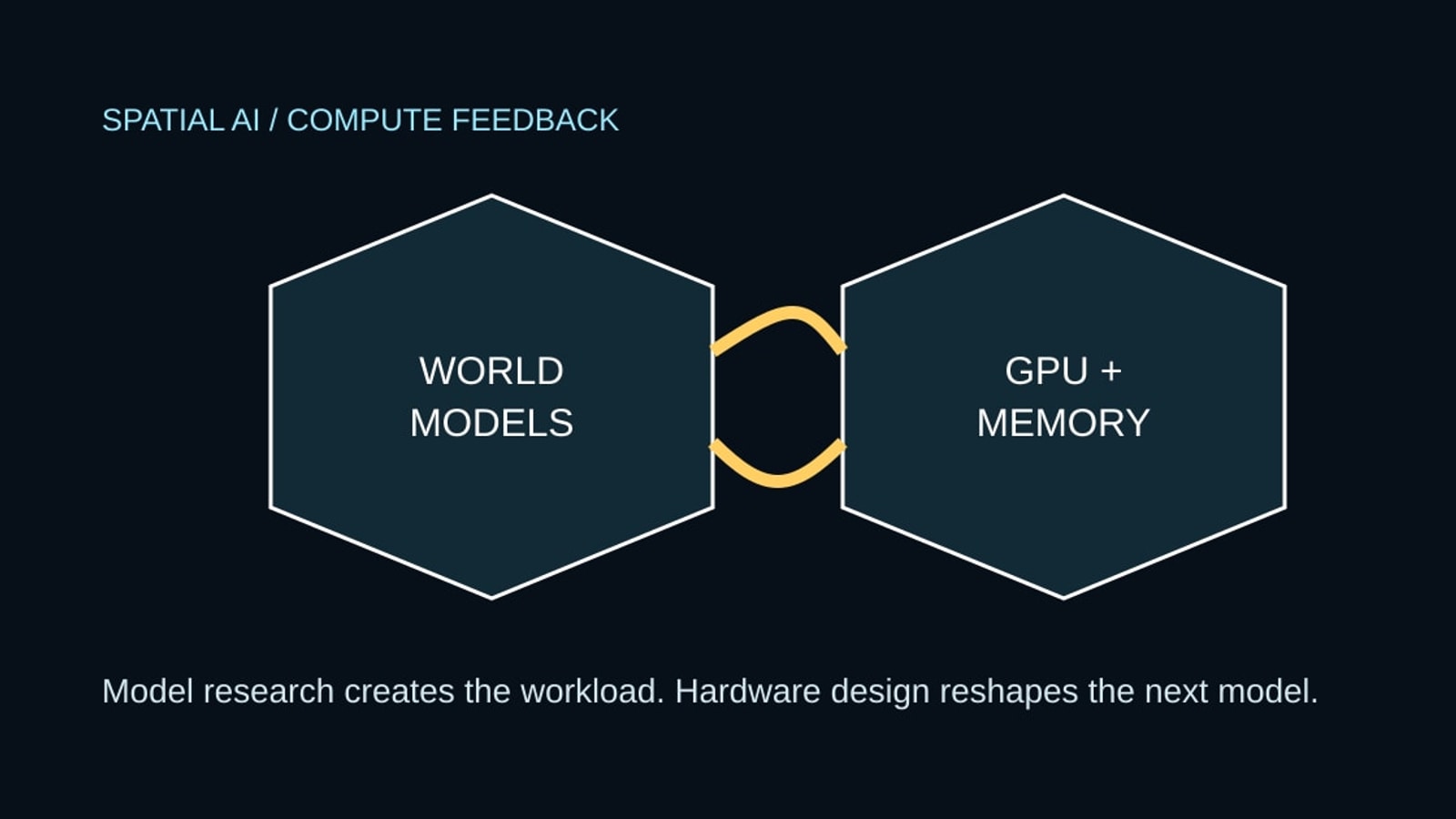
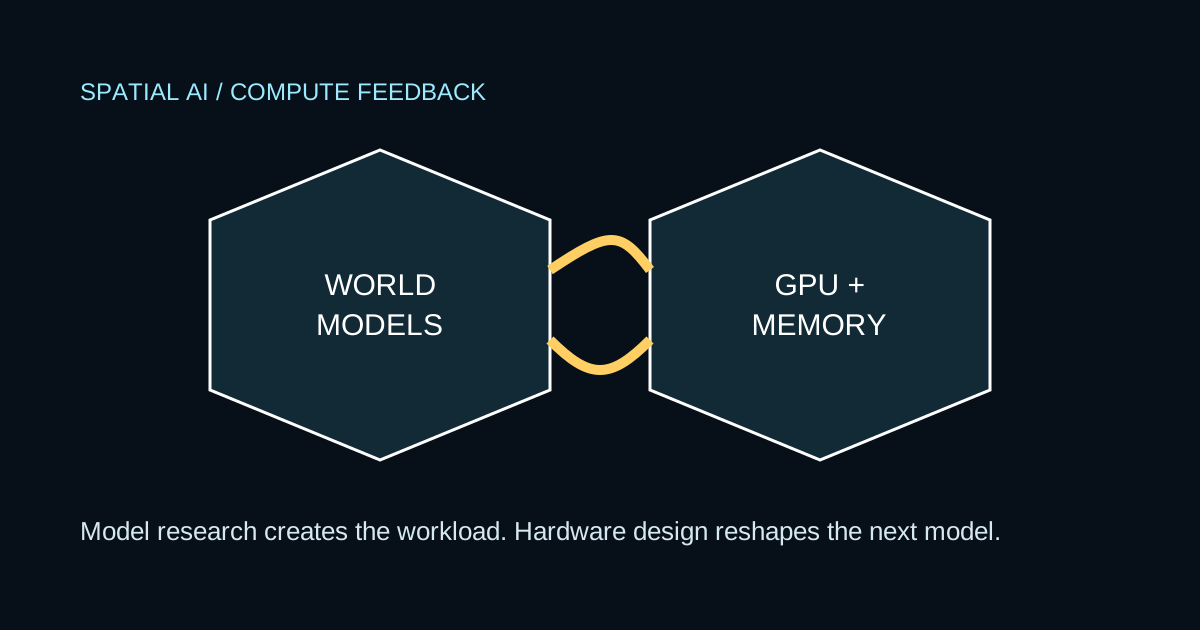
For a hardware company, that matters because workloads define machines. Memory capacity, bandwidth, interconnects, precision formats, scheduling, compiler behavior and accelerator architecture all become design decisions around what customers actually run.
AMD says World Labs will give it deeper insight into how emerging models are evolving and help shape future hardware, software and systems roadmaps. That statement is strategic intent, not evidence that a particular future chip design has already changed.
The acquisition shortens the feedback path
A chip vendor normally learns about new model behavior through customers, benchmarks, software partners and internal research. Owning a research organization working on spatial intelligence creates a more direct loop: researchers expose bottlenecks; systems engineers can observe them; hardware and software teams can respond; the next model can then stress the revised stack.
That loop could be particularly relevant to robotics. Physical AI needs simulated environments, perception, planning, policy learning and eventually execution on machines with severe power, latency and reliability constraints. The useful unit is not just training throughput. It is how efficiently the whole stack turns experience into reliable behavior.
$8.2 billion is also a valuation statement
The transaction price is large enough to show what AMD believes access to model research may be worth to an infrastructure company. It does not establish that World Labs currently produces $8.2 billion of economic value, nor that the acquisition will earn an adequate return.
The SEC filing also makes clear that the final number of AMD shares is not yet known. It will depend on a ten-trading-day volume-weighted average price ending shortly before closing. In other words, the headline value is approximately $8.2 billion, while the actual share issuance remains mechanically tied to AMD's market price.
Watch what changes after closing
The meaningful evidence will arrive after integration. Does AMD expose new spatial-AI software primitives? Do future accelerators change memory or interconnect assumptions around world models? Does World Labs gain materially larger training and simulation infrastructure? Do robotics customers appear in the resulting ecosystem?
Fei-Fei Li is expected to become AMD executive vice president and chief scientist after closing, reporting to CEO Lisa Su. That places model research unusually close to the top of a major compute company. The org chart is not proof of technical integration, but it makes the intended feedback path difficult to miss.
The merger is announced, not completed. Strategic benefits described here are analysis of the stated integration logic; future product effects and financial returns remain unproven.