
GENOME ENGINEERING / CRISPR / DE-EXTINCTION
How Do You Build an Extinct Animal?
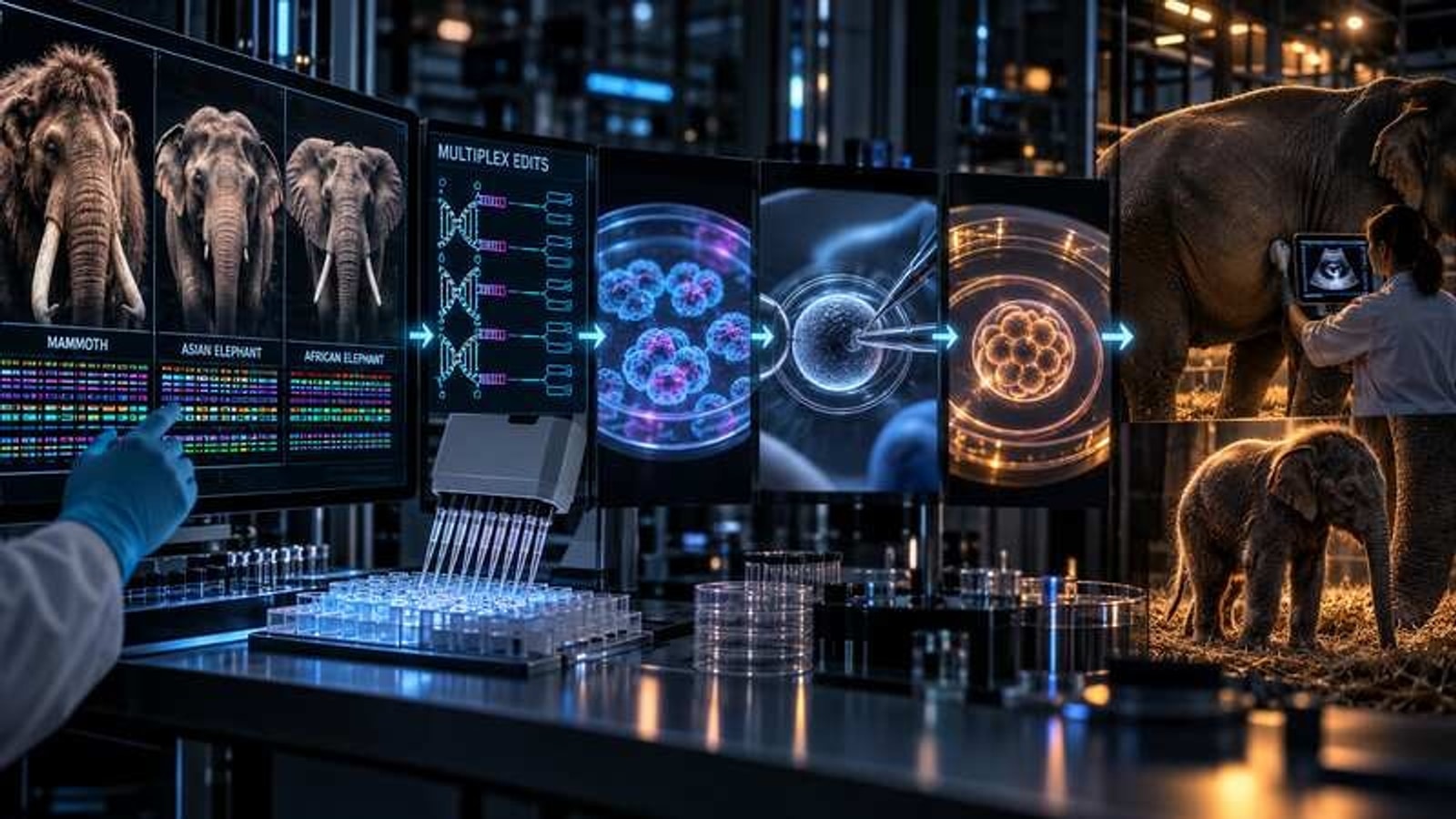
Not by cloning a frozen corpse. The modern route is closer to engineering: compare extinct and living genomes, identify functional differences, rewrite cells, generate embryos, and then find out which assumptions biology refuses to honor.
By Cyberdelia Research Desk · September 10, 2026 · Method: biotechnology pipeline reconstruction
Step one: define the target
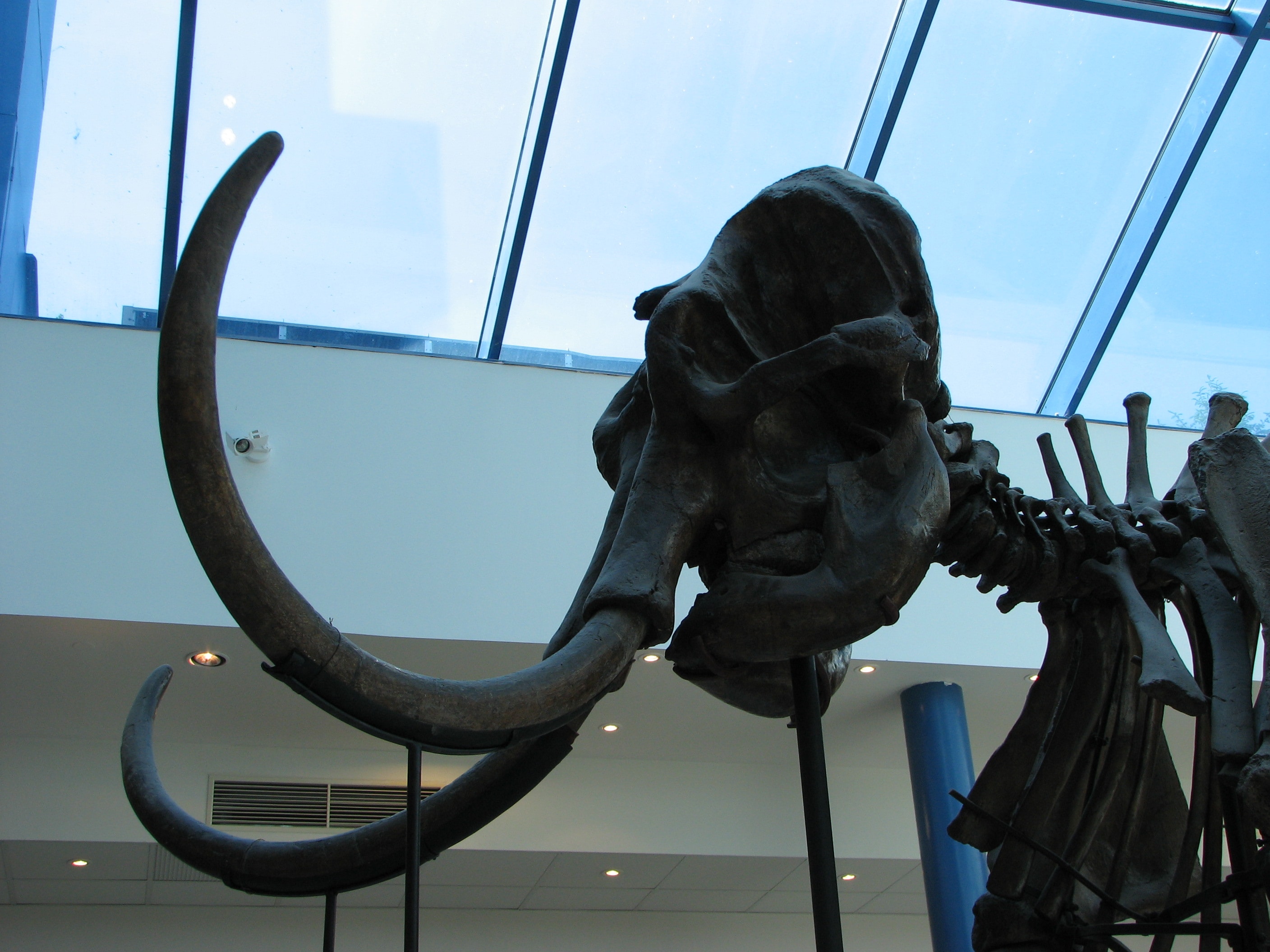
The phrase "bring back the mammoth" sounds precise until an engineer asks for a specification. Which mammoth? Woolly mammoths existed as populations, not as one canonical genome. Individuals differed. Populations adapted to different environments. Some lineages accumulated harmful mutations when isolated. Any de-extinction program therefore has to choose which traits and sequence states count as the target.
That target is assembled from paleogenomics. Researchers sequence DNA from multiple mammoth specimens, compare those genomes with Asian and African elephants, and identify genetic differences that repeatedly track with mammoth biology. The best candidates are not simply variants that are different. They are differences supported by functional evidence, conservation across mammoth populations, experimental models, or known roles in traits such as hair, fat, hemoglobin, ear morphology and cold response.
This distinction matters because the elephant and mammoth genomes are already extremely similar at the gross level. The engineering problem is not to replace an entire elephant genome with a mammoth genome. It is to determine which differences mattered enough to produce the extinct phenotype.
Step two: turn evolutionary history into an edit list
A comparative genome produces millions of differences. Most are useless for a first-pass engineering target. Some lie in noncoding regions. Some are neutral. Some reflect population history rather than mammoth-defining biology. Others may affect development in ways that are difficult to predict.
The edit-selection problem therefore combines evolutionary genomics with functional biology. Researchers look for genes and regulatory regions associated with cold tolerance, hair structure, adipose tissue, skull form, oxygen transport and other phenotypes. They may then test homologous genes in mice or cell culture to determine whether particular changes generate the expected effect.
Colossal's public estimates have changed as its program has matured. Earlier descriptions focused on roughly 65 target genes. More recent company material discusses around 85 genes for the mammoth program. That movement is itself instructive. De-extinction is not a fixed recipe discovered in a fossil. The specification evolves as researchers learn which traits require additional regulatory or developmental changes.
Step three: edit living cells
CRISPR-Cas systems transformed genome engineering because they allow researchers to direct cutting or editing machinery to chosen DNA sequences using guide RNAs. Newer approaches can make substitutions without always creating a full double-strand break, and large engineering programs increasingly combine CRISPR with base editing, prime editing and other tools depending on the desired change.
For mammoth work, the practical challenge is multiplexing: introducing many changes into the same cell line while preserving chromosome integrity and normal cell behavior. Every edit needs verification. Off-target changes, rearrangements or unintended mutations can appear. A line with the correct intended edits may still be biologically abnormal.
This is why de-extinction teams maintain and screen many edited cell lines. The objective is not merely to produce a DNA sequence on a computer. It is to produce living cells that carry the designed state, divide normally and remain competent for embryo production.
The woolly mouse is a pipeline test, not a mammoth
In 2025 Colossal announced gene-edited mice with unusually long, woolly coats and altered lipid biology. The company used several edits inspired by mammoth genetics alongside mutations already known to affect mouse hair. The result attracted exactly the two reactions it deserved: genuine interest and immediate skepticism.
The skeptical case is straightforward. A shaggy mouse does not demonstrate that researchers can generate a healthy cold-adapted elephant. Mouse genes do not map cleanly onto elephant development, and some of the engineered traits were already familiar from laboratory mouse genetics. Nature quoted researchers who argued that the experiment should not be treated as a giant leap toward a mammoth.
But dismissing the experiment completely also misses the mechanism. The work demonstrated an end-to-end engineering loop in a fast mammalian model: identify candidate genes, edit embryos or stem cells, establish pregnancies, produce offspring and verify visible phenotypes. That pipeline can expose failures before equivalent work is attempted in elephants, where a pregnancy takes nearly two years.
The woolly mouse therefore functions less as a miniature mammoth and more as a systems test. It checks whether some assumptions about trait engineering survive contact with a living mammal.
Step four: choose a reproductive route
Once an edited elephant cell line exists, researchers still need an embryo. Several routes are conceptually possible.
One is somatic cell nuclear transfer, the technique associated with Dolly the sheep. A nucleus from an edited somatic cell is placed into an egg whose own nucleus has been removed. The egg cytoplasm then attempts to reprogram the introduced nucleus into an embryonic state. If development proceeds, the embryo can be transferred into a surrogate.
Nuclear transfer is powerful but inefficient in many species. Reprogramming errors, abnormal placentation and developmental failure remain serious issues. Elephants add practical difficulty because obtaining mature oocytes is not routine at laboratory scale.
Another route involves induced pluripotent stem cells. Mature elephant cells can be reprogrammed into a more embryonic-like state. In principle, such cells might eventually be differentiated into sperm or eggs, enabling edited genomes to enter embryos through fertilization rather than nuclear transfer. In 2024 Colossal reported elephant iPSCs, an important technical milestone. Nature emphasized the same caveat researchers did: making pluripotent elephant cells is not the same as making functional elephant gametes or embryos.
Both approaches are part of a larger field called assisted reproductive technology. For endangered species, these methods have conservation value even without de-extinction because they can preserve and propagate rare genetic material.
Step five: prove the edits did what you think
Genome engineering becomes dangerous intellectually when sequence confirmation is mistaken for phenotype confirmation. A successful edit says the DNA changed. It does not prove the animal will grow the intended hair, regulate body heat correctly or develop normal organs.
Researchers therefore need layers of validation. Cells can be tested for gene expression, protein function and metabolic behavior. Organoids or differentiated tissues may reveal effects in skin, fat, blood or other systems. Small animal models can test analogous pathways. Embryos can be screened for chromosomal integrity and early development.
Only later does the most expensive evidence arrive: a living animal.
If a calf is eventually born, scientists will need longitudinal measurements of body temperature, metabolism, fat distribution, hair morphology, circulation, oxygen transport, immune function, growth, behavior and fertility. A mammoth-like appearance would be the beginning of verification, not its conclusion.
Step six: iterate
This is perhaps the most modern feature of de-extinction. The process resembles iterative engineering more than a one-time resurrection event. A first-generation proxy would reveal unexpected interactions. Some edits might be unnecessary. Others might be insufficient. New variants could be added or removed. Developmental problems could force redesign.
That means the first successful animal would almost certainly not be the final specification. It would be version one.
Such language can sound uncomfortably industrial when applied to sentient animals, and that discomfort is justified. Engineering logic has to be constrained by animal welfare. An iterative cycle that is ordinary for software becomes ethically serious when each failed test may involve embryos, pregnancies and intelligent mammals.
Cyberdelia assessment
Modern de-extinction is best understood as a constrained reconstruction problem. Ancient genomes provide the historical target. Living relatives provide the cellular chassis. Genome editing supplies the modification layer. Reproductive technology attempts to turn engineered cells into organisms. Development and physiology then determine which assumptions were correct.
This model explains why mammoths are technically plausible without pretending the task is simple. Every stage already exists in some form. What has not been demonstrated is the complete chain at elephant scale with a healthy, fertile, cold-adapted animal at the end.
It also explains why the Jurassic Park cloning metaphor is obsolete. The future animal is unlikely to emerge because scientists recovered a perfect ancient nucleus. It will emerge, if it does, because modern laboratories learned enough about extinct biology to edit a living relative into a new organism constrained by the old one.
Uncertainty and falsification
The project would fail scientifically if the selected edits do not generate the intended traits, if embryo production remains too inefficient, if gestation produces unacceptable welfare costs, or if resulting animals are unhealthy or infertile. A successful birth alone would not falsify those concerns; multi-year physiological and reproductive evidence would be required.
Source trail
Sources include Nature reporting on the woolly mouse and elephant iPSCs; Nature Biotechnology coverage of the mammoth engineering plan; Colossal's public mammoth and research documentation for company targets; and the broader peer-reviewed literature on CRISPR, cellular reprogramming and mammalian cloning.
Corrections: Cyberdelia updates technical features when primary evidence changes.