

NightmareStresser sold one of cybercrime's oldest conveniences: why build and maintain attack infrastructure when somebody will rent it to you through a web interface?
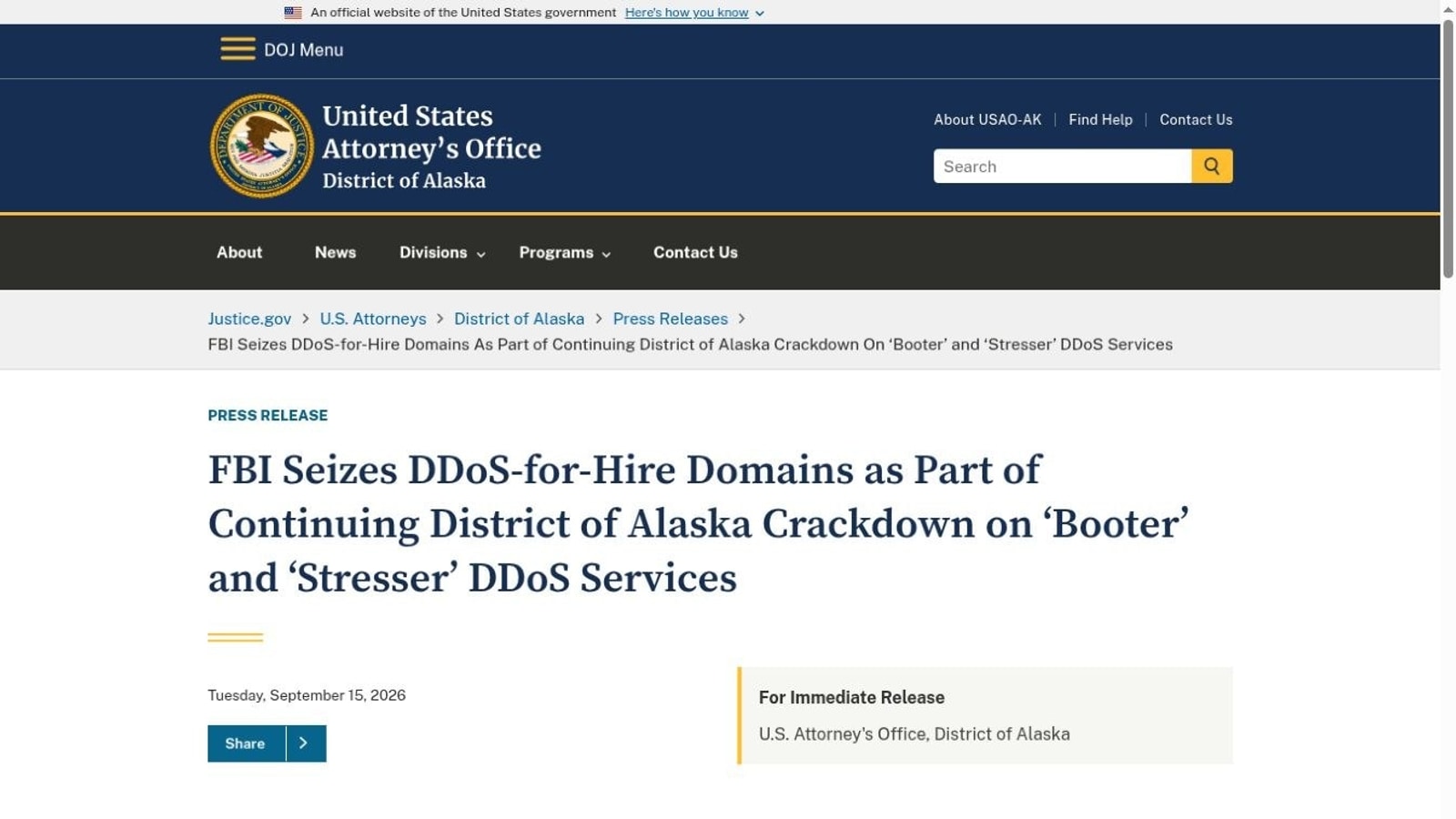
On September 15, 2026, the U.S. Department of Justice announced that the FBI had seized two internet domains associated with the distributed-denial-of-service-for-hire operation, nightmare-stresser[.]com and nightmarestresser[.]org. The seizure was carried out by the FBI Anchorage Field Office in coordination with the Royal Canadian Mounted Police under the continuing international campaign known as Operation PowerOFF. According to the Justice Department, the service had been used since 2022 to launch hundreds of thousands of actual or attempted DDoS attacks against victims around the world.
That is the headline. The more useful question is what, exactly, law enforcement attacked when it seized the domains.
A domain name is not a botnet. It is not a rack of servers. It is not a payment wallet, customer database, command system, reseller account, or administrator sitting behind a keyboard. A domain is the public address through which those pieces become usable as a service. Seizing it matters because the storefront is part of the machine. But confusing the storefront with the whole factory produces the same analytical mistake that makes cybercrime look more mysterious than it is.
The product was abstraction
A DDoS attack attempts to make a networked service unavailable by overwhelming some constrained resource: bandwidth, connection state, application processing, upstream capacity, or another bottleneck that legitimate traffic also needs. The mechanics vary. The business innovation is simpler. A booter or stresser service packages those mechanics so the customer does not need to design the infrastructure personally.
The customer provides a target and buys capacity. The service handles the machinery.
That is not a minor usability improvement. It changes the population capable of participating. Technical skill that once had to exist in the attacker can be concentrated inside the service provider and sold repeatedly. The result is cybercrime-as-a-service in its purest form: complexity becomes a backend problem and destructive capability becomes a user-interface problem.
BleepingComputer, citing Searchlight Cyber's 2023 research, reported that NightmareStresser had more than 566,000 registered users and 52 dedicated servers, with advertised attack capability reaching Layer 4 and Layer 7 targets. Registered users are not the same thing as verified criminals, paying customers, or successful attacks, and that distinction matters. But a user base measured in the hundreds of thousands demonstrates something more important than the precise conversion rate: the service had reached platform scale.
Human civilization remains remarkably efficient at taking difficult machinery, adding a dashboard, and discovering that the addressable market was larger than expected.
The name was silly. The service model was not.
Cybersecurity reporting often inherits the aesthetics chosen by the criminals themselves. Names like NightmareStresser sound adolescent because they frequently are adolescent. That can encourage a dangerous category error. Ridiculous branding does not imply trivial infrastructure.
Before the seizure, NightmareStresser advertised itself as an always-available service and promoted the reliability of its attack platform. That is an ordinary business claim applied to an illegal product. Reliability matters to customers whether the product is cloud hosting, pizza delivery, or rented denial-of-service capacity. Once a criminal service competes on uptime, server capacity, payment convenience, referral traffic, attack options, and customer trust, the correct analytical frame is not "hacker website." It is service infrastructure operating in an illicit market.
That matters to defenders because markets create different failure points than individual attackers do. A single operator may disappear without changing demand. A service may be replaced. Customers may migrate. Infrastructure can be rebuilt. But centralized conveniences also create leverage. Domains, payment rails, hosting relationships, administrator identities, account databases, reseller networks, support channels, and public reputation become places where investigators can apply pressure.
The same abstraction that lowers the customer's technical burden creates organizational surfaces that can be mapped and disrupted.
A domain seizure is disruption, not proof of eradication
The Justice Department described the September action as an effort to disrupt infrastructure used by NightmareStresser. That wording is important. The public announcement does not say that every server was seized, every administrator arrested, every user identified, or every underlying attack resource neutralized. It announced the court-authorized seizure of internet domains.
That is still consequential. A public domain is part of customer acquisition, authentication, communication, branding, search visibility, referrals, and trust. Replacing the service's normal interface with a law-enforcement seizure notice interrupts more than DNS resolution. It changes the customer's risk calculation.
A person visiting an illicit service has to ask a new question: if law enforcement controls the front door, what else did it obtain on the way in?
That uncertainty is operational pressure. Criminal services depend on confidence that the provider is available, discreet, technically capable, and not currently functioning as an evidence source. Domain seizure damages each of those assumptions at once.
But defenders should resist the satisfying cinematic ending. Cybercrime infrastructure is highly reusable. Code can move. Domains can change. Hosting can migrate. Customer communities can regroup. Operators can rebrand. What matters is whether the cost of rebuilding, reacquiring customers, restoring trust, reestablishing payment, and avoiding identification becomes high enough to reduce the market's reliability.
NightmareStresser has been here before
The September 2026 seizure also illustrates why single-takedown thinking is too narrow. BleepingComputer notes that a NightmareStresser-associated domain had already been caught in a Justice Department enforcement wave in December 2022. The service name nevertheless remained relevant years later.
That does not mean earlier enforcement failed. It means disruption should be measured as a campaign rather than a magic trick. A service that loses infrastructure, customers, domains, money, operators, or trust is paying a tax imposed by enforcement. The tax can matter even when the market survives.
Operation PowerOFF is designed around that cumulative logic. The Justice Department says previous actions involving prosecutors and investigators in Anchorage and Los Angeles over the last eight years charged twelve defendants who facilitated DDoS-for-hire services and seized more than 100 domains associated with them. The current action is another strike inside that longer campaign, not an isolated victory screen.
For defenders, the strategic target is therefore larger than NightmareStresser. It is the economic reliability of DDoS-for-hire as a service category.
The criminal market has the same incentive as legitimate technology
The most important pattern here reaches far beyond DDoS. Modern cybercrime repeatedly becomes more scalable when specialized capability is separated from the end user.
Ransomware crews built affiliate programs. Initial-access brokers sell footholds into networks. Credential-stealing malware feeds marketplaces. Phishing kits package page cloning and credential collection. Proxy networks sell routing through compromised devices. DDoS providers package attack capacity. Different crimes, same industrial move: concentrate expertise, standardize the interface, then sell access.
The transformation is important because the technical sophistication of the customer stops being a useful proxy for the technical sophistication of the attack. A low-skill buyer can invoke a high-capability backend. The operator of the service becomes the force multiplier.
That means defenders and investigators gain something by mapping the supply chain rather than treating each attack as an independent event. Shared infrastructure can create shared indicators. Shared payment systems create financial traces. Shared hosting creates concentration. Shared code creates signatures. Shared support systems create identities and communications. Shared customers create datasets.
Centralization is efficient right up until somebody starts subpoenaing it.
What the seizure does not tell us
There are several things the public record does not yet establish.
We do not know from the Justice Department announcement how much backend infrastructure was directly seized or imaged, whether customer records were obtained, whether cryptocurrency wallets or payment processors were identified, whether administrators are currently within reach of investigators, or whether the service has already prepared replacement domains. The announcement also does not attach a complete count of successful attacks, because it describes actual or attempted attacks together.
Those are not technicalities. They determine whether this is primarily a public-access disruption, an intelligence windfall, a precursor to arrests, or some combination of the three.
The most useful next indicators are therefore not another screenshot of the seizure banner. Watch for indictments, named operators, infrastructure forfeitures, disclosed customer records, cryptocurrency seizures, international arrests, and evidence of the service attempting to reconstitute under another identity.
Cyberdelia assessment
The FBI did not "solve DDoS" by taking two domains. It did something narrower and more interesting: it struck a distribution layer in a market whose entire value proposition is making destructive capability easier to consume.
The strategic question is whether repeated international enforcement can make that market less dependable. Every domain seizure, server seizure, arrest, payment disruption, and customer-data recovery increases uncertainty for both operators and buyers. The goal does not need to be the impossible elimination of denial-of-service attacks. It can be the degradation of the commercial system that makes them cheap, convenient, and scalable.
NightmareStresser sold customers a promise: somebody else would handle the ugly infrastructure and keep the service online.
The FBI has, at minimum, modified the uptime agreement.
Method / evidence boundary
This analysis separates the confirmed domain seizures and attack-count claims in the Justice Department release from infrastructure-scale figures reported by BleepingComputer and attributed to Searchlight Cyber. It does not infer arrests, backend-server seizure, customer identification, or full service eradication where the public record does not establish those facts.
Source trail
U.S. Department of Justice, District of Alaska — FBI Seizes DDoS-for-Hire Domains, 15 Sep 2026
BleepingComputer — US takes down NightmareStresser DDoS-for-hire platform, 17 Sep 2026

Corrections / updates
This is a developing enforcement story. If later filings identify operators, seized backend systems, customer records, payment infrastructure, or replacement services, this article should be updated at the claim level rather than silently rewritten. Send corrections through the site's correction trail.