

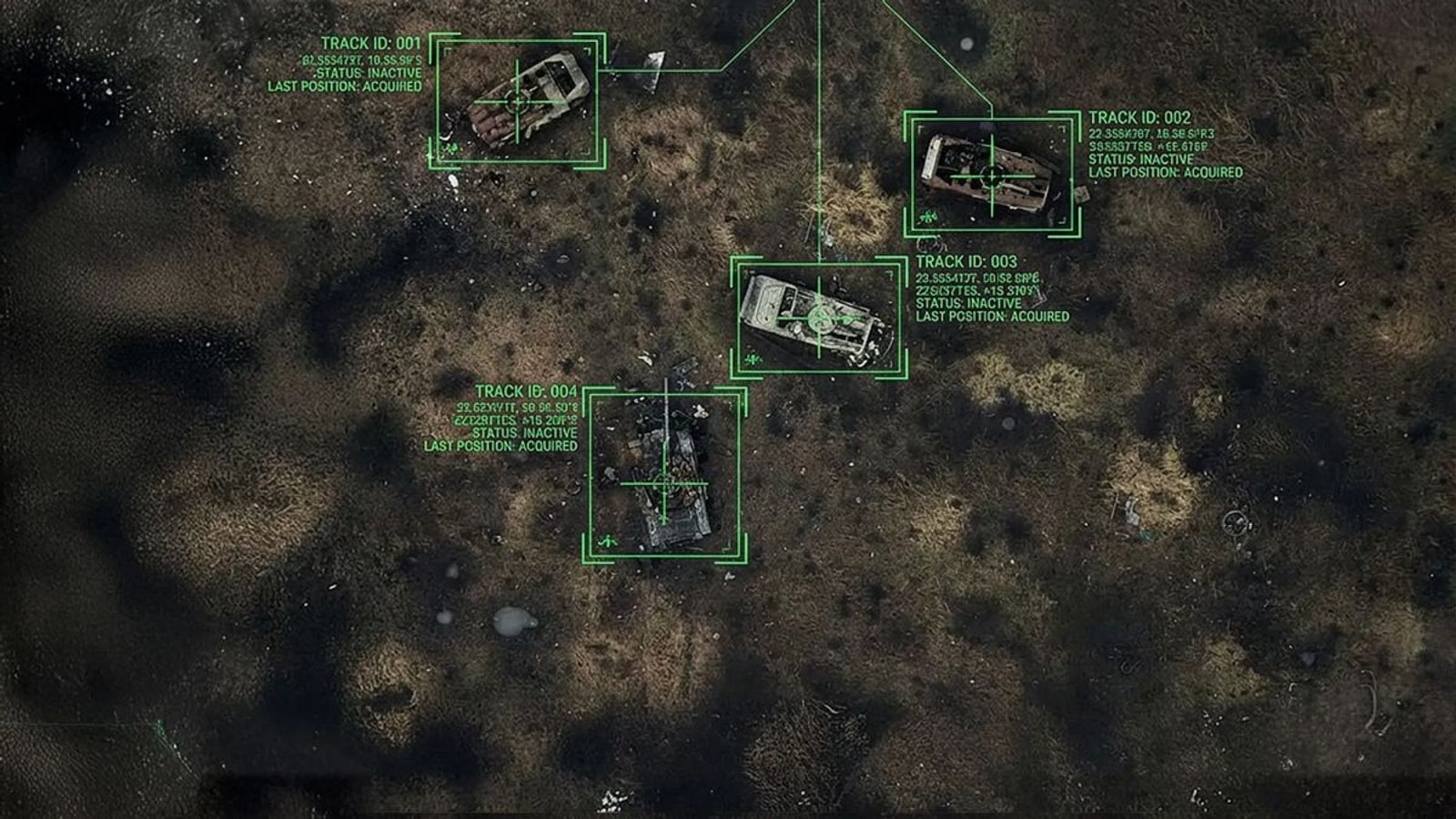
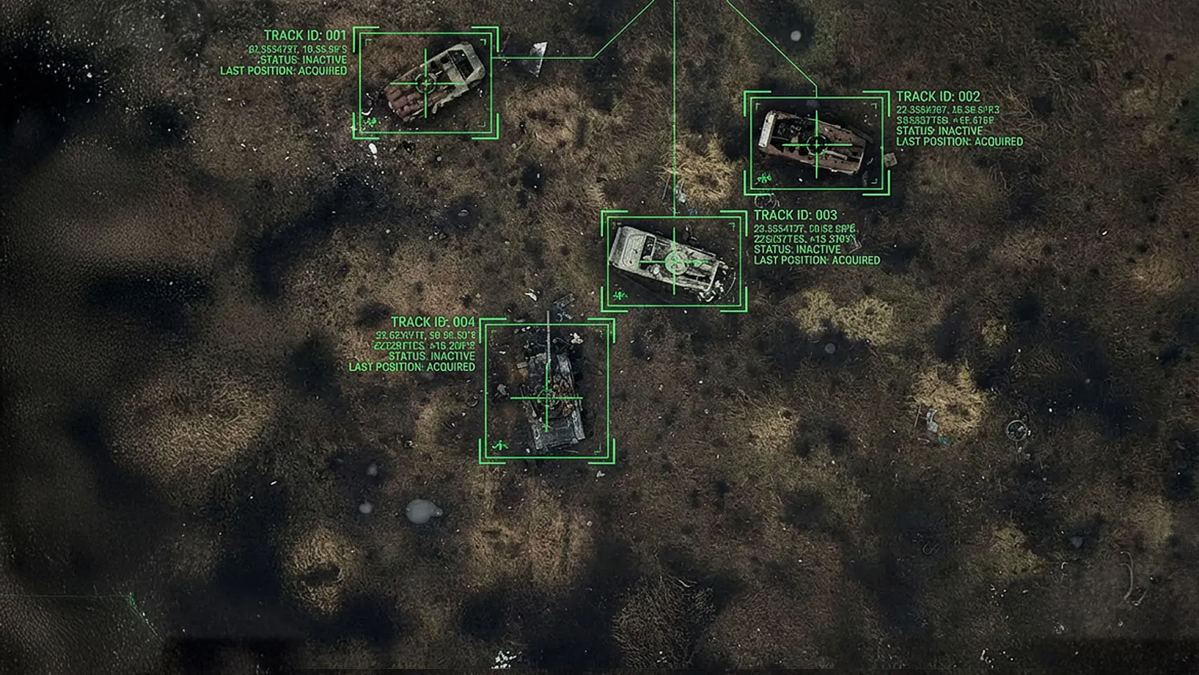
A drone camera films a vehicle in Ukraine. A human or another system labels it. The clip becomes a training example, and a model learns to pick out similar shapes in the next stream of footage. That sequence sounds routine until its scale and destination change. Ukraine is making an annotated battlefield collection available for approved military AI work with foreign partners. Reuters reported on August 24 that Britain became its first international partner, with projects spanning defense and security applications. The immediate promise is better recognition under combat conditions. The harder question is what evidence travels with each example when a model trained on one war influences decisions in another operation.
In August, Ukraine's defense ministry described roughly five million annotated frames in its Avengers Labs environment. A frame is a picture; a detection is an identified object or event within data. One frame may hold multiple detections, and a stream contains many frames. A raw count of frames cannot establish the number of independent encounters, weather conditions, aircraft types or unique targets in the training corpus. The practical value depends on the range and quality of those examples as well as their quantity.
The ministry's March 12 announcement describes a controlled environment intended to allow model training without handing partners direct access to sensitive databases. That distinction matters: supervised access to a training platform is a narrower commitment than releasing raw military video to the public. Yet the exact terms for British users, auditing arrangements and permitted downstream use are not laid out in the public announcement. The governance of this dataset will matter as much as its size.
The acquisition pipeline is part of the model
A labeled image does not appear out of nowhere. Its sensor had a field of view, altitude, compression setting, spectrum, flight path and time of day. An operator or another system selected a region, and an annotator decided what counted as a tank, artillery piece, air-defense component, soldier or decoy. The model can learn the intended feature, but it can also learn the signature of one camera, one battlefield, one season or one annotation practice. If all of those vary in a future operation, impressive results on held-out images from the original campaign may not predict performance there.
Ukraine's ministry says its platform draws on millions of annotated frames from tens of thousands of combat flights and uses continually updated material. Its August 10 description says domestic companies can train their own models through Avengers Labs and relates the effort to DELTA, the country's battlefield management system. It reports more than 100,000 UAV video streams processed monthly and a target-detection system that identifies about 70 percent of enemy targets in real time. The latter is the ministry's operational claim. Without the underlying evaluation protocol we cannot translate it into precision, false-positive rate, recall across target categories, or performance against camouflage and decoys.
To see why, consider a model that flags seven of ten actual targets. That is potentially useful if it produces few spurious alerts and an operator has time to investigate. It is potentially dangerous if it also flags dozens of civilian vehicles or loses accuracy when terrain changes. “Identifies 70 percent” does not tell us which of these situations applies. The denominator might be all observed targets, labeled frames, or a selected benchmark set. The average might hide a poor result for a particularly consequential target class. An editorial assessment must ask for the confusion matrix and the testing conditions before turning one percentage into battlefield capability.
Label quality also changes with time. The battlefield includes newly modified vehicles, improvised defenses, thermal signatures, damaged equipment and deliberately deceptive objects. A target recognized yesterday can look different after a camouflage adaptation. Operators on both sides respond to what reconnaissance systems can see. The dataset is therefore not a passive record of stable nature. It is a sample taken from an adaptive contest in which the subject is trying to evade the instrument.
From detection to swarms is a chain of decisions
The British partnership and wider swarm research point toward many possible applications, but the phrase covers multiple tasks. A formation may distribute search areas, coordinate routes, relay communications, avoid collisions, prioritize sensor coverage or recommend a target for human review. It does not follow from a better object detector that a group of drones can safely make attack decisions on its own. Perception, coordination, navigation and engagement are distinct functions with distinct failure modes. Public descriptions do not establish which components British researchers are training on Ukrainian data or what authority any resulting systems would have in combat.
Britain and Ukraine signed an AI defense partnership on August 24, opening a path for British research access to the Avengers Labs platform. The arrangement reportedly includes work on low-power chips and fiber-optic sensing as well as autonomous systems. Those are materially different engineering projects. A low-power model running on a drone may have to trade accuracy against battery life, latency and onboard memory. A system coordinating several aircraft also has to handle intermittent radio links, variable GPS availability and operators who need to regain control when the plan goes wrong.
The British defense laboratory's September 16 account of swarm research describes the ambition to coordinate multiple drones. It is contextual evidence of the work, not proof that a particular Ukraine-trained model passed a live operational test. An honest feature should keep the stages separate: access to annotated data; training or tuning a model; laboratory evaluation; trials under realistic interference; deployment with specified human controls. Announcing the first stage cannot certify the last.
Even a system described as having a human “in the loop” needs a more precise account. Does a person approve each identification, every proposed engagement, or only the overall mission before launch? Can the person inspect the evidence behind a model's recommendation? What happens if the network link fails or many drones present alerts at once? Human involvement can be meaningful oversight or an interface that asks a fatigued operator to rubber-stamp more recommendations than a person can assess. The operational design, rather than the label, determines which it is.
Data access is a security boundary
Ukraine says the training environment protects sensitive databases by letting partners work with data without direct database access. That is a sensible starting architecture. It does not by itself settle whether a partner can export model weights, intermediate features, embeddings, screenshots, logs or predictions that reveal aspects of restricted data. Nor does it answer whether access is confined to a project, a company, named engineers or subcontractors. Every one of those boundaries has a different audit trail.
A useful access agreement would specify the source and date range of material, categories excluded from training, permitted retention, model ownership, testing responsibilities and what happens when a partner discovers mislabeling or sensitive footage. It would also define whether models trained in the environment can be sold or transferred beyond the original defense program. These are proposed questions, not claims that the existing program lacks such provisions. The public record gives a high-level description of the access model, not the contracts.
There is an intellectual-property problem as well as a security one. Ukraine has paid for its data in combat risk, equipment and lives. A foreign developer may contribute scarce training expertise, sensors and chips. If a model improves through joint work, who may use it after the partnership, and who receives the performance evidence? A clear allocation can make the partnership durable; vague rights may be difficult to repair after the most valuable labels and learned parameters have left the original environment.
Dataset provenance is especially consequential if the training material contains mistakes. Suppose footage of a damaged vehicle is labeled as an active weapons system, or a civilian object is repeatedly captured near a military site. Such examples can teach a system the wrong association. A record tying each label to its original sensor and reviewer enables correction, sampling and independent evaluation. Once provenance is severed, a wrong label can be copied into derivative datasets and become harder to find. Robustness is not only a property of the model architecture; it depends on a recoverable history of the examples that shaped it.
The test that matters happens outside the training distribution
A serious evaluation would first separate training and testing by mission and time, rather than allowing nearly identical adjacent frames into both groups. It would publish performance by sensor, weather, altitude, target type and level of obstruction. It would include adversarial cases: inflatable vehicles, altered paint, thermal masking, deliberately misleading movement, damaged hardware and civilian lookalikes. For a swarm, it would then test coordination under signal loss and latency, and document the threshold for a human to interrupt or reject a proposed action.
No public release reviewed here supplies those matrices for the British projects. Nor does the partnership announcement establish a battlefield outcome attributable to the new partner models. That absence is not a verdict against the collaboration. It defines the present evidence boundary. Ukraine has a rare and valuable stream of contemporary combat examples; British firms have an opportunity to build and test systems with it. Whether the resulting tools improve decisions, and under what limits, is a question for disciplined evaluation rather than a claim that can be inferred from dataset size.
The value of this partnership may lie in shortening the loop between observed battlefield failures and revised equipment. But a faster loop can also accelerate a mistake if labels, access rules and evaluation are weak. The defining feature is not the five-millionth frame. It is whether every claim made from those frames can be traced back to the conditions under which they were recorded, interpreted and tested.
Dataset provenance and out-of-distribution testing determine how safely the models travel to other missions. Public records do not supply partner contracts, independent confusion matrices or outcomes of British model trials.