

Seven days ago, Cyberdelia argued that an orbital AI data center has a heat problem before it has a business model. On October 1, Google put the first relevant hardware into orbit.
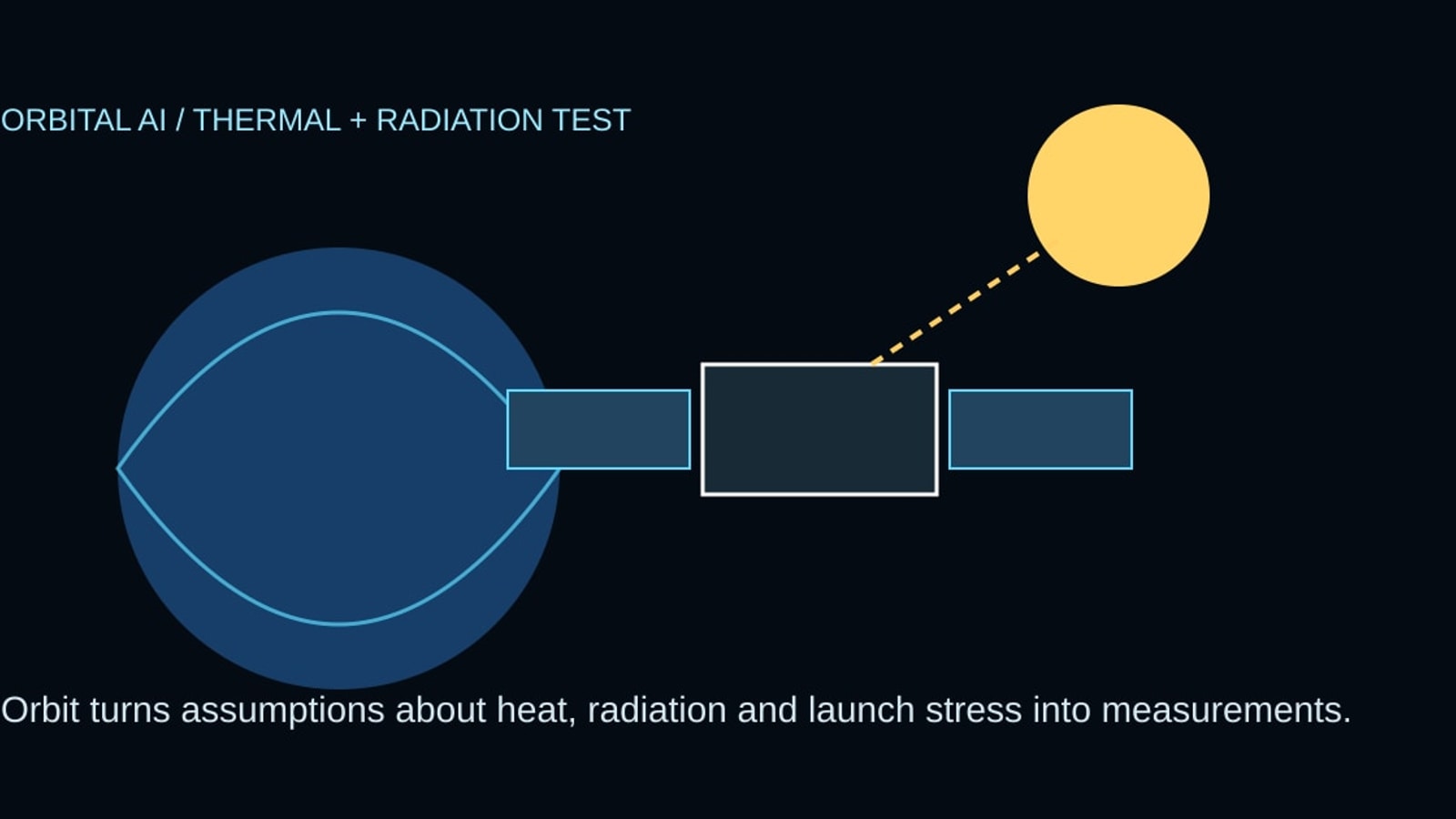
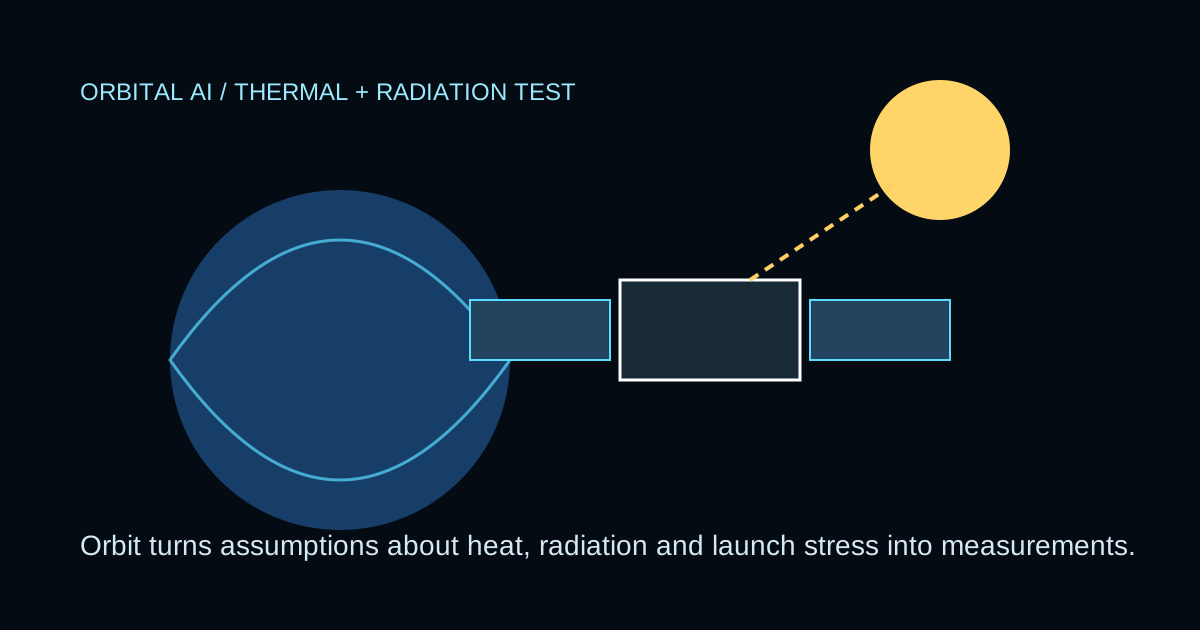
Google says its Project Suncatcher prototype launched aboard SpaceX's Transporter-18 rideshare mission, established contact, and is operating as expected. Over the coming weeks, the team plans to collect in-orbit data on how its TPU hardware handles launch stress, radiation and thermal extremes.
That does not mean Google launched a data center. It means the argument finally gets measurements.
The experiment is narrower than the headline
Project Suncatcher explores whether machine-learning infrastructure could eventually operate in space. The prototype is an early physical test of assumptions underneath that idea. One satellite cannot demonstrate a production compute cluster, competitive economics, continuous ground service or a scalable optical network.
What it can do is expose hardware to the environment engineers cannot reproduce perfectly on a bench.
Launch vibration and acceleration stress packages and interconnects. Radiation can produce transient errors or longer-term degradation. Orbital thermal cycles force the spacecraft to manage heat without convection. Those are not side issues. They determine whether useful compute survives long enough to matter.
Heat still has nowhere convenient to go
On Earth, data centers move heat into air or liquid and then reject it through cooling infrastructure. In vacuum, the final rejection mechanism is radiation. That makes radiator area, temperature and spacecraft geometry part of the compute architecture.
Our September analysis, The Data Center in Orbit Has a Heat Problem, treated thermal behavior as one of the decisive unknowns. The new mission does not invalidate that analysis. It advances it from model to experiment.
The useful result is therefore not a photograph of a satellite above Earth. It is a thermal curve under sustained compute load, correlated with power use, orbital position and hardware error behavior.
Radiation is the second bill
Modern AI accelerators are extraordinarily dense electronic systems. Space adds energetic particles that can disturb stored or processed information and gradually damage electronics. Shielding adds mass. Redundancy adds mass and power. Error correction consumes compute. Replacement requires another launch.
Google's orbital data can tell engineers whether their laboratory assumptions about TPU behavior survive the real environment. A successful short-duration test would be evidence that a particular hardware configuration can operate in orbit. It would not establish acceptable lifetime economics for a large constellation.
The next proof requires a network
Even a perfectly healthy accelerator is not a data center. Distributed AI workloads depend on communication among accelerators, storage and users. Google's broader Suncatcher roadmap includes optical inter-satellite links, and that step will introduce another set of measurements: throughput, pointing stability, synchronization, routing and behavior when a node or link disappears.
Only after those layers work together does the economic question become meaningful. Launch cost, radiator mass, solar generation, communications, replacement rate and useful compute delivered all belong in the denominator.
This is what evidence progression looks like
Technology coverage often treats every announcement as a fresh universe. Engineering is cumulative. A design paper creates assumptions. A prototype tests some of them. Measurements kill bad assumptions or justify the next prototype.
Project Suncatcher has now moved one step down that chain. Google has hardware in orbit and contact with it. The next story should be written when the spacecraft returns enough measurements to tell us something the launch announcement cannot.
Google reports successful launch, contact and expected operation. Thermal, radiation and workload results have not yet been published; production-scale orbital AI infrastructure remains a research proposition.