
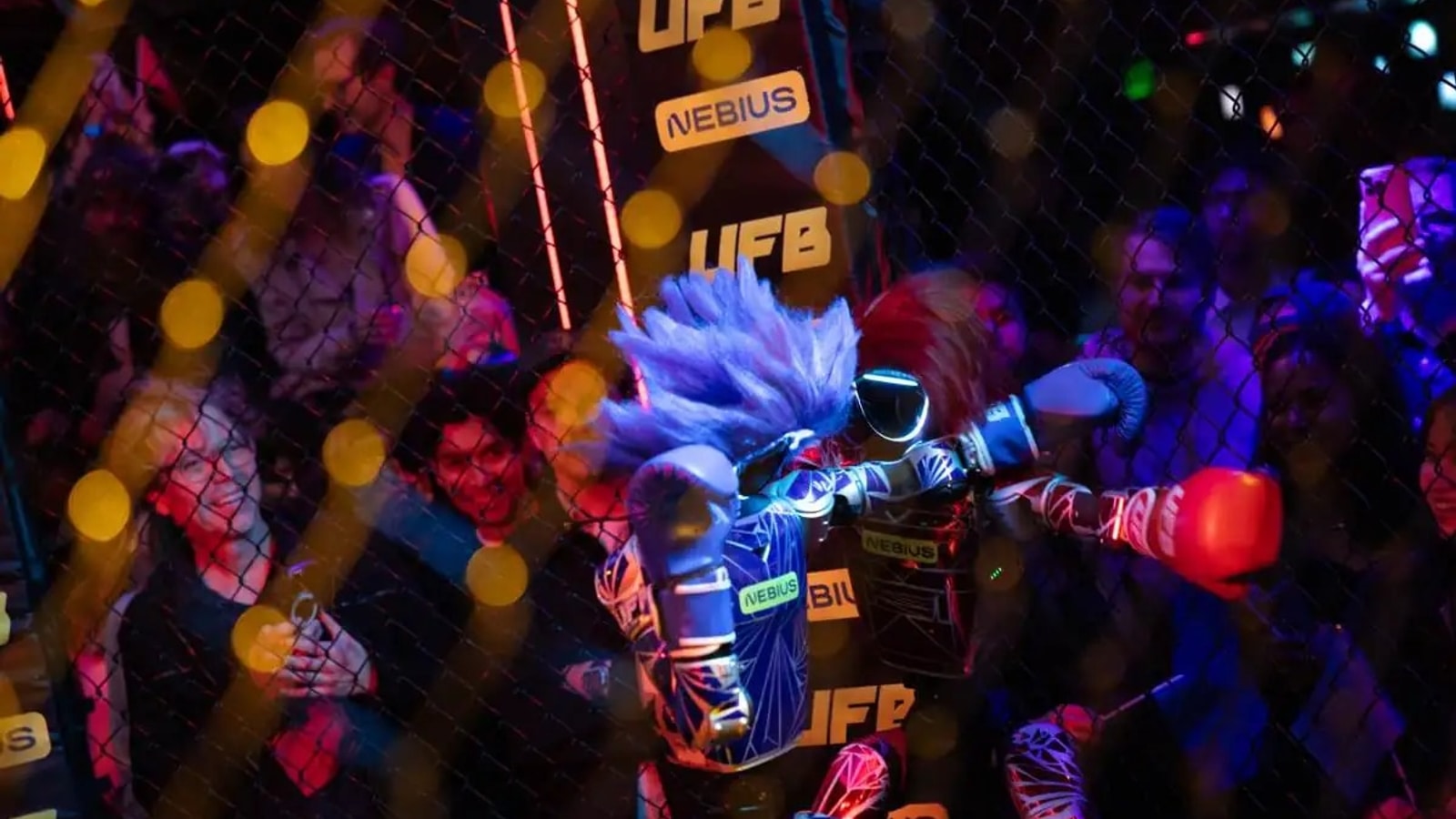
The boxer in the next robot fight might not own its best punch. The body could belong to a league. The timing could belong to a pilot. The step into range could come from a trained controller. The punch itself could begin as somebody else's video, become a motion dataset, and end as a file loaded onto a machine that its creator has never touched. When the crowd cheers, whose performance did it see?
That is not a philosophical parlor game. Ultimate Bots has split its proposed Season 2 workforce into pilots who drive league-assigned humanoids and “ghosts” who build the physical-AI stack. Its current Ghost Trial asks entrants to teach a humanoid a move that a stock model cannot perform. The martial-arts track explicitly welcomes strikes, kicks, throws and forms. The contest is open through September 27, with winners scheduled for announcement October 1. It is an unusually clear window into how a robot-boxing skill can be assembled before there is a bout at all.
The public instructions tell entrants to make or collect motion data, convert it to the competition's format, fine-tune a released SONIC whole-body control checkpoint, and demonstrate the improvement against the stock baseline in simulation. An entry includes an exported ONNX policy, its dataset, training configuration, video and before-and-after comparison. Judges consider a WBT-Bench tracking score, penalties for flailing, self-collision and jitter, walking and turning fundamentals, originality, execution and reproducibility. The league says entrants retain ownership of their work; winners grant it permission to run the winning skill on physical robots and its channels.
That is a more honest account of the work than the familiar video caption that says a robot “learned boxing.” A video can show a clean hook. It cannot tell us whether the underlying system recognized an opening, followed a human command, replayed a prearranged trajectory, or merely tracked a demonstration well enough to look convincing from one camera angle. The Ghost Trial exposes the middle of the process: data selection, retargeting, a base controller, fine-tuning, evaluation and deployment. Each stage can be impressive. None automatically supplies a complete fighter.
Start with the motion. A human boxer does not throw a hook as a fixed collection of joint angles. The feet establish a base, the hips rotate, the shoulder transmits energy, the arm describes a path, and the body remains available to defend or recover. A humanoid may imitate that silhouette while operating under entirely different joint limits, actuator speeds, mass distribution and balance constraints. Video alone cannot carry motor torque, contact force or the sensation of a foot beginning to slip. Retargeting must translate a human gesture into an achievable robot trajectory.
The trial permits synthetic motion from its Studio, existing motion sets, licensed video or a participant's own capture. That freedom makes the dataset the first competitive battleground. A clean source clip may simplify the problem but leave the controller helpless when an opponent touches its shoulder. A broad set of awkward transitions can look worse in a promotional reel yet produce a skill that survives the first interruption. The moment of truth is often between the attractive poses: entering range, changing weight, missing, being bumped and getting both feet back under the body.
Fine-tuning from a released checkpoint matters for the same reason. Entrants are not building a complete motor system from zero. They are adapting a controller that already tracks whole-body motion. The new policy has to express the move without forgetting how to walk and turn. A punch that earns a high motion-tracking score but destroys the robot's stance is a failed boxing skill. The organizer's own benchmark makes that tradeoff visible by penalizing instability and checking locomotion basics. A ring would make it harsher: another machine gets a vote.
Simulation is a necessary filter, not a bout. The public trial says its submissions run in simulation and that the organizer handles physical deployment for winners. Simulated contacts, actuator limits and floor friction can be wrong in ways that matter more under impact than in dance. A skill can clear an offline benchmark and still drive a real shoulder into a hard stop, produce a delayed recovery, or fail when the floor has different traction. A credible transition to the ring would document both the simulation result and the physical test, including failures and human intervention.
Now put the pilot back in the picture. Ultimate Bots says pilots drive humanoids in the arena while ghosts develop the stack behind them. That can produce a sensible division of labor: a person selects target and timing; onboard control keeps the body upright and executes a trained move. It could also describe several radically different architectures. The pilot might continuously command limbs, select one of a handful of canned skills, steer a locomotion controller, or approve actions suggested by perception software. Those are distinct athletic and engineering achievements. The word “autonomous” cannot resolve the difference.
A useful fight card would list the control mode as plainly as it lists the teams. What did the pilot command? Which sensors informed the machine? Did opponent tracking run on the robot or on an external computer? Was a strike selected by a human, triggered by a simple condition, or chosen by a policy using live perception? How much was preprogrammed? Could the team intervene after a fall? A league need not publish proprietary weights to answer those questions. A bounded disclosure would make the sport intelligible without handing out every team's playbook.
The training-data trail deserves its own line on that card. Ultimate Bots tells entrants to use models and datasets whose licenses permit the intended work and specifically warns that some data are restricted to noncommercial or small-company use. That is not clerical housekeeping. A crowd-facing move may embody a person's recorded performance, a licensed dataset, a shared base checkpoint and a team's original tuning. The organizer's ownership statement says creators keep their contributions while winners grant deployment rights. The exact scope of any particular entrant's rights still depends on its inputs and the official terms.
An honest record would distinguish authorship from execution. A fighter may carry a skill developed by one remote team, piloted by another person and maintained by the league. That resembles a racing machine with drivers, mechanics and software engineers, but the executable movement adds a new layer. If a winning motion becomes a reusable skill across teams, the competition has to decide whether it is standard equipment, a licensed advantage, or a performance credited to its creator each time it appears. Without that rule, the scoreboard can quietly reward the team with the best access to somebody else's reflex.
There is a second difficulty: a boxer needs perception, not just movement. A skill that reproduces a punch does not know when a guard is open, whether the opponent is retreating, or whether a miss will leave the machine facing the ropes. Boxing is a sequence of conditional decisions under contact. A convincing fighter must select among imperfect options, manage distance, defend during recovery and sometimes decide not to throw. It also needs a low-level controller fast enough to keep the body stable while those slower tactical decisions happen.
That layered architecture is why the ghost metaphor works and also where it misleads. There is no single spirit animating the machine. There is a stack: sensory estimates, balance, locomotion, learned motions, tactical selection, operator commands and safety overrides. A failure at any layer can look like cowardice, clumsiness or genius to a spectator. An apparent feint might be deliberate deception. It might be a controller aborting a motion after a balance error. The broadcast needs enough telemetry to tell the difference.
This is where robot boxing becomes worth covering seriously. The competition can expose whether a motion policy survives contact, whether a pilot can steer without destabilizing it, and whether a skill transfers from simulation to physical hardware. If bouts are repeatable under common rules and control modes are disclosed, the ring becomes a rough but valuable test of embodied control. If every spectacular exchange is presented as a self-directed machine outthinking an opponent, the ring becomes a theater for inflated claims.
The Ghost Trial does not prove that anyone has built the complete autonomous boxer. It demonstrates the supply chain for one component of that boxer and asks entrants to make the component measurable. That is real progress. The next step is to connect the submitted skill to a physical bout and disclose the human and machine responsibilities along the way.
When the robot lands its first clean shot, applaud the motion. Then ask who recorded it, who trained it, who selected it, who kept the machine upright and who stopped it when the fight went wrong. The answer is the actual athlete: a team stretched across bodies, code, data and the corner.
A trained strike is a valuable component, not evidence of a self-directing fighter. Robot boxing becomes an engineering sport when leagues disclose the human commands, learned skills and onboard control that produced each performance, and when simulation claims survive a real opponent.