

One of the most believable moments in the 1995 film Hackers is sitting in plain sight beneath one of its least believable interfaces. Dade Murphy, newly released from a court order prohibiting computer use, is awake after midnight attacking a local television station. He wears narrow sunglasses indoors. The screen glows with dense code. A digital clock burns red in the foreground. Beside the computer sits an enormous fan-fold listing.
Most viewers register the paper as set dressing: one more prop telling the audience that this teenager is operating at a level beyond ordinary comprehension. To someone who learned computing when manuals, source listings and processor references lived on shelves, the paper explains the method. Dade is not guessing. He has identified the target environment and obtained material that tells him how it works.
That changes the scene. The fantasy is not that a teenager can compel a broadcast automation system to play the wrong program. The fantasy is the speed, the visual language and the dramatic duel that follows. The underlying workflow is old-school reconnaissance: determine the product or processor family, locate the documentation, map the target's behavior to the standard system, and search for the smallest controllable state change.
The paper is the search engine.
Modern developers expect documentation to be searchable. They can query vendor portals, source repositories, package registries, issue trackers, archived mailing lists and code-search systems without leaving a chair. In the period represented by the film, important technical knowledge often arrived as printed books, binders and fan-fold listings. The interface was physical. Search meant knowing which volume contained the instruction set, protocol, service routine or source module, then using indexes, headings, line numbers and repeated structures to navigate it.
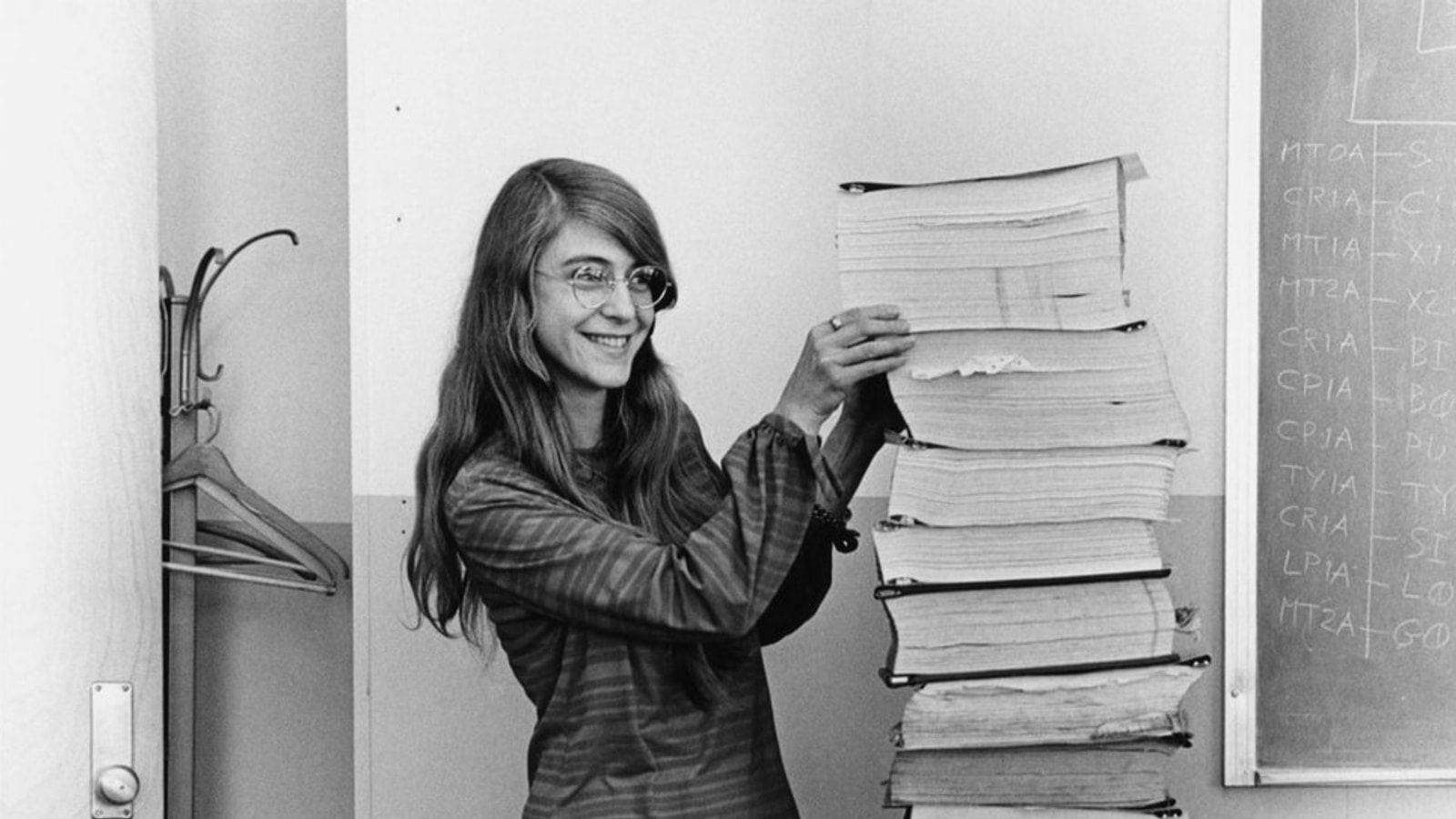
The famous 1969 photograph of software engineer Margaret Hamilton standing beside the printed Apollo flight-software listings remains an almost comical demonstration of scale. The stack is taller than she is. It is not a monument to inefficient programmers. It is what a complex software system looked like when the durable, reviewable object was paper. Listings supported inspection, annotation, review and comparison. They could be carried into rooms where the computer was not available. When an operator needed to understand a program, the source could be spread across a desk rather than summoned through a browser.
A person did not need illicit access to possess useful knowledge about many systems. Vendors published programming references, installation manuals, service documents, operator guides and product literature. Colleges acquired them. Libraries collected them. Training partnerships placed them in school laboratories. Internship programs exposed students to commercial equipment. Manufacturers wanted engineers, customers and technicians to understand their products, because incomprehensible machinery does not sell or remain operational.
That information ecosystem created a peculiar security condition. The documentation was public or semi-public, but functionally invisible to almost everyone. The barrier was not classification. It was recognition. A shelf could hold an exact description of a system's assumptions for years while thousands of people walked past it. The useful question was not, “Where is the secret?” It was, “What is this machine called, and which book explains its habits?”
OTV is not merely a television transmitter.
The fictional OTV station is presented as an automated operation with a robotic videotape library. That matters. A television automation system does not simply turn a transmitter on and off. It maintains an inventory of recorded material, associates program identifiers with physical media, selects a tape, moves it into a transport, cues it, switches sources, begins playback and returns the tape to storage. It also handles exceptional states: missing media, an occupied drive, a failed load, an incorrect cue point or an operator override.
Period systems such as Odetics Broadcast's TCS line were built for exactly this job. A 1993 trade advertisement described the TCS90 as an automated cart machine designed around tape-library management and future expansion. Sony's Flexicart family occupied a similar operational category. Cyberdelia cannot establish from the frame alone which exact product the filmmakers meant OTV to use, and the displayed screen may be simulated. But the intended technical object is legible: Dade is studying the control logic behind an automated tape system.
Once the target is understood that way, the intrusion goal becomes narrower. He does not need to “take over television” in some universal sense. He needs to alter the decision that connects a scheduled event to a specific tape or playback path. The automation system already possesses the machinery, privileges and timing required to broadcast a program. The attacker is trying to make the legitimate machine perform one illegitimate selection.
Old programs exposed their structure through repetition.
Software written for operational systems was often repetitive by modern standards. Memory was limited. Languages and compilers varied by platform. Programs were expected to run for years and remain understandable to technicians who had not designed them. A routine might evaluate a series of tape slots one at a time, repeat nearly identical checks for each device, and record state changes through numbered lines or fixed fields. What later programmers might compress into an abstraction could appear as a long sequence of explicit operations.
That repetition was not always elegant, but it was navigable. If five blocks are nearly identical and only one value changes, the difference advertises itself. A reader can find the section governing slot state, trace the variable representing an empty transport, and follow the transition that marks the next tape as selected. The printed listing becomes a map of state changes.
This is why identifying the language or processor family mattered. “68000” was not a magic word. It narrowed the universe. Motorola's 68000 family had a defined register model, instruction set and addressing modes. A programmer's reference manual could explain the machine-level grammar even when a particular deployment contained custom code. Product documentation could explain the standard architecture. A site-specific listing could then reveal what the owner changed. The attacker did not need every answer in one stolen file; standard references supplied the baseline against which customization became visible.
The same principle applied above the processor level. BASIC programs used explicit line numbers, DATA blocks, loops and branch statements. Lotus Notes applications could contain long sequences of field assignments and repeated formula-language evaluations. COBOL advertised record layouts and business rules in prose-like divisions. Each environment had conventions, and conventions made unfamiliar code less unfamiliar.
The attack began before the modem connected.
Popular culture usually treats “the hack” as the interval during which fingers move and screens flash. In real operations, that is often the shortest and least important phase. The work begins when someone identifies the target, its supplier, its model family, its operating environment, its dependencies and its documentation trail. By the time the modem connects, the attacker may already know which menu, command, state variable or maintenance interface matters.
This is not an argument that manuals cause attacks or should be suppressed. Hiding documentation makes maintenance worse and rarely protects a determined adversary for long. It is an argument against confusing obscurity with control. If a system becomes unsafe when its manual is read, the manual is not the vulnerability. The unsafe assumption is.
Modern security grew partly from the collapse of those assumptions. Default passwords printed in manuals remained unchanged. Diagnostic ports exposed production authority. Trust boundaries existed only in the operator's head. Service accounts carried broad permissions because the software was expected to live on an isolated machine. Network connections later joined systems that had been designed as islands. Documentation helped attackers recognize the weakness, but it also helped defenders understand and repair it.
The asymmetry persists. Today the material is easier to obtain than it was in 1995. Vendor manuals, firmware images, patent filings, certification records, procurement documents, training videos, decommissioned equipment and decades of archived discussion are searchable from home. Yet most people remain unable to turn that abundance into a useful model. Access to information is not the same as the ability to recognize which information matters.
The scene rewards the correct kind of literacy.
Hackers is remembered for rollerblades, fluorescent wardrobes, impossible graphical cyberspace and dialogue that treats a laptop specification like erotic poetry. That style has made it easy to dismiss the entire film as technical nonsense. The dismissal misses the researchers, consultants and subcultural details buried beneath the spectacle.
The OTV sequence compresses several authentic ideas into seconds. Dade selects a bounded target. He recognizes that programming schedules are implemented by physical automation. He studies technical material away from the target. He uses a known architecture as the baseline for understanding a particular deployment. He seeks control over one consequential transition rather than rewriting the entire system. Finally, he encounters another operator who understands the same environment and can contest the action.
The paper matters because it denies the myth of spontaneous genius. Dade's advantage is not that code appears to him as revelation. His advantage is that he knows where knowledge accumulates, can tolerate the material's density, and can translate documentation into behavior.
That was one of the great divisions in early computing culture. Laboratories and libraries were full of information that looked dead to the uninitiated: binders, standards, source listings, service notes, processor manuals and books about languages no fashionable employer requested. Some readers used those materials to break systems. Others used the same materials to keep payrolls running, recover machines, write drivers, repair industrial equipment and teach the next generation. The moral category did not live in the book. It lived in the reader and the action.
Cyberdelia assessment
The strongest reading of the scene is not that the filmmakers reproduced an exact Odetics or Sony implementation line for line. That claim cannot be established from the available frame and should not be pretended into certainty. The stronger and more defensible conclusion is that the scene depicts a real research method. The printed material represents system documentation and source or source-like listings for a broadcast automation environment. Its dramatic purpose is to show that Dade has studied the target's machinery deeply enough to manipulate its scheduling and tape-selection behavior.
The sunglasses are costume. The city-shaped data graphics are cinema. The giant listing is the quiet truth.
Before the exploit was on the screen, it was on the shelf.
Method and limitations
Cyberdelia treated the film itself and the published screenplay as primary narrative evidence, compared the depicted function with period broadcast-automation material, and separated visible facts from model identification. The exact OTV hardware, the authenticity of the displayed code and the provenance of the prop listing remain unresolved. A production archive, prop inventory, technical-adviser interview or legible close examination of the complete listing could materially change the equipment-level conclusion without changing the broader analysis of documentation-led reconnaissance.
Sources and further reading
- Hackers screenplay transcription — Rafael Moreu screenplay, hosted by CEMP
- Broadcast Engineering, September 1993 — period Odetics TCS90 advertisement
- Margaret Hamilton with Apollo software listings — NASA photograph via Wikimedia Commons
- M68000 Family Programmer's Reference Manual — Motorola/NXP
- Broadcast Software International — public manuals and documentation

Corrections: Cyberdelia preserves material corrections and updates. Documentation identifying the exact OTV prop system or listing may be submitted through the site's contact channel.