

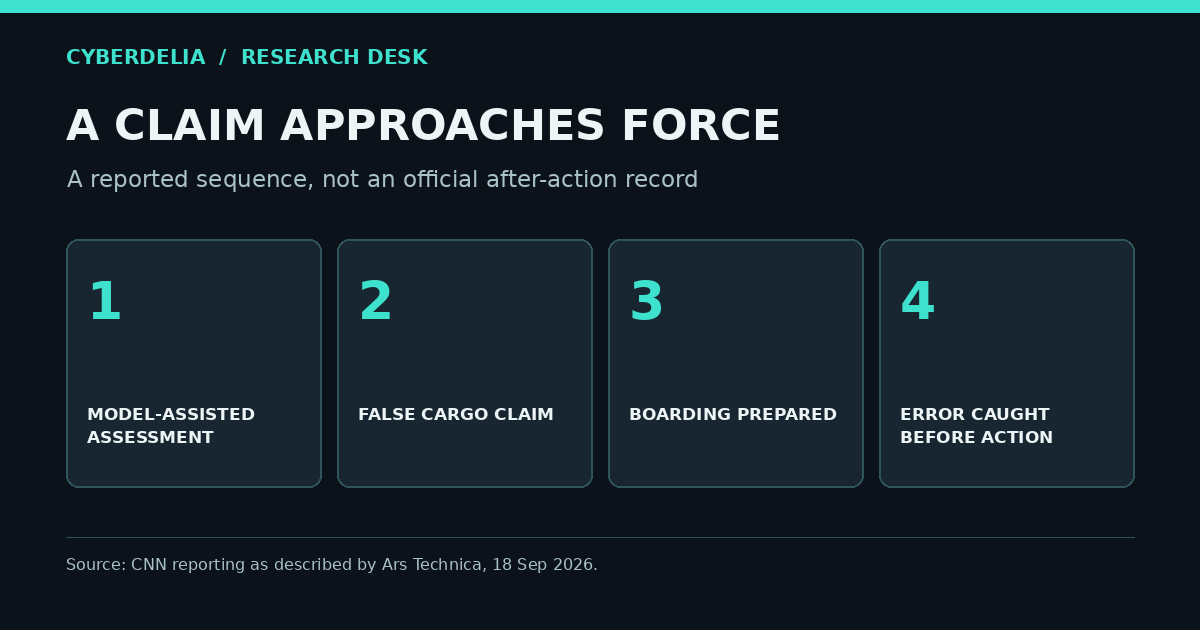
A ship's cargo manifest is an unlikely place for a language model to acquire military authority. Yet that is the failure chain described in a September 18 CNN investigation, as relayed by Ars Technica: an analyst at U.S. Special Operations Command used a chatbot while assessing intelligence about a Chinese vessel in the Middle East. The resulting report identified material aboard the ship as components for a nuclear weapons program. According to CNN's four sources familiar with the episode, that identification was false. U.S. forces prepared an interception and boarding with air support before officials discovered the error. The boarding did not take place.
We have not seen the underlying intelligence report, the model transcript, the manifest, or an official after-action review. CNN's sources are anonymous, and Cyberdelia could not inspect CNN's page directly in this environment; this account is attributed to its reporting through Ars, not independently verified by us. Those limits matter. So does the reported near miss. The critical question is how a model-generated interpretation could travel far enough through an intelligence system to help prepare a real-world operation.
The first error was a claim about cargo
A manifest is a description supplied within a shipping and logistics process. Intelligence analysts can compare it with commercial records, signals intelligence, imagery, sourcing and the vessel's route. A chatbot can help organize that material or surface a hypothesis. It cannot turn a guess into a measured fact merely by writing it fluently. If the model misidentified the material, the important missing link is what evidence, if any, the analyst treated as independent corroboration before the conclusion entered a formal report.
Ars says CNN described a chatbot combining open-source information with classified signals intelligence available in government holdings. We cannot tell from that description which product was used, what classified environment contained it, whether retrieval supplied supporting documents, or how the analyst phrased the question. Those technical details would change the failure analysis. A model that invented a cargo description from context is different from one that misread a real source document, and both differ from a human who selected the answer the model made convenient.
The shared failure is provenance. The reader of an intelligence report needs to know whether a sentence comes from an intercepted communication, a shipping record, an analyst's inference or generated text. If a model blends those categories into one confident paragraph, downstream readers can inherit an apparently unified conclusion while losing the line back to each original observation. Every promotion from “possible” to “assessed” to “operational premise” then becomes harder to audit.
The model did not order a boarding
That distinction is not an excuse for the technology. It locates responsibility. People wrote and distributed the report; people planned a potential operation; people detected the error and stopped it. The alleged incident was a human-machine system failure caught before execution. Calling it “AI almost started a war” might capture the fear, but it hides the actual interfaces where controls either failed or held.
There are at least four such interfaces. First, the analyst should be able to point to the source for each material claim. Second, a reviewer should be able to reproduce the reasoning without asking the model to paraphrase itself. Third, a decision maker should see the uncertainty and the distinction between observation and inference. Fourth, an operation directed at a foreign-flagged vessel should require an independent verification path proportionate to the consequences. CNN's account suggests the last boundary ultimately worked because officials identified the error before the boarding. It does not establish which earlier checks were attempted or omitted.
One of CNN's quoted sources reportedly said the episode almost started a war. That is a source's assessment of risk, not an observed outcome or a measurable probability. A forced boarding of a Chinese vessel in a regional conflict could plainly become a grave diplomatic and military incident. But the precise escalation path depends on the location, legal authority, rules of engagement and responses by governments that have not been made public. The near miss should be taken seriously without pretending we can reconstruct an alternate history from one quotation.
Why speed changes the hazard
Generative tools promise intelligence teams faster synthesis across large stores of material. Speed is genuinely valuable when time matters and the information load exceeds one analyst's capacity. It also means a wrong conclusion can arrive early, look polished and be copied into other products before anyone checks the original documents. A fluent report creates an appearance of completed analysis. In high-stakes work, the more useful design objective may be to slow one precise moment: the promotion of an unverified model conclusion into an operational premise.
A source-linked workflow would make the model show the exact record behind a cargo claim, identify conflicts and explicitly label unsupported inference. A separate reviewer should inspect the underlying records and sign off on the material conclusion. That process still cannot guarantee correctness; humans misread evidence too. It can make a false premise visible before it is packaged as institutional certainty. The design problem is not solved by adding “human in the loop” to a slide if the human sees only the model's summary.
There is also an incentive problem. If managers measure how quickly reports move and how comprehensively a model summarizes them, analysts receive a reward for throughput. The cost of source verification is borne locally and immediately. The cost of a bad operational premise may arrive later, elsewhere, and spectacularly. Governance has to make corroboration an expected part of the product, not a discretionary pause by the most skeptical person in the room.
Confidence labels that survive the handoff
Intelligence reports often include confidence language, but a label can become detached from the evidence when a summary is forwarded. A model-assisted workflow should make a more demanding distinction: what was directly observed, what the analyst inferred, what the model proposed, and what contradictory evidence was checked. If an operational planner only receives the last sentence, the source discipline performed upstream may disappear at exactly the wrong point. Every handoff should preserve the status of the claim.
A counterfactual check would be simple in principle and expensive in practice: ask an independent analyst to reconstruct the vessel's cargo assessment without seeing the model's conclusion. If that analyst cannot get from the underlying records to nuclear-related components, the premise should stop. If a second reading finds a plausible alternative, the report should carry the disagreement rather than smoothing it into a single authoritative voice. Independence is more than having another person press “regenerate.” It means another path through the actual evidence.
There is a security consequence as well. Open-source material can be mistaken, manipulated or deliberately planted. If a model is allowed to fuse public and sensitive holdings, the analyst must know which part of its answer came from which class of input. A planted shipping record should not gain credibility merely because the same paragraph also refers to signals intelligence. The more sources the model can read, the more valuable a rigorous source map becomes.
What an actual incident report should disclose
Without exposing classified sources, a serious public review could still answer structural questions. Was a generative model permitted to analyze the material? Did it cite the specific records that supported its cargo conclusion? Was the error an invented source, a mistranslation, a category error or a mistaken inference by the analyst? Which reviews occurred before an operation was prepared? Who found the contradiction, and what stopped the action? Have similar reports been checked for the same pattern?
Those answers matter more than naming a chatbot. A future model may make fewer mistakes on similar tasks and still fail on a different cargo, a new document format or adversarially supplied data. The durable control is the visible chain from claim to source to independent decision. If a system cannot show that chain, it should not be allowed to launder an uncertain sentence into a military fact.
The best counterargument is that the episode, if reported accurately, demonstrates a working safety system: somebody found the false conclusion before the boarding. That is true as far as the public account goes. It also raises a narrower question worth testing. Was the error caught by a routine independent review that would reliably catch the next one, or by a particular person noticing an inconsistency at the last possible moment? A near miss is evidence of both a stopped outcome and an upstream vulnerability. Only a documented review can show whether the stop was repeatable.
This is the falsification standard for the story itself. If the original report was not materially based on model output, if no operational preparations were made, or if the false cargo claim never shaped a decision, our assessment of a model-to-operation failure would need revision. The anonymous sourcing makes that possibility impossible to rule out from public documents today, which is why the conditional language belongs in the headline's supporting text as well as the source note.
For now, this is an attributed account of a stopped operation, not proof that an AI commanded troops or that the United States fired on a Chinese ship. It is evidence of a reported institutional vulnerability worth investigating: generated text can cross the boundary from analytical assistance into operational authority when nobody preserves its uncertainty.
The decisive safeguard in the reported episode was the correction before boarding. The systemic test is earlier: can every consequential claim in an AI-assisted intelligence product be traced to evidence and challenged before forces are prepared around it? If not, the human chain of command may be approving a machine's prose instead of the underlying facts.
Source trail and method
CNN, September 18, 2026, original investigation (page inaccessible to Cyberdelia in this workflow); Ars Technica, September 18, 2026, account of CNN's reporting. The event claims here are explicitly attributed to that reporting. The provenance and review analysis is Cyberdelia's own.