

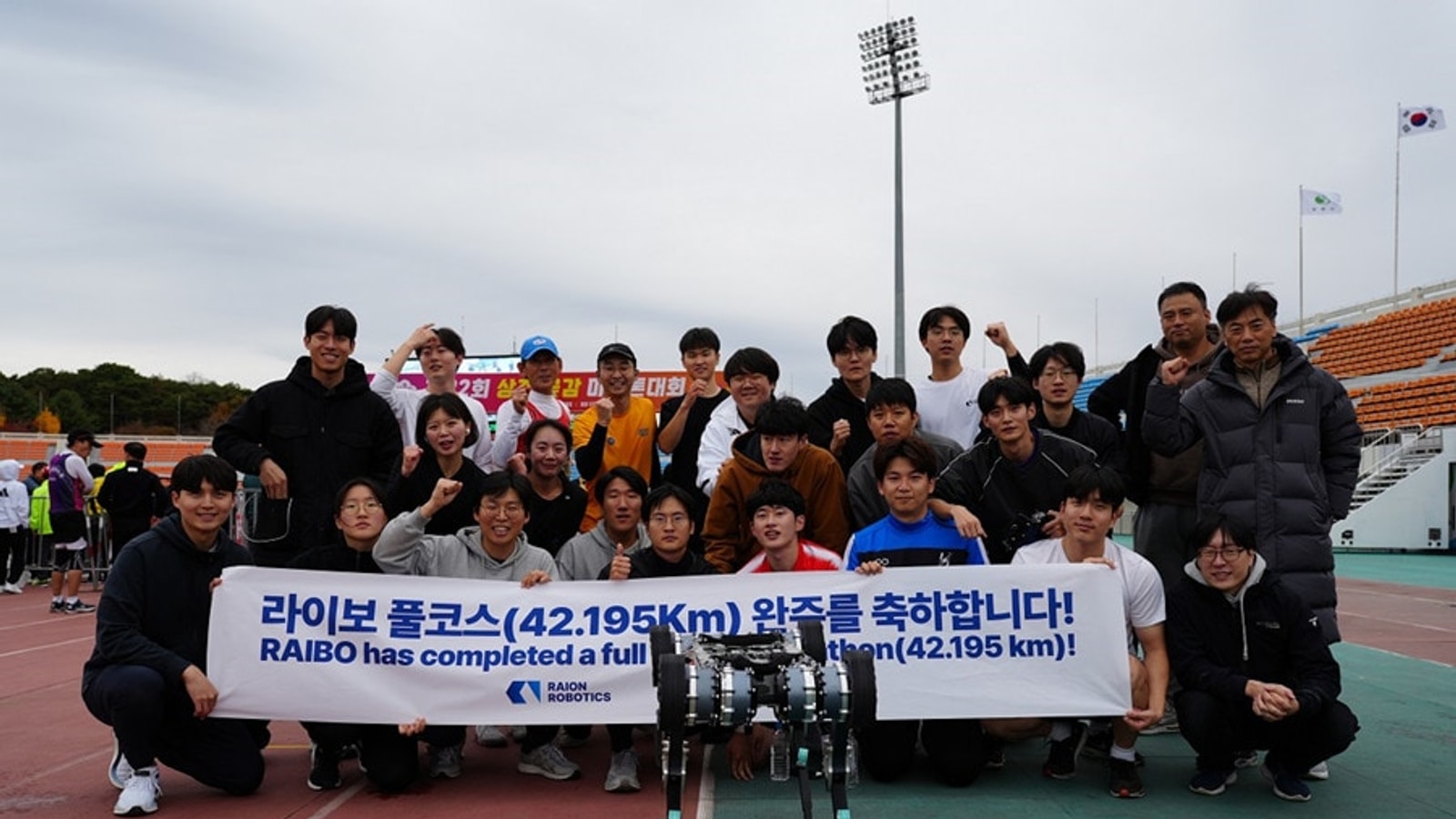
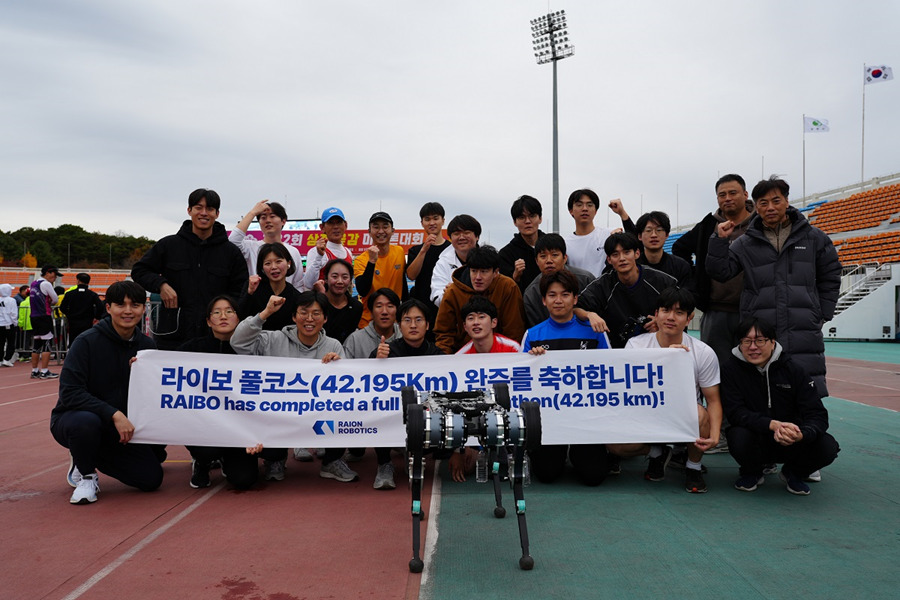
A quadruped finishing a marathon invites the wrong first question: how human was its performance? RAIBO2 did not need lungs, training miles, or a runner’s will. It needed a power budget that could survive 42.195 kilometers of repeated impacts. The researchers’ achievement was to stop treating the battery as the only limiting part and to hunt losses everywhere a joule leaves the pack without moving the machine forward.
That framing changes what the demonstration means. A wheeled robot can coast. A legged machine spends energy holding itself up and repeatedly accelerating limbs and body mass as its feet strike and leave the ground. Some energy is lost as heat in motor windings and electronic switches; some disappears into mechanical collisions and imperfect gearing. A locomotion controller optimized chiefly to stay upright or run fast can waste power even when the motors and battery are excellent. The KAIST team addressed the mechanical design, motor drive, and policy together. Nature’s September paper reports the integrated result; the run it analyzes is not a new race staged this month.
The denominator decides the story
Total cost of transport, often abbreviated TCOT, expresses energy consumed per unit of weight and distance. A lower value indicates that moving the system’s weight a given distance takes less energy under the chosen accounting convention. The authors report 0.25 for RAIBO2 and cite a human benchmark of 0.37. This is a striking comparison, but it is not a declaration that the machine has better all-around endurance than a person. Humans and robots have different fuel systems, mass allocations, payloads, terrain tolerances, repair needs, and definitions of useful work. The paper’s comparison is about a specific normalized energy metric.
The robot’s marathon time works out to about 9.74 kilometers per hour over the official distance. That arithmetic is simply 42.195 divided by approximately 4.331 hours. It tells us the test was sustained locomotion, not a stationary endurance claim or a short sprint. The paper labels one figure as a loss analysis “with 1,447 Wh,” but the accessible figure heading alone does not establish whether that quantity is battery capacity, energy available in the modeled configuration, or energy actually consumed in the race. An energy-per-kilometer calculation requires the measured discharge and a clear system boundary, so we do not derive one from that caption.
The real-world run matters because laboratory treadmill efficiency can hide weather, slopes, turns, pavement variation, software interruptions, and thermal drift. Conversely, one successful route can hide distributional risk. If ten identical runs under different loads and surfaces yielded very different ranges, the marathon would remain genuine while its operational extrapolation weakened. A field buyer would ask for variability, reserve charge at finish, ambient conditions, component temperatures, and maintenance after repeated runs.
Why the leg is not just a motor
The researchers describe lightweight, force-transparent hardware. In practical terms, a foot contacting the ground should transmit useful information and force without a heavy, resistant mechanism squandering energy. Reducing mass at the calf and other moving parts does more than shave the robot’s total weight: distal mass must accelerate and decelerate during every stride. A kilogram moved repeatedly at the end of a leg can cost more dynamically than a kilogram fixed close to the body. The paper’s extended data describes lightened links and compact bearing choices intended to preserve structural rigidity.
The tradeoff is durability. Remove too much material and an efficient leg may become a brittle one. Design the actuator around a narrow operating band and it may suffer when a rescuer asks it to climb rubble or carry equipment. This is why the marathon is best read as a measured operating point, not as proof that the same design dominates every robot mission. The decisive field metric might be range while carrying sensors or supplies over a rough surface, including time spent stopping, scanning, and recovering from slips.
Gearing and motor choice affect losses in both directions. A high gear ratio can help a motor produce force at a joint but introduces transmission effects and changes how well the leg responds to contact. Electrical current makes torque and heat: resistive losses rise with the square of current, so a design that occasionally demands very high torque can pay disproportionately. The paper’s sensitivity analysis varies gear ratio, motor characteristics, body weight, calf mass, current sensing, and gate resistor values. Those variables show why a single “better battery” answer misses much of the system.
The motor driver is part of the actuator’s energy economy. Low-resistance switching and current sensing reduce losses between battery and mechanical output. They also introduce engineering questions about heat, switching behavior, reliability, and electromagnetic noise. An efficient circuit on a research platform is not automatically the right circuit for a robot expected to run in mud for hundreds of hours. A commercial version would need environmental qualification and maintainable parts in addition to a good efficiency curve.
The controller learns when to spend
Locomotion software can move the same hardware cheaply or expensively. If a foot lands with avoidable relative velocity, the contact dissipates energy. If the controller demands a low body posture, joints may carry higher torque for the same distance. If its reward function favors speed, stability, or visual smoothness while ignoring electrical losses, it can spend battery freely to achieve those other goals.
The KAIST team trained a policy intended to reduce energy dissipation, including losses around foot contact and actuator current. Supplementary experiments compare behavior with and without collision-related rewards on a treadmill. The paper also examines body height as a variable in electrical loss. This does not mean “AI made a robot efficient” in some generic sense. The engineering contribution lies in encoding physically meaningful penalties, building the hardware to respond well, and testing what the policy actually does. A learned controller cannot recover energy that has already been lost in a hot winding or a heavy leg, and an elegant motor cannot choose the right gait for it.
There is a useful comparison to electric vehicles. A car’s battery capacity is a convenient headline, but rolling resistance, aerodynamics, drivetrain efficiency, temperature, speed, and route determine range. A quadruped has analogous systems plus the recurring expense of creating and breaking ground contacts. The analogy clarifies the budgeting problem; it does not imply a robot will achieve road-vehicle efficiency. Wheels remain a powerful option when the terrain allows them.
What the result can and cannot buy
The authors say RAIBO2 offers more than triple the per-charge travel range of existing quadrupeds in their comparison. That claim is about the selected literature and systems, not a universal ranking across every robot sold or prototyped in 2026. It does establish that integrated loss analysis can move the practical boundary in a way isolated battery improvements may not. Search-and-rescue teams, inspectors, and field scientists care about the distance from a charging point, but they also care about useful payload, sensing time, reliability, and whether a robot can return with enough reserve after an unplanned detour.
A marathon is especially suited to exposing steady-state loss. It is less suited to measuring manipulation, repeated stair climbing under load, self-righting after a fall, or all-day duty cycling. The natural follow-up experiments would disclose mass and payload, state of charge, battery aging, route elevation, surface distribution, thermal behavior, repairs, and the controller’s performance on terrain it did not see during training. Publication of code for locomotion policy training and a Zenodo dataset makes parts of the result inspectable, though reproducing the integrated physical system still requires the hardware.
There is a subtle measurement trap in the human comparison. Normalized cost of transport intentionally removes some scale differences. It does not price manufacturing, battery production, human judgment, terrain selection, or the value of cargo delivered. A human can choose a shortcut, ask for help, open a door, and make a judgment about danger; a robot that runs efficiently in a known route may not yet do any of those things. Conversely, a machine can carry certain sensors into conditions where sending a person is the wrong choice. Efficiency is enabling, not sufficient.
KAIST’s account of the 2024 course mentions two notable climbs, near 14 and 28 kilometers. The route was therefore more informative than a perfectly level treadmill, while remaining a single organized event with team support. The institution also described a torque-transparent joint mechanism that can recover some downhill energy. To turn that claim into a general range forecast, a reader would need a measured energy-flow trace for climbs and descents, not merely the total time and finish. An urban delivery route, a mountain trail, and an indoor patrol can share a distance while imposing very different electrical and collision losses.
The next test
We would change this assessment if independent repetitions showed a sharply different cost of transport, or if the comparative baseline turned out to exclude relevant peers. It would strengthen if varied routes, payloads, temperatures, and battery ages retained a substantial advantage, with clear maintenance and failure data. The authors’ paper and shared data are a basis for those tests, not their substitute.
For now, the result makes a more interesting claim than “a robot ran a marathon.” An energy budget can be designed across a whole body: material where it moves, current where it heats, contact where it collides, and software where it chooses. The distance was the public demonstration. The ledger of losses is the part engineers can carry into the next machine.
The integrated mechanical, electrical, and control design is the advance. Field readiness remains an open question until the range survives payload, terrain, repeatability, and maintenance tests.