

Soft robots are appealing for almost the same reason they are annoying to control.
A rigid mechanism tries to make its geometry predictable. A soft actuator bends, stretches, stores energy, loses energy, remembers where it was and changes its response with loading history. That compliance can make a machine safer, lighter and more adaptable. It also means the controller inherits a body that refuses to behave like a clean textbook equation.
Researchers at ETH Zurich have demonstrated another route: stop insisting on modeling every physical detail and learn the low-dimensional dynamics the actuator actually uses.
The complete physics can be larger than the useful behavior.
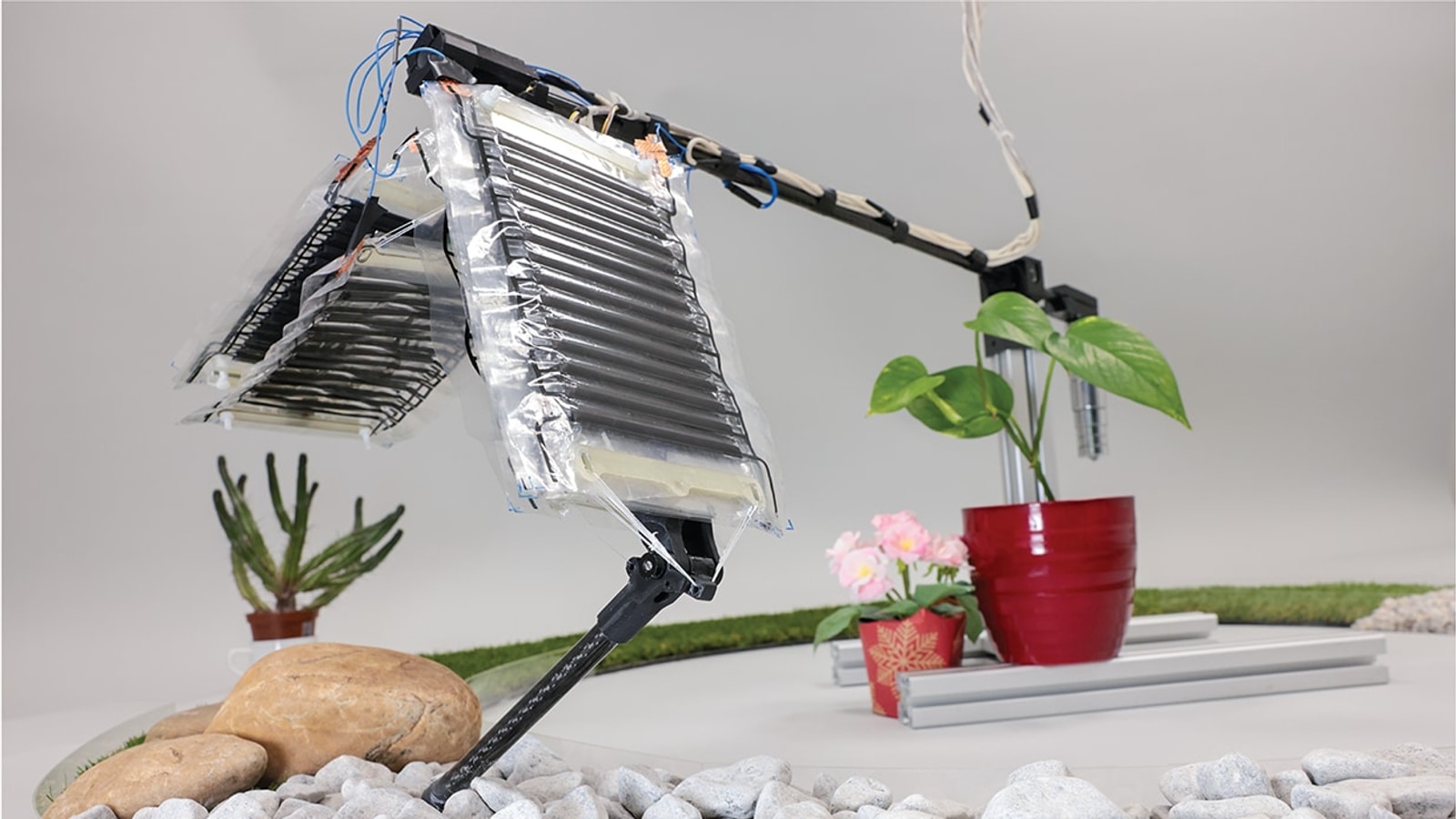
The study focuses on HASEL-type electrohydraulic artificial muscles and an antagonistic joint built from electrohydraulic clutches. These actuators combine flexible structures, dielectric liquids, electrostatic forces, mechanical deformation and pronounced hysteresis. A high-fidelity model can become computationally expensive and still struggle with manufacturing variation and unmodeled losses.
The ETH team uses spectral submanifold theory to search for a lower-dimensional slow manifold inside the full dynamics. In plain language, a complicated system can have many physical degrees of freedom while most of its ordinary motion collapses onto a much smaller set of dominant relationships.
If the controller can learn that smaller surface directly from experiments, it does not need to solve the entire multiphysics problem every millisecond.
The machine learns from forced motion instead of waiting for perfect decay tests.
Reduced-order modeling often depends on carefully measured free-decay trajectories, which can require large step inputs and experiments that are awkward or damaging for soft actuators. The new method works from forced-response data gathered while the system is being driven.
Under an adiabatic regime, the researchers learn an explicit input-output relationship on the slow manifold. That relationship captures the actuator's memory and hysteresis well enough to act as a feedforward model inside a real-time controller.
They then paired the learned model with feedback on an antagonistic joint. The result was substantially better trajectory tracking than either feedback-only or feedforward-only control, with the published results reporting reductions in tracking error that reached roughly two-thirds in some tests.
That is not a claim that feedback is obsolete. It is the opposite. The learned feedforward term handles the repeatable nonlinear body dynamics, while feedback cleans up the remaining errors and disturbances.
This is what embodied intelligence looks like before anyone gives it a personality.
Robotics conversations keep getting dragged toward language models and high-level planning, but a machine that lives in the physical world has a more primitive intelligence problem: it needs an accurate relationship between commands and motion.
A soft actuator does not merely execute software. Its material state participates in the computation. Pressure history, charge, temperature, deformation and mechanical loading all influence what the same command produces next.
Learning a compact dynamical model from the actual actuator is therefore a kind of calibration between software and body.
That has practical consequences beyond one lab joint. If two nominally identical soft actuators leave the factory with slightly different responses, a data-driven reduced model can potentially be learned for the machine that actually exists instead of relying exclusively on the machine the CAD model promised.
The interesting failure mode is drift.
The next test is not whether the controller can reproduce the laboratory trajectory. It is whether the learned model remains useful as the body changes.
Soft materials age. Electrodes degrade. Fluids heat. Seals change. Repairs introduce asymmetry. Loads vary. A model trained on yesterday's actuator may become an increasingly inaccurate map of today's machine.
That creates a maintenance question that looks suspiciously like biology: how often does the controller need to relearn its own body?
The published work does not answer that for fielded systems. Its adiabatic assumption also means violent transients, impacts and abrupt state changes can push the system outside the regime where the reduced model is trustworthy.
Those are not reasons to dismiss the approach. They define the next benchmark.
A useful robot does not always need a complete closed-form equation for its body. It needs a model accurate enough to predict the part of the dynamics the controller actually visits, plus feedback capable of catching what the model misses. The ETH work shows that soft artificial muscles can be controlled by learning that reduced dynamical structure directly from experiments. The harder field problem is now persistence: whether the model can remain calibrated as real machines wear, drift, get repaired and leave the laboratory.
The body can be complicated. The controller only has to know which complications matter right now.