
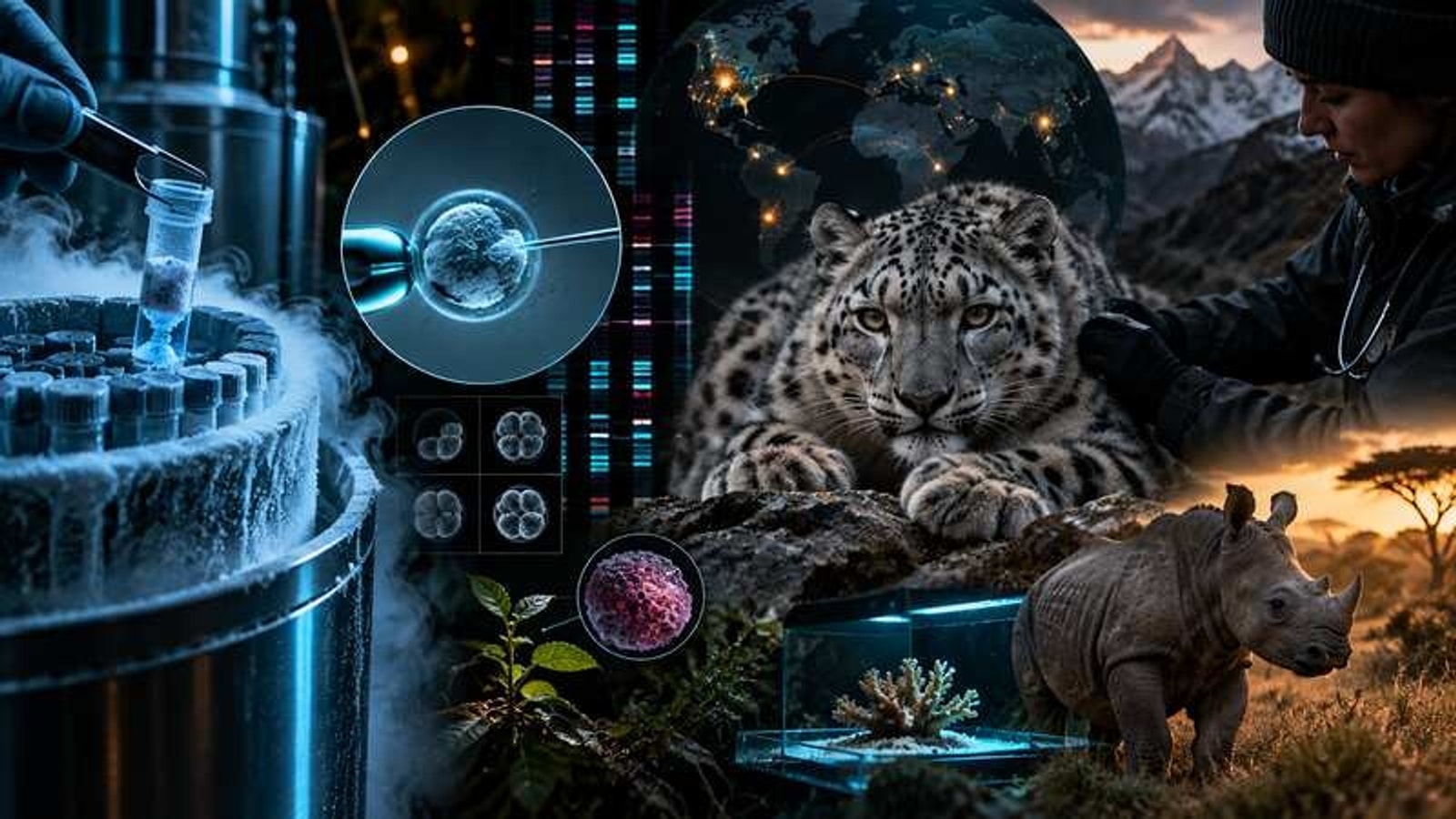
CONSERVATION BIOTECH / GENETIC RESCUE / DE-EXTINCTION
The Useful Jurassic Park.
The most important legacy of de-extinction may not be resurrected species. It may be the reproductive, genomic and cellular tools developed while trying to build them, then redirected toward species that are still alive enough to save.
By Cyberdelia Research Desk · September 10, 2026 · Method: conservation-technology impact analysis

The spectacle and the actual technology
De-extinction attracts attention because it offers an image no grant proposal can compete with: an animal that vanished returning to the world. Mammoths, thylacines and dodos make better headlines than cryopreservation protocols, ovarian stimulation or cell-line quality control.
But conservation biology may ultimately benefit more from the boring machinery.
Every attempt to reconstruct an extinct species forces researchers to solve problems that endangered-species programs already face: how to preserve genetic material, recover rare alleles, derive stem cells, produce gametes, collect oocytes, fertilize embryos, maintain pregnancies and manage small populations without losing diversity.
If those tools become reliable, they can be applied before extinction rather than after it.
Biobanks turn extinction into a different problem
Frozen zoos and wildlife biobanks preserve tissue, sperm, eggs, embryos and cell lines from threatened species. The basic logic is simple: genetic information stored today may become usable by technologies that do not yet exist.
That idea already has precedent. Cloning efforts in endangered mammals have used frozen cells from individuals that died years earlier, effectively returning genetic variants to a living population. The black-footed ferret program is a prominent example: cells from a ferret named Willa, preserved in the 1980s, were used decades later to create cloned animals carrying genetic diversity absent from the contemporary breeding population.
The important lesson is not that cloning solves conservation. It is that frozen cells can become a genetic reservoir. As reproductive tools improve, archives stop being passive records and become potential inputs into population recovery.
Genetic rescue does not require extinction
Small endangered populations often lose genetic diversity through bottlenecks and inbreeding. Conservationists sometimes address this through genetic rescue: introducing individuals from another population to restore variation and reduce inbreeding depression.
Biotechnology expands the toolkit. If banked cells contain alleles no longer represented in the living population, cloning or stem-cell-derived reproductive methods may someday reintroduce those variants without relocating whole animals.
Genome editing creates an even more controversial option. Researchers might correct a harmful mutation, restore a lost resistance allele or engineer protection against an invasive toxin or disease.
That crosses an important boundary from preserving existing variation to deliberately designing future variation. The justification therefore needs to be stronger than "we can." It should rest on a clear threat mechanism, a well-characterized edit, welfare evidence and realistic ecological benefit.
De-extinction programs are already spilling into conservation
Colossal and affiliated researchers have increasingly emphasized conservation applications alongside flagship resurrection projects. Their published research includes elephant pluripotent stem cells, assisted reproduction in antelope species, marsupial reproductive biology, ancient-DNA alignment tools and gene-editing work aimed at toxin resistance in endangered Australian marsupials.
Each of these projects addresses a real technical bottleneck independent of whether a mammoth is ever born.
Elephant induced pluripotent stem cells could support reproductive research in Asian elephants, not merely mammoth proxies. Improved ovum-retrieval methods can matter for endangered antelope breeding. Better ancient-DNA mapping tools improve paleogenomics generally. Marsupial reproductive work may help threatened species with reproductive biology poorly served by standard laboratory models.
This is the strongest practical argument for allowing de-extinction research to exist alongside conventional conservation rather than treating the two as enemies by definition.
The funding objection is still real
Critics reasonably ask whether enormous investments in charismatic extinct species would save more biodiversity if spent on habitat protection, anti-poaching work, invasive-species control or ordinary conservation breeding.
There is no universal answer because money is not perfectly fungible. Some investors funding a high-risk biotechnology company would not otherwise donate the same capital to wetland restoration. De-extinction can attract money, engineers and public attention that conservation programs might never receive.
But opportunity cost still exists. Scientific talent, animal facilities, regulatory attention and philanthropic capital are finite. A spectacular technical program can distort priorities if it encourages the belief that extinction is reversible enough to tolerate.
The existence of a rescue technology must never become an excuse to destroy habitat now and promise reconstruction later.
Prevention remains cheaper than resurrection
Even a successful mammoth proxy would illustrate the asymmetry brutally. Thousands of years after extinction, researchers must reconstruct genomes, edit elephant cells, solve reproductive bottlenecks, manage developmental risk and eventually build a population from scratch.
Keeping a species alive avoids most of that.
A living population retains behavior, microbiomes, learned migration routes, ecological relationships and naturally reproducing genetic diversity. Once those disappear, biotechnology can recover only portions of the system.
That means de-extinction technology is best viewed as a last-resort extension of conservation, not a replacement for it.
Better reproductive tools could change endangered-species management
Assisted reproductive technologies are routine in humans and livestock but uneven across wildlife. Every species has different reproductive anatomy, hormonal cycles, gamete biology and gestational requirements. Methods cannot simply be copied from cattle into elephants, birds or marsupials.
De-extinction programs are forced to work on precisely those non-model organisms. The resulting protocols may create a library of species-specific reproductive techniques that conventional conservation historically lacked funding to develop.
Oocyte pickup, in vitro maturation, IVF, embryo transfer, semen cryopreservation, stem-cell derivation and eventually in vitro gametogenesis could allow zoos and wildlife programs to manage genetics more deliberately.
That does not turn conservation into a laboratory-only discipline. Habitat remains the limiting resource for many species. But it gives managers additional options when breeding pairs are geographically separated, when fertility is low or when important genetics survive only in frozen tissue.
Genome editing against immediate threats
One of the most provocative conservation applications is engineering resistance to a threat that evolution has not had time to solve.
Australian northern quolls have suffered catastrophic declines after eating invasive cane toads whose bufotoxins can kill native predators. Researchers associated with Colossal have investigated genetic changes to ATP1A1, a protein targeted by those toxins, as a possible route toward increased resistance.
This kind of intervention is not de-extinction in the headline sense, but it uses the same conceptual machinery: identify a historical or comparative genetic solution, engineer it into cells, test function and evaluate whether the resulting phenotype improves survival.
The ethical standard should be extremely high because edited alleles could spread through wild populations. But the conservation payoff could also be direct and measurable.
The line between restoration and design is becoming blurry
Traditional conservation often aims to preserve historical states. Climate change, invasive species and fragmented landscapes increasingly make that impossible. Some populations will face environments unlike those in which they evolved.
Assisted gene flow already moves adaptive variants between populations. Genome editing could someday accelerate the same logic. At that point conservation becomes partly prospective: not merely preserving what a species was, but helping it remain viable under conditions humans have changed.
That idea makes many biologists uncomfortable for good reasons. Ecosystems are complex, and genetic interventions can have unexpected effects. But refusing intervention is also a decision when extinction risk is high.
The useful framework is not natural versus artificial. It is evidence, reversibility, welfare, ecological consequence and governance.
Cyberdelia assessment
The strongest defense of de-extinction research is not that humanity deserves a technological victory lap with a mammoth. It is that the project forces rapid development of tools for preserving and manipulating rare genomes, and those tools may be deployed against extinctions that have not happened yet.
That benefit should be measured explicitly. A de-extinction company that produces conservation protocols, open datasets, viable cell lines and recovered genetic diversity has created value even if its flagship proxy misses a deadline. Conversely, a spectacular animal with little transferable conservation value should not automatically be treated as a biodiversity success.
Jurassic Park's fictional biotechnology was designed to populate an attraction. The useful real-world version is almost the inverse: build enough reproductive and genomic capability that fewer species ever require resurrection.
Uncertainty and falsification
The spillover thesis would weaken if de-extinction tools remain too species-specific, too expensive or too proprietary for conservation programs to use. It would strengthen if independent wildlife agencies adopt these methods and document improved genetic diversity, fertility, disease resistance or population recovery.
Source trail
Sources include published and publicly listed Colossal-associated research on elephant iPSCs, antelope ovum pickup, marsupial biology, toxin resistance and ancient-DNA mapping; established endangered-species cloning and biobanking programs; and conservation-genetics literature on genetic rescue and assisted gene flow.
Corrections: Cyberdelia updates technical features when outcomes become independently measurable.