

A data center is often described as a computing problem, but it becomes a financing problem long before a chip processes its first prompt. Somebody must buy the land, arrange the electrical supply, construct the shell, install cooling and networking, acquire accelerators, and carry the interest while the building produces no rent. At Project Jupiter in New Mexico, the timetable for that sequence is now under dispute. Reuters reported on September 24 that Oracle issued a force majeure notice to a unit of Blue Owl, whose STACK Infrastructure is developing the campus for Oracle and its customer OpenAI. A person familiar with the arrangement said securing power is Oracle's responsibility and the project faces a one-year delay. Oracle said the project remains on its planned schedule; Blue Owl said the notice does not change the parties' financial commitments. Those statements do not resolve whether the building can be delivered or monetized on the original schedule.
The immediate event matters because the money has been arranged in layers. Reuters reported approximately $3 billion of Blue Owl equity in the project and described a construction-stage return that rises after completion. Earlier accounts put project loans at $18 billion, but that figure is based on reporting about financing rather than a complete public loan schedule. A delay may defer a higher contractual return without erasing the financing cost or the physical work. It may change who bears carrying costs, when tenant payments begin, and what lenders can count as collateral. Contract language determines the actual allocation, and the full Jupiter contracts are not public.
The New Mexico story arrived alongside a September 23 Brookings conference paper by Stijn Van Nieuwerburgh that estimates a $10.3 trillion U.S. AI infrastructure investment from 2025 through 2032. The figure is a model of a possible buildout, not money already spent or contractually committed. The paper's deeper point is more immediately useful: the industry is moving some exposure from conspicuous technology-company capital spending toward leases, special-purpose vehicles, private credit, securitization, guarantees and project-level debt. Project Jupiter is a case through which to test what that shift does when the electric grid does not arrive on cue.
The calendar is a financial instrument
Picture three clocks. The first is the physical construction clock: transformers, permits, generation, transmission, water systems, shells and racks. The second is the financial clock: interest accrues, equity expects a return, and lenders assess a completion date. The third is the demand clock: a customer may need capacity at a particular time, but its eventual usage and willingness to pay are uncertain. The project works most cleanly when the three clocks align. A power delay can upset all three even if the appetite for AI computation remains strong.
According to Reuters' separate September 24 account, a person familiar with the terms said Blue Owl receives a lower yield during construction and a higher yield after completion. The same source said Oracle cannot terminate the lease in the circumstances described and bears the debt costs. Reuters also reported Blue Owl's assertion that the notice leaves its financing commitments intact. These are attributed descriptions of a private arrangement, not a published contract we can audit. Still, the mechanism is plain: shifting the date of completion shifts the date when an asset can earn its mature return. The question for investors is whether a lease payment, a tenant commitment or an insurance and contract remedy covers the interval.
A data center can be almost ready and still economically unfinished. A rack without energization does not produce sellable compute. A completed building without sufficient cooling cannot operate dense accelerators at the planned level. Grid upgrades and local permitting can therefore behave like components on the critical path rather than external inconveniences. A lender underwriting a tenant's credit quality still has to underwrite the prospect of a long wait for the asset that tenant intends to occupy, even when there is a substantial backlog of future AI demand.
There is also a difference between moving a risk and removing it. A technology company may lease a campus from a developer instead of paying all construction costs on its own balance sheet. The developer may borrow against anticipated rent, while an investment manager brings in equity and lenders sell slices of exposure onward. That changes the first party absorbing a shock. The ultimate economics still depend on the same power connection, customer demand and useful lifetime of the equipment. If several facilities share the same assumptions, diversity of legal vehicles may conceal a common underlying bet.
What the ten-trillion-dollar estimate actually counts
Van Nieuwerburgh's conference draft estimates roughly $41 billion for a gigawatt of AI campus capacity once the buildings, power infrastructure and computing equipment are considered. It models 183 gigawatts completed by 2032 and another 118 gigawatts from the 2025–2032 pipeline coming online later. The author derives approximately $10.3 trillion invested during the eight-year period, or an average 3.63 percent of U.S. GDP annually in the paper's comparison. These figures depend on modeled capacity, unit cost and timing. Treating them as an announced national construction program would turn an analytical scenario into a false certainty.
The composition matters at least as much as the headline total. Chips, servers and network equipment represent a large share of the cost and may be replaced much sooner than a building. A concrete shell can have decades of useful life. A specialized accelerator may be superseded in a few years by faster, more energy-efficient hardware. A financing arrangement that values an operating campus as one durable asset can obscure those different depreciation clocks. Investors need to ask whether the residual value of the equipment supports the debt and whether the tenant has a contractual obligation to refresh it.
The paper examines what revenue would justify the investment under specified return and operating-margin assumptions. Its roughly $3.7 trillion annual revenue requirement in 2032 for a 10 percent unlevered return at a 50 percent operating cash-flow margin is a stress test, not a forecast of AI customer spending. The result rises if equipment wears out economically faster or utilization disappoints. There is no contradiction between a genuine market for AI services and a buildout that earns less than its cost of capital. Demand can grow rapidly while supply grows faster, prices decline or a customer concentrates purchases among only a few providers.
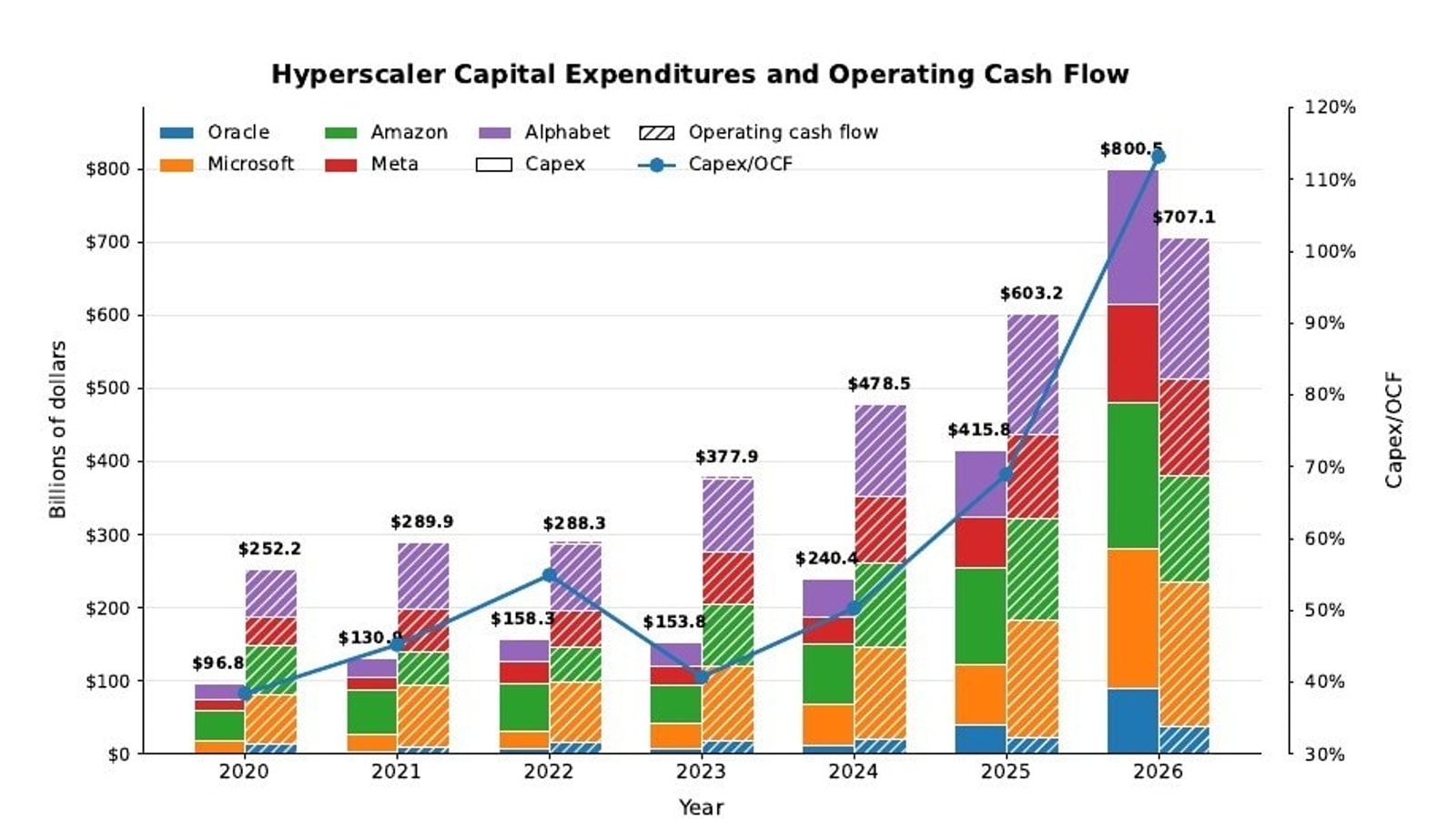
The five-company capital-spending chart in the paper offers a narrower observed baseline. It compiles filings and projections for Oracle, Microsoft, Amazon, Meta and Alphabet, showing combined capital expenditures climbing from about $97 billion in 2020 to more than $400 billion in 2025, and a projected figure above $800 billion in 2026. The final point is an estimate, not a completed fiscal-year result. Capital spending also contains assets outside AI; the chart cannot isolate every dollar spent on frontier-model infrastructure. Its value is to show the rate at which the existing operators' financing capacity is being tested, not to prove a particular amount of AI revenue must follow.
Where a megawatt turns into credit risk
The physical bottleneck begins before the financing closes. A project needs an electrical connection with enough firm capacity at an acceptable time and cost. It may seek on-site generation as a bridge, but fuel delivery, air permits, turbines and interconnection each add their own dependencies. Reuters said the Jupiter notice concerned delays in securing power. Local objections over air and water impacts are material here because they can affect permits and schedules. They deserve examination on their engineering and community merits, rather than treatment as an unexplained political veto on technology.
The financing bottleneck follows. During construction the collateral is a partly built facility whose completion cost can grow. Once operational, the cash flow may depend heavily on one tenant. If that tenant is itself renting compute onward to a smaller group of AI developers, apparent diversification at the lease level can narrow at the end of the chain. Long-term lease commitments can stabilize a lender's projections, but their protection depends on counterparty credit, enforceability, timing, and exactly which costs a force majeure clause defers. A promised stream of rent is not interchangeable with cash received today.
Investors also face a maturity mismatch. Buildings and power facilities are financed for long lives while the useful life and resale price of accelerators remain contested. Loan structures can require refinancing before the facility reaches the end of its lease. If interest rates rise, utilization disappoints, or chip prices fall, a refinancing may become expensive even when servers are still running. Private lenders can price that risk, but outsiders may struggle to see how many institutions hold similar claims on the same customers and assumptions. Brookings does not assert that the sector already poses systemic risk comparable with earlier credit booms; it says more transparent measurement would help before interconnected exposures become hard to observe.
Oracle illustrates why a prestigious tenant is not a substitute for project analysis. Its reported project commitments and recent capital spending are substantial, and its cloud order backlog signals expected future work. Backlog is not contemporaneous cash, nor is all of it guaranteed profit. The relevant underwriting question is more precise: which entity pays for delay, what date triggers rent, what happens if the planned power supply changes, and who owns a half-finished asset if counterparties disagree? Answers require the project contracts, not a share-price reaction.
How to tell whether the buildout is sound
Three disclosures would make a useful start. First, publish facility-level milestones: contracted grid capacity, energization dates, backup-power strategy and the permits that still stand between a building and operation. Second, report the capital stack: cash equity, construction loans, lease obligations, guarantees, securitized exposure and the contractual party responsible for overruns. Third, distinguish revenue already earned from backlog, reserved capacity and assumptions about future utilization. Those figures would let investors compare campuses built for robust demand with campuses built chiefly on optimistic projections.
None of these tests produces a single universal answer. A site with costly power may still serve a valuable low-latency customer. A company might rationally build ahead of current usage to secure scarce land and interconnection capacity. A project delay may be manageable for a well-capitalized developer and painful for another. The point is to make the assumptions observable before those differences vanish into an aggregate dollar estimate.
Project Jupiter is not proof that the AI buildout is failing. Oracle disputes the reported slippage, Blue Owl says it remains committed, and the full legal and financial terms are unavailable. It is proof that the promised future of AI arrives through electrical substations, permits, contracts and interest payments. When the power is late, the risk does not wait quietly at the edge of the campus. It runs through the entire capital structure.
Construction delays can defer mature rent and move risk among tenants, developers and lenders. The full project contracts, actual revised completion date and ultimate losses are not public.