
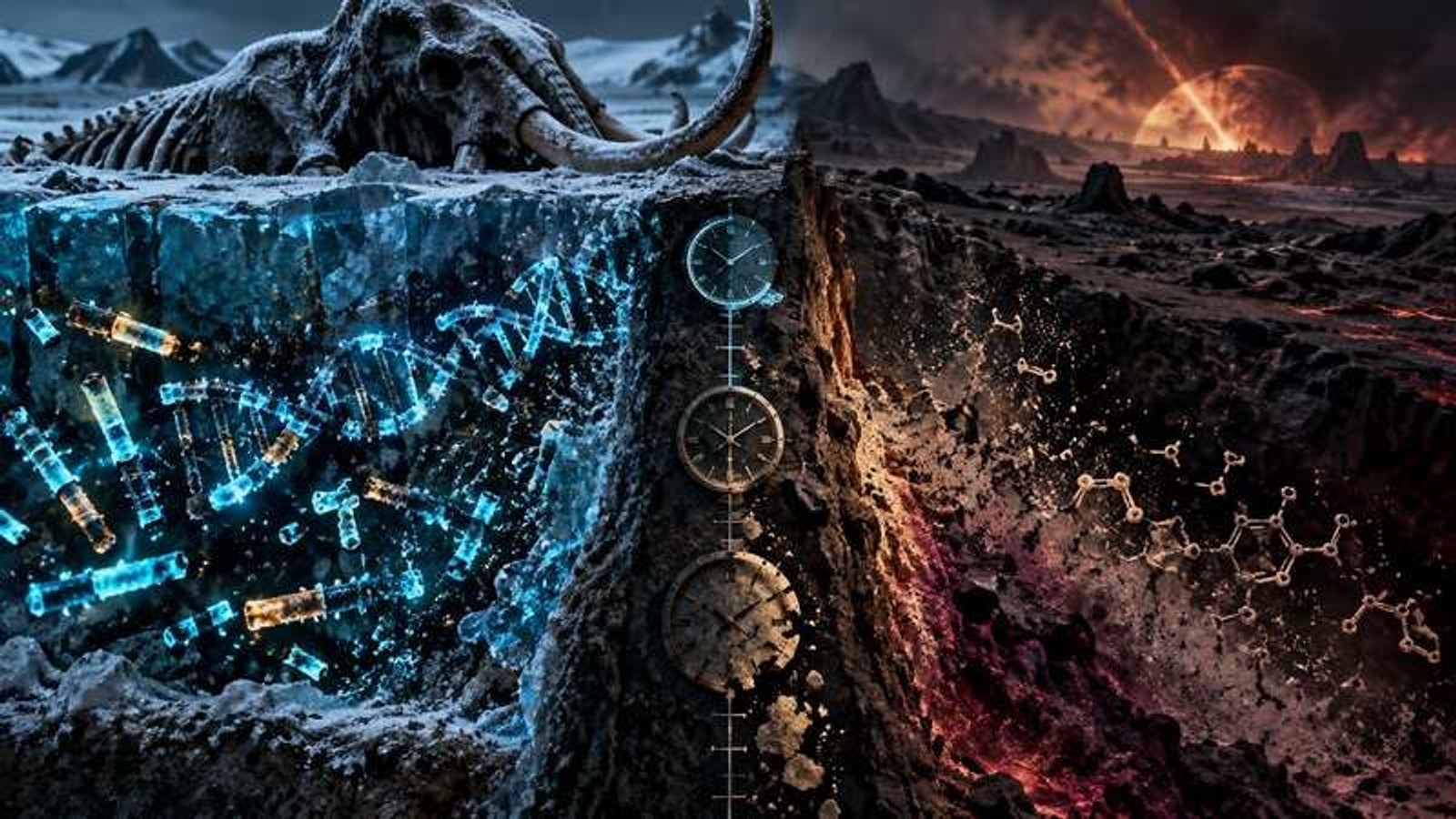
PALEOGENOMICS / DE-EXTINCTION / JURASSIC PARK SCIENCE
Why Mammoths Are Possible and Dinosaurs Aren't.
The difference is not imagination. It is chemistry. Ancient DNA has a brutal shelf life, and mammoths sit close enough to the present that scientists can still recover useful genomic information. Non-avian dinosaurs do not.
By Cyberdelia Research Desk · September 10, 2026 · Method: comparative paleogenomics and biotechnology synthesis
Jurassic Park starts with the wrong kind of miracle
The most famous de-extinction story begins with a mosquito in amber carrying dinosaur blood. That premise solved the hardest problem in a single cinematic gesture: it assumed dinosaur DNA survived tens of millions of years in readable form. Modern ancient-DNA research has spent the last three decades discovering just how hostile time is to that assumption.
DNA is chemically unstable after death. Enzymes stop maintaining the genome. Water, oxygen, heat, radiation and ordinary molecular motion begin breaking long chromosomes into shorter fragments and altering individual bases. The older the specimen, the shorter and more chemically damaged the surviving fragments tend to be. Ancient-DNA sequencing therefore works less like opening a preserved book and more like reconstructing a shredded manuscript whose scraps have been mixed with dirt, bacteria, fungal DNA and modern contamination.
The oldest broadly accepted environmental DNA recovered so far is roughly two million years old, from sediments in northern Greenland. Researchers used the fragments to reconstruct parts of an ancient ecosystem including plants, reindeer and mastodon relatives. That achievement was extraordinary precisely because it pushed preservation so far beyond the usual range, aided by cold conditions and mineral binding that helped stabilize DNA fragments.
Now compare that with the end-Cretaceous extinction: about 66 million years ago. Even if a future sample preserved DNA ten times longer than the Greenland record, it would still miss non-avian dinosaurs by tens of millions of years. The gap is not a small engineering obstacle. It is the difference between damaged information and information that almost certainly no longer exists in recoverable molecular form.
Mammoths live on the other side of that line
Woolly mammoths survived until only a few thousand years ago, and their remains are often preserved in permafrost. Researchers have sequenced many mammoth genomes from bones, teeth, hair and tissue. More remarkably, a 2024 study reconstructed aspects of chromosome organization from roughly 52,000-year-old freeze-dried mammoth skin. The preservation was good enough to reveal three-dimensional chromosomal architecture, including features comparable to chromatin domains and loops seen in modern cells.
That does not mean scientists found a viable mammoth nucleus waiting to be cloned. It means they recovered enough surviving molecular structure to learn more than raw sequence alone could tell them. The result strengthened a critical point for de-extinction: for recently extinct species preserved under favorable conditions, modern laboratories can extract not only fragments of genetic code but clues about how that code was packaged and regulated.
The genome is reconstructed, not simply recovered
No ancient mammoth genome comes out of a sequencer as one pristine chromosome set. Researchers assemble ancient fragments computationally using overlap, population comparisons and reference genomes from living relatives. Asian elephants are especially important because they are the closest living relatives of woolly mammoths.
This is where de-extinction becomes fundamentally different from cloning. A cloned animal, in the classic sense, begins with a sufficiently intact nucleus from the organism being copied. Mammoth projects instead rely on reconstructing sequence information from many extinct individuals, comparing those sequences with elephants, identifying differences associated with mammoth traits, and editing elephant cells accordingly.
That makes the intended product a proxy rather than a recovered original. The IUCN has explicitly used the phrase "proxy of an extinct species" for organisms created through de-extinction technologies. Colossal Biosciences likewise describes its target as a cold-adapted elephant carrying core mammoth biological traits rather than a perfect genetic duplicate of a prehistoric individual.
Could we reconstruct a dinosaur without dinosaur DNA?
This is where the question becomes more interesting than a simple no. If intact dinosaur DNA is unavailable, could scientists infer a dinosaur genome from birds, crocodilians, fossils, developmental biology and comparative genomics?
Only to a point. Birds are living dinosaurs in the evolutionary sense, and crocodilians are the closest major living outgroup. Comparative genomics can reconstruct some ancestral states statistically. Developmental biology can reveal dormant or modified pathways that still shape feathers, scales, tails, teeth and limb patterning. Researchers can experimentally alter gene regulation in embryos of living animals to expose ancestral developmental possibilities.
But that is not equivalent to recovering Tyrannosaurus rex. Every inferred base adds uncertainty. Millions of years of lineage-specific changes, gene losses, duplications, regulatory shifts and chromosomal rearrangements separate modern species from their ancient ancestors. A sufficiently ambitious synthetic biology program might someday build an organism that expresses selected dinosaur-like traits. It would be a designed descendant or proxy assembled from living biology, not a resurrection verified against a recovered T. rex genome.
That distinction matters
The phrase "bring back" compresses several different technical goals. Recovering an extinct genome, recreating its visible traits, reproducing its physiology, restoring its ecological role and rebuilding its historical lineage are not the same accomplishment.
Mammoths are plausible candidates because researchers have direct ancient genomic evidence, close living relatives, tractable genetic differences and remains young enough to preserve information. Dinosaurs fail at the first step. Without recoverable DNA, scientists lose the molecular reference that would let them distinguish reconstruction from invention.
That does not make dinosaur-inspired synthetic organisms impossible forever. It means any future "dinosaur" would cross a line from paleogenomics into synthetic biology much earlier than a mammoth project does.
Cyberdelia assessment
The popular question "can we bring back dinosaurs?" is malformed if "bring back" means reconstructing a genetically verified non-avian dinosaur from ancient DNA. There is no credible evidence that usable dinosaur DNA has survived from the Mesozoic, and current molecular preservation records fall vastly short of that timescale.
The mammoth case is fundamentally different. Its genome is empirically accessible, its closest living relatives survive, and the biological engineering pipeline can be anchored to real extinct sequence data. The animal eventually produced may still be a proxy, but the proxy can be measured against a genuine paleogenomic target.
The useful dividing line is therefore not "extinct versus alive." It is whether enough trustworthy biological information survives to constrain the reconstruction. Mammoths remain inside that boundary. Dinosaurs, as far as current evidence shows, do not.
Uncertainty and falsification
This assessment would change if independently replicated research recovered endogenous dinosaur DNA with convincing contamination controls, chemically plausible damage patterns and reproducible sequence information. No such result currently exists. Future discovery of other durable molecular information could also improve ancestral reconstruction, but that would still not be the same evidentiary category as a genome.
Source trail
Key sources include Nature reporting on approximately two-million-year-old Greenland environmental DNA; Nature Genetics and NSF coverage of 52,000-year-old mammoth chromosome architecture; Nature Biotechnology reporting on current de-extinction engineering; IUCN guidance on proxies of extinct species; and Colossal Biosciences' own mammoth project documentation. Company claims are treated as reported engineering targets, not as demonstrated outcomes.
Corrections: Cyberdelia updates technical features when primary evidence changes. Contact routes are listed on the site.