


THE SIGNAL
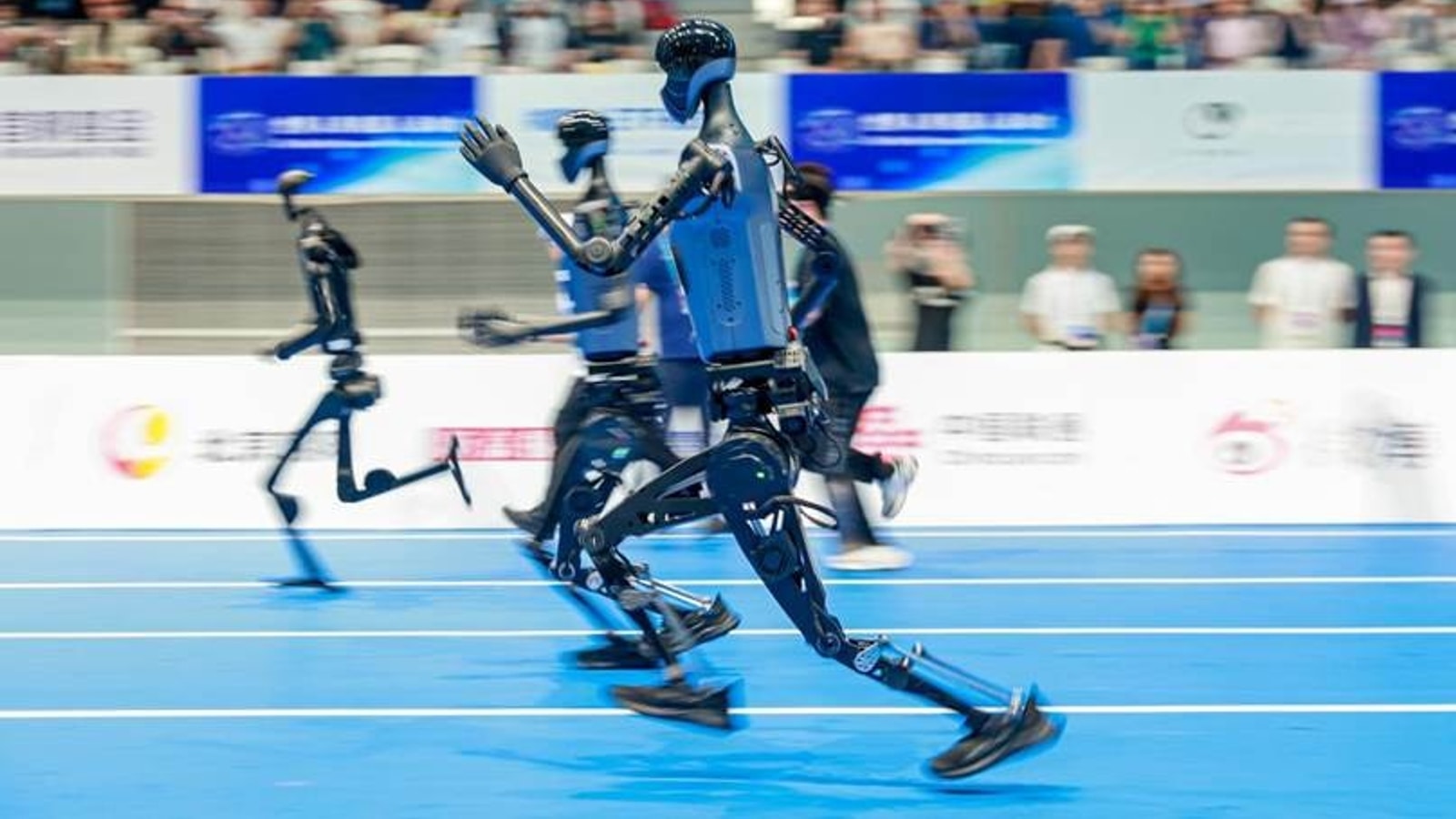
Beijing’s World Humanoid Robot Games looks like a sports event because that is the easiest part to film. Robots sprint, fall, kick footballs, lift weight, dance, fight, and occasionally discover the persuasive authority of a padded wall. But the second edition of the Games is becoming something more useful than a collection of viral clips: a public stress test for embodied robotics.
The 2026 event, held Aug. 22 through Aug. 26 at Beijing’s National Speed Skating Oval, brings together 666 teams and 2,056 robots from 16 countries across 51 competition events. Xinhua reported 280 teams and more than 500 humanoid robots at the inaugural 2025 Games. Whatever definition is used for the exact year-over-year robot count, the participation increase is substantial.
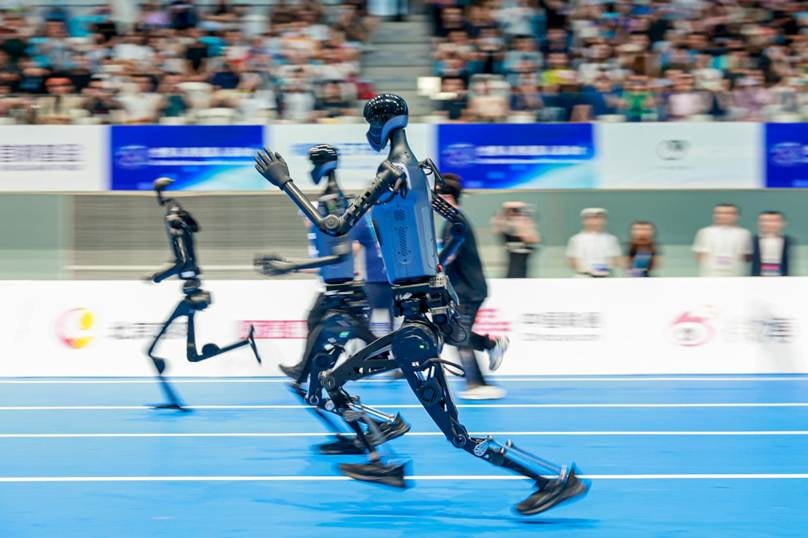
The headline sprint is real. The comparison needs care.
On Aug. 25, Tiangong Ultra, developed by the Beijing Humanoid Robot Innovation Center, recorded a 100-meter time of 8.86 seconds during competition, improving on the 9.39-second robot mark reported earlier in the Games.
That number is faster than Usain Bolt’s 9.58-second human world-record time, which guarantees the comparison will dominate headlines. It is also where technical reporting needs to resist becoming a carnival barker.
A humanoid robot competition is not World Athletics. Different rules, machine geometry, mass distribution, power systems, timing procedures, control constraints, and failure tolerances mean the two records are not interchangeable as sporting achievements. The useful engineering fact is simpler and more impressive on its own: a bipedal machine completed 100 meters under competition conditions in 8.86 seconds.
It also reportedly suffered minor damage after the sprint. That detail matters. Acceleration is one problem. Maintaining balance at speed is another. Deceleration, impact management, structural durability, thermal load, actuator control, and surviving repeated runs are part of the same system whether or not they fit inside the victory clip.
Sport turns hidden engineering problems into public ones.
A robot standing on a stage can be choreographed around its weak points. Sport is less polite.
Running stresses gait planning, dynamic balance, foot placement, actuator power, mechanical compliance, state estimation, traction, impact tolerance, and control-loop latency. Football adds perception, localization, moving-object tracking, path planning, collision avoidance, team coordination, and decision-making under uncertainty. Weightlifting and tug-of-war expose torque, grip, stability, frame strength, thermal performance, and power delivery. Table tennis pushes perception and response time. Martial arts makes contact unavoidable.
The point is not that winning a robot race proves a machine is ready to work in a warehouse, hospital, or home. It does not. The point is that competitive tasks force many subsystems to operate at once while spectators, judges, opponents, and physics refuse to cooperate with the demo script.
A humanoid is not one technology. It is a stack of perception, planning, control, power, mechanics, sensing, software, and recovery behavior wearing roughly human geometry.
The less glamorous events may matter more.
The 2026 Games also include scenario-based contests in factories, hotels, homes, emergency-response settings, hospitals, and retail environments. Organizers have emphasized moving these tasks away from purely simulated settings and toward environments that resemble actual workplaces and daily life.
That shift is more consequential than a faster sprint.
Real environments punish assumptions. Floors vary. Lighting changes. Objects are not perfectly placed. Doors resist. Fabrics deform. Humans walk into the scene. Tools are designed for hands that evolved rather than grippers that shipped last quarter. A machine that can perform a task once under staging conditions is different from one that can repeat it safely, diagnose failure, recover, and continue.
For humanoid robotics, that distinction is the entire commercial problem.
Why humanoid form at all?
The basic argument for humanoids is not that the human body is mechanically optimal. It plainly is not. Wheels are better for many floors. Fixed industrial arms are faster and more precise for many repetitive tasks. Purpose-built machines routinely outperform general-purpose bodies.
The argument is that human environments are already designed around human dimensions: stairs, ladders, door handles, shelves, tools, workstations, vehicles, corridors, and storage. A sufficiently capable humanoid can, in theory, enter existing infrastructure without requiring every building and tool to be redesigned around the robot.
That flexibility comes at a cost. Bipedal balance is hard. Hands are hard. Battery life is unforgiving. Actuators generate heat. Falls damage expensive hardware. Perception mistakes can become mechanical events very quickly. The Games expose those costs in unusually visible ways.
China is treating robotics as an industrial system, not a novelty.
The rapid expansion of the event also sits inside a much larger Chinese push into humanoid robotics and embodied AI. Government support, manufacturing depth, component supply chains, university research, established electronics production, and an increasingly crowded commercial field all matter here.
Competitions serve several roles at once. They are public demonstrations, engineering deadlines, recruiting stages, investor theater, international showcases, and test environments. That mixture means no single performance should be mistaken for an objective measure of national technological superiority. It also means dismissing the event as entertainment would miss what is being built around it.
The year-over-year numbers are difficult to ignore. In 2025 the inaugural Games drew 280 teams and more than 500 humanoid robots. In 2026, 666 teams arrived with 2,056 robots. Scale does not automatically produce maturity, but it does produce iteration.
What the Games still do not prove.
There are several things a strong performance in Beijing cannot establish by itself.
- Reliability: a successful run does not tell us mean time between failures across weeks or months.
- Economics: technical capability does not establish that the robot is cheaper than existing automation or human labor for a given task.
- Generalization: success in one event does not prove robust performance across unfamiliar environments.
- Safety: speed and strength increase the importance of sensing, shutdown behavior, collision handling, and predictable failure.
- Autonomy: event rules vary. Reporting should distinguish fully autonomous behavior from teleoperation, preprogrammed routines, supervised autonomy, and human intervention.
- Maintainability: a machine that performs brilliantly but requires constant repair may still be an excellent research platform and a poor product.
Those caveats are not reasons to shrug at the Games. They are the reasons to watch them carefully.
The benchmark is becoming the story.
Humanoid robotics has spent years trapped between two bad forms of coverage: corporate demos treated as destiny and compilations of robots falling over treated as proof the field is a joke.
Beijing’s Robot Games offers a better middle ground. The falls matter. So do the records. So do the recovery behaviors, broken parts, awkward transitions, improved times, expanded task sets, and repeated attempts. Progress in embodied systems is usually visible as a narrowing collection of failures rather than a single magical threshold.
That makes the 2026 Games useful precisely because they are messy.
A robot crossing 100 meters in 8.86 seconds is an extraordinary engineering result. A robot crashing after doing it is also engineering data. A machine completing a hotel or factory task repeatedly may ultimately matter more than either. The spectacle gets the cameras into the room. The failures tell us what to measure once they are there.