

The product is the rack, not the chip
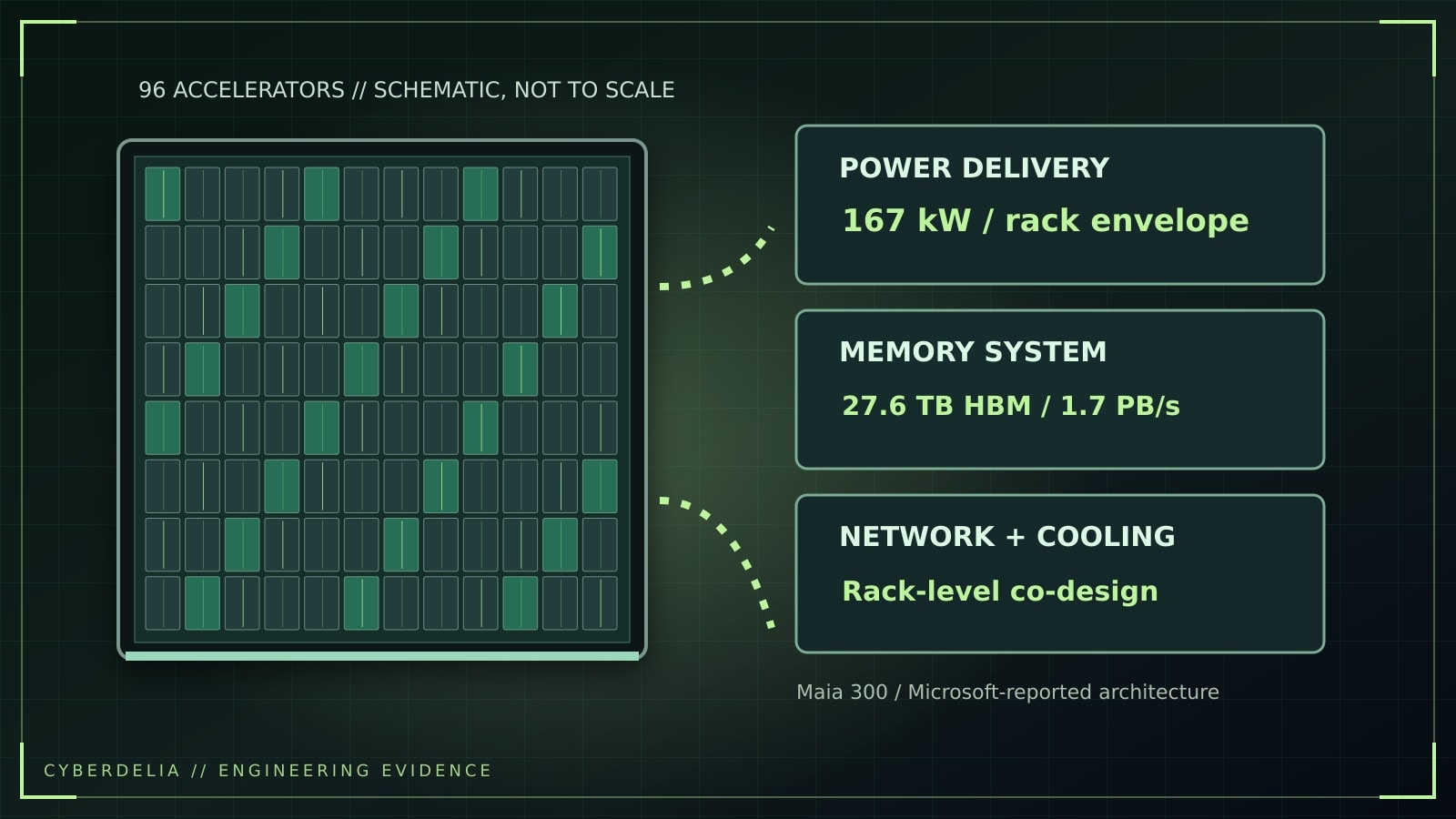
The most revealing number in Microsoft's October 12 announcement is not a transistor count. It is 167 kilowatts. That is the stated power envelope of a Maia 300 rack carrying 96 accelerators. At this scale, an AI computer stops resembling a larger version of the workstation beneath someone's desk. It becomes a controlled allocation of electricity, cooling capacity, memory bandwidth, network traffic and capital, all of which must work together before a single useful answer appears on a screen.
Microsoft says its Maia 200 hardware already serves production workloads, including Microsoft Copilot, while Maia 300 production deployment is planned for 2027. The company intends to expand its accelerator family toward multi-gigawatt installations. Those are statements about an existing predecessor and a future rollout, respectively. Treating the two as interchangeable would turn a roadmap into an accomplishment. The distinction matters because deployment forecasts and measured fleet economics are very different forms of evidence.
The architecture appears designed around AI inference, the stage in which a trained model generates outputs for actual users. Training still commands much of the spectacle, but inference is where a repeated service either earns its operating costs or becomes a very expensive demonstration. Microsoft describes changing demands from long-context conversations, tool use and multi-step agents. These tasks do not merely multiply arithmetic; they keep model state, cached context, memory requests and communication pathways busy in unfamiliar proportions.
A rack-scale computer also makes comparison unusually treacherous. A vendor can advertise tokens per watt, a chip manufacturer can advertise arithmetic throughput, and a data-center operator can ask how many useful tasks finish inside a constrained megawatt. Those are connected measurements, not synonyms. The definition of a token, the chosen model, request length, concurrency, latency objective, precision format and accounting boundary all affect the apparent winner.
Memory is not a supporting actor
According to Microsoft's announcement, a Maia 300 rack combines 27.6 terabytes of high-bandwidth memory and an aggregate 1.7 petabytes per second of HBM bandwidth across its scale-up domain. These are reported platform specifications, not Cyberdelia benchmarks. They describe capacity and transfer potential at rack level, where data availability matters because accelerator arithmetic units are useful only when they have something to process.
For an autoregressive language model, generating the next token depends on model weights and an evolving representation of the conversation. As user requests get longer, the working set changes. A service accepting many simultaneous conversations must schedule memory and computation across requests that may have different priorities and very different lifetimes. The longer an agent retains context while calling external tools, the more important locality, cache policy and traffic patterns become to predictable performance.
A first approximation divides the advertised 27.6 terabytes by 96 accelerators: about 287.5 gigabytes per accelerator on average. This is arithmetic on a total, not proof of uniform memory layout or per-chip usable capacity. Dividing 1.7 petabytes per second by the same 96 would similarly produce a simple average of about 17.7 terabytes per second. But real workloads encounter network, placement and contention constraints; average bandwidth does not tell us whether each request can reach each byte at that rate.
This is the point where marketing and engineering frequently part company. Aggregate numbers are easy to print. Effective bandwidth under a specific model, with a specified batch profile and latency target, is harder to establish. A system may excel at high-throughput batched inference and be less impressive at a very small interactive request. Another system may serve a constrained model well while stumbling when model size or context length forces communication across devices.
Microsoft's own architecture discussion emphasizes co-design: silicon, software, racks, networking and facilities optimized as one system. That strategy is coherent. It also means a head-to-head test cannot isolate the chip from the surrounding infrastructure without changing the thing being measured. A meaningful comparison would publish the workloads, model versions, quantization, serving configuration, latency distribution, facility power boundary and cooling overhead.
The 167-kilowatt boundary
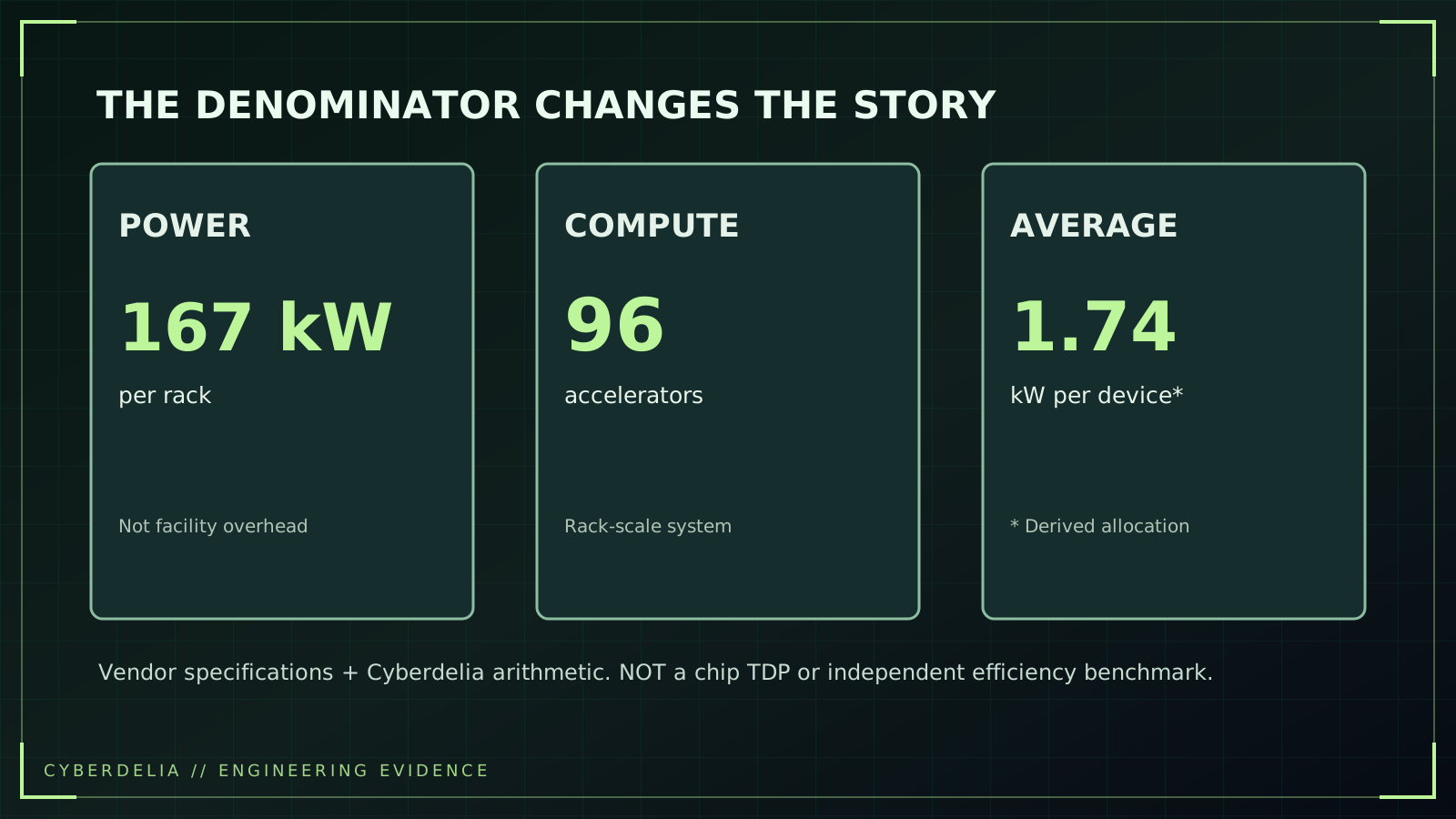
The rack's stated 167-kilowatt envelope is equivalent to about 1.74 kilowatts per accelerator when divided evenly across 96 devices. That is an allocation average, not an accelerator's thermal design power. The rack also contains other electrical consumers, and actual draw depends on utilization and operating conditions. Still, the figure reveals the scale of the engineering challenge more honestly than a heroic photograph of a single chip.
At continuous full stated envelope, one rack would consume 167 kilowatt-hours each hour, or 4,008 kilowatt-hours in a 24-hour day. Thirty days at that sustained level would amount to 120,240 kilowatt-hours. Those calculations assume uninterrupted operation at the envelope and exclude upstream facility overhead, so they are not a prediction of a rack's actual electricity bill. They do establish the order of magnitude operators must plan around.
Electrical infrastructure has to deliver that energy without turning the building's distribution system into the limiting factor. Cooling has to remove the heat, not merely accept the nameplate load. A design that increases token output per megawatt can reduce power required for a fixed job, but operators may choose to use the resulting capacity to serve more work rather than consume less electricity overall. An efficiency improvement is not automatically a reduction in total demand.
This is why the useful denominator is bigger than the accelerator. An operator buying hundreds of racks faces power availability, transformers, switchgear, liquid-cooling plumbing, maintenance windows and workload placement. Server utilization may fluctuate, yet much of that supporting plant is sized for demanding conditions. A product that is efficient only at an idealized operating point may not deliver equivalent improvement across a mixed, production traffic pattern.
The difference matters to municipalities and energy planners too. A forecast of multi-gigawatt deployments is a statement about an extraordinary amount of infrastructure, not merely a silicon purchasing plan. If future racks meet their intended efficiency, that would change how much computing fits within a given supply. It would not eliminate questions about where capacity is built, who pays for interconnection upgrades, or what remains available during grid stress.
A more honest efficiency comparison
Microsoft projects that Maia 300 will deliver about 40 percent more tokens per megawatt than a relevant competing system. Another company-facing summary describes up to seven times the rack-scale token throughput of Maia 200. Both are vendor claims tied to comparative configurations and future deployment. They are newsworthy, but they are not independent reproduced measurements. The accompanying definitions and benchmark conditions determine whether they are useful to a purchaser.
Consider a simple normalized comparison. If a baseline system produced 100 units of output per megawatt under identical tests, a 40-percent increase would produce 140. For a fixed 100-unit workload, the improved system would require roughly 0.714 of the baseline power, an idealized saving of about 28.6 percent. That is a mathematical consequence of the ratio, not a measurement of Maia 300. The test must hold service quality and the measurement boundary constant.
Now change the problem. If faster hardware encourages ten times as many requests, total power consumption can rise even while every request becomes cheaper. If latency deteriorates under concurrency, raw token totals can increase while customers see worse service. If the comparison excludes network or cooling energy that another platform includes, the ratio may flatter one design. None of these objections proves the performance claim false. They describe the evidence required to evaluate it.
One subtle consequence of multi-step agents is that completed tasks, not generated tokens, may be the better business measure. An agent that calls a tool, retries after an error, scans large documents and asks another model to check its work might emit far more tokens than a concise agent that finishes correctly. A useful operator dashboard would track successfully completed tasks, median and tail latency, total joules, human escalation and error rates alongside traditional model-serving counters.
There is an additional architectural question about openness. Microsoft says Maia will run multiple model families, including its own and external models. Supporting several model families can reduce some application constraints, but the degree of portability depends on compilers, kernels, runtime integration, networking requirements and the economics of moving a trained workload. Hardware choice and meaningful software choice are related, not automatically equivalent.
Custom silicon does not make the cloud disappear
Building first-party accelerators can change the bargaining position between a hyperscaler and merchant chip suppliers. It can also concentrate more engineering responsibility inside the cloud provider. Drivers, frameworks, fleet scheduling, spare parts and silicon validation become its own obligations. A custom chip succeeds commercially when the whole fleet reliably delivers useful work at favorable total cost, not when its die looks elegant under magnification.
The alternative argument deserves respect. General-purpose accelerator ecosystems benefit from mature tools, broad developer experience, and the ability to support a variety of workloads as software changes. Specialization can produce an advantage for a known workload while sacrificing flexibility if inference methods evolve faster than hardware refresh cycles. Microsoft is betting that its ability to observe large internal services makes those tradeoffs manageable. That remains to be tested at Maia 300's future deployment scale.
Data center economics also resist simple headline arithmetic. Capital expenditure is incurred before a rack earns its keep. Energy charges vary by location and contract. Cooling design, hardware life, utilization, component failure, staffing and network topology all contribute to cost per useful task. No single reported rack specification lets us calculate the actual cost of an answered question. Any such number would need observed service data and a declared accounting model.
There is nevertheless an important shift in the engineering narrative. For years the flagship question was how fast one accelerator could perform a benchmark. The more serious question now is how much reliable inference a whole power-constrained installation can deliver. It elevates memory locality, network fabric, energy conversion and thermal engineering to the same level as arithmetic density. The power plant has moved inside the definition of the computer.
What would validate the promise
A robust verification program should first reproduce a published model-serving workload at rack scale. It should identify model weights, precision settings, input and output length distributions, batch sizes, concurrency, scheduling software and all applicable performance limits. Then it should measure output quality, failed requests, sustained throughput, p50 and p99 latency, wall power and the energy needed to keep the system at operating temperature.
The second test would deliberately leave the ideal case. Run variable traffic, multi-turn conversations, long context, intermittent tool calls and recovery after component failures. The third test would report lifetime economics: deployment labor, facility adaptations, uptime, hardware replacement and software portability. Microsoft may eventually publish enough production evidence to answer these questions, but an October architecture announcement does not yet close the loop.
For a reader outside Microsoft's data centers, the takeaway is not that everyone needs a custom accelerator. It is that the actual unit of AI infrastructure has grown. A workstation builder should consider memory and power delivery; a laboratory should measure task completion rather than AI theater; a cloud buyer should demand power-normalized results under its own workload. Scale changes the size of the problem. It does not abolish the need to measure.
The 167-kilowatt rack may become an important step in industrializing AI inference. For now, it is an instructive set of engineering claims tied to a future product and an existing deployment program. The interesting part is what happens after the promotional lighting goes out and the meters stay on.
CYBERDELIA ASSESSMENT
Maia 300 is a serious rack-scale inference architecture proposal, but its most striking efficiency and throughput claims remain vendor-reported and future-facing. Independently reproducible task-level energy and latency results will determine whether the advantage survives production.
SOURCE TRAIL
- Microsoft official announcement, October 12, 2026, primary vendor statement.
- Microsoft Azure technical architecture discussion, October 12, 2026, primary vendor explanation.
- Reuters report, October 12, 2026, independent reporting on deployment and market context.
METHOD / REPRODUCIBILITY
Read the vendor announcement and technical architecture alongside independent reporting; separate deployment status from intention. Arithmetic uses 96 accelerators and a 167 kW rack envelope, without asserting any chip-specific TDP or facility overhead. Check ratios only under like-for-like serving conditions. No access to Microsoft production telemetry or hardware for direct benchmark reproduction.
CORRECTIONS & UPDATES
First published October 16, 2026. Performance statements are explicitly attributed to Microsoft and may change as the system ships. Submit corrections through the Corrections Ledger.