

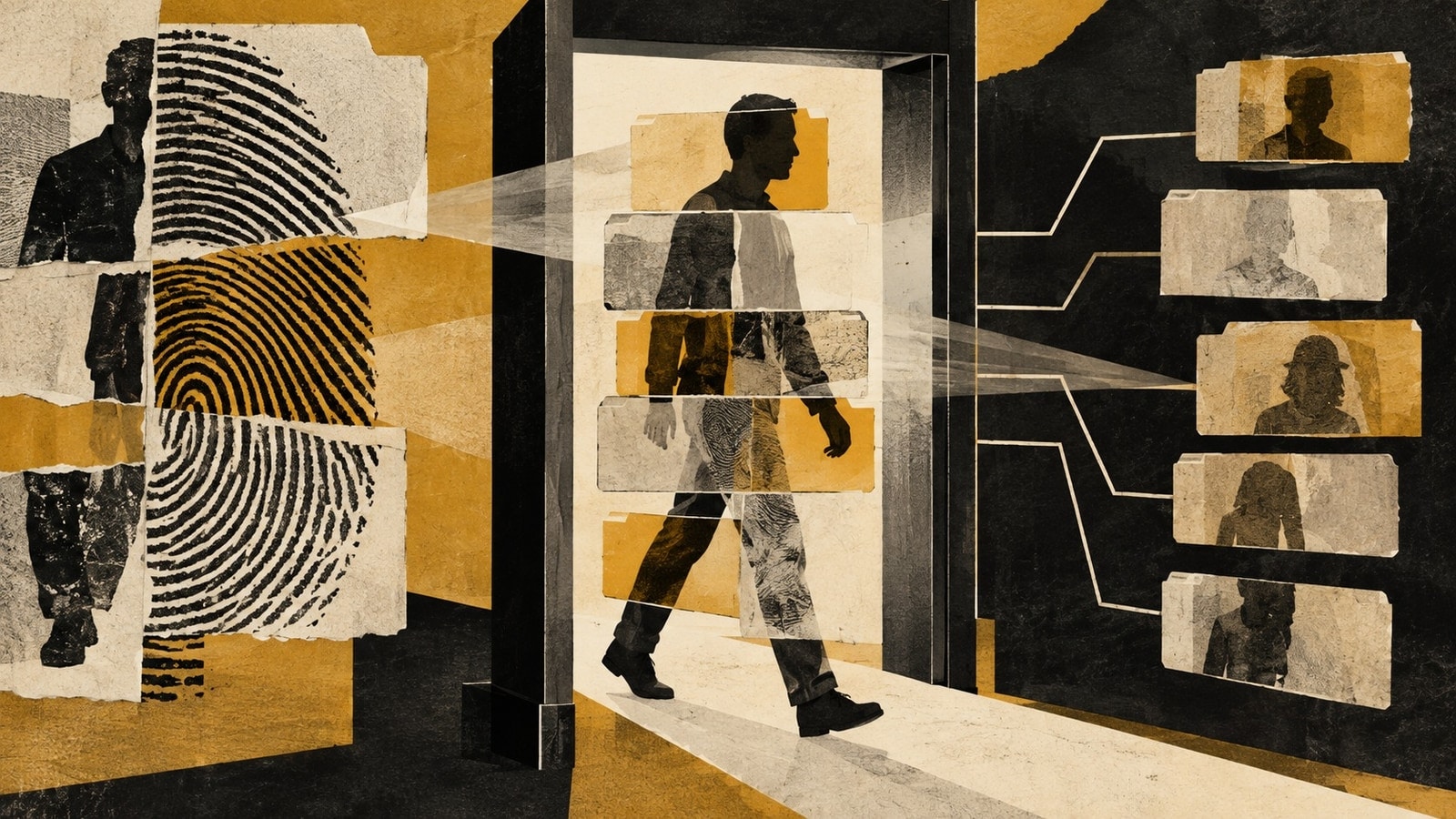
A biometric system does not recognize a whole person. It processes a measurement and returns a result under a set of conditions. The dangerous leap happens afterward, when an institution treats that result as permission to decide everything else: access, suspicion, eligibility, or the credibility of the person standing in front of the machine. The matching algorithm gets the attention. The administrative machinery gets the power.
False Normal makes classification a pressure point, from a security scanner to systems that assign categories to bodies. No real-world scanner possesses the novel's extraordinary perception. What transfers into the present is the question of who gets to turn a partial measurement into an authoritative identity. Cyberdelia's concern is that handoff. A system can produce a technically intelligible output and still support an unjustified institutional conclusion.
Verification and identification are different tasks. Verification compares a presented sample with a claimed identity. Identification searches a collection for possible matches. A successful comparison does not establish why someone is present, what they intend, or whether a separate record attached to the identity is accurate. Those are additional questions requiring additional evidence. When an interface compresses all of them into one green indicator, it makes a policy decision look like a sensory fact.
NIST's face-recognition evaluations document that performance depends on the algorithm, the images, and the task, and that demographic differentials appear across many evaluated systems. Its findings do not justify saying that every face matcher has identical bias or that a particular deployment must fail in a particular way. They establish that accuracy is conditional. A procurement claim about average performance cannot substitute for understanding the actual population and operating environment.
An illustrative access system shows the distinction. A camera produces a similarity score. The organization chooses a threshold. Crossing the threshold triggers an action. Raising or lowering that threshold changes which kinds of mistakes the system permits. The physical camera did not decide the acceptable cost of denying someone entry or admitting the wrong person. People did, often through a configuration screen that never reaches the person affected by it.
The size and purpose of a search also matter. A score meaningful in one comparison does not automatically carry the same meaning when the system searches a large gallery. There are more opportunities for an unrelated record to appear interesting. An operator needs to know whether a result is a candidate for investigation, a verified identity, or an automated decision already executed. Treating those stages as interchangeable is an implementation failure, even if the algorithm is behaving exactly as specified.
NIST's digital authentication guidance places constraints around biometric use, including the relationship between biometric comparison and an authenticator and requirements intended to address presentation attacks. That is a narrower claim than saying a face is a password. A face is observable, difficult to replace, and available in many settings where its owner never intended to authenticate. Binding a biometric check to a controlled credential changes the security model. It still does not turn recognition into a complete account of personhood.
The administrative record can be the weak link. Imagine a matcher correctly connecting someone to their own file while that file contains an obsolete restriction. Improving the camera would not fix the harm. Neither would a second biometric. The system has a record-governance problem: who entered the restriction, how long it remains valid, how it can be challenged, and whether downstream systems preserve the correction. A correct match can deliver a wrong decision with exceptional efficiency.
That is why an appeal route belongs in the engineering diagram. An operator should be able to distinguish a failed capture from a failed comparison, a comparison from a policy denial, and a policy denial from a stale record. The affected person needs an intelligible explanation and a route to a qualified human who can change the relevant state. A help desk that can only restart the device is not an appeal system. It is a reset button with office hours.
Fallback access deserves equal attention. If a person cannot produce a usable sample because of injury, environmental conditions, or ordinary variation, the fallback should preserve the purpose of the check without making them permanently suspect. It must also resist becoming the easiest route for an attacker. This is difficult engineering, but difficulty does not excuse leaving the legitimate user outside. A security design that handles only ideal bodies has outsourced its edge cases to the people least able to resolve them.
Local processing can reduce some exposure, yet it does not settle the authority question. Keeping templates on a device rather than in a cloud database changes who can obtain them and how a breach might spread. The local controller can still apply a bad rule, retain data without a clear purpose, or deny access without explanation. Privacy architecture and decision accountability reinforce each other; neither is a substitute for the other.
A useful deployment review would follow one denied transaction from capture to correction. Every stage should have an owner, a retained explanation proportionate to the stakes, and a way to identify which assumption failed. The review should also examine what happens when the original record is corrected: does the change reach copied lists, cached decisions, and linked services? A person's identity should not fracture into incompatible institutional versions merely because replication was easier than reconciliation.
The scanner can measure a feature. The institution must answer for the consequence. We should judge biometric infrastructure by whether it preserves that distinction under pressure, when the line is growing, the operator is tired, and the machine appears certain. A match is evidence. The rest needs an argument.
A biometric match estimates a relationship between samples. Institutions turn that narrow result into decisions about identity, access and belonging.
Nine technologies behind False Normal
Independent technical essays inspired by manuscript concepts. No plot recap or ending reveals.
- The Implant Outlives the Company. Who Keeps the Body Working?
- A Scanner Finds a Match. The Institution Invents the Rest.
- The Person Watching Your Vitals Should Not Automatically Own Your Day
- When Your Eyes Come With a Ranking System
- A Perfect Hash Can Preserve a Perfect Lie
- The Air Gap Ends Where the File Begins
- An AI's Permission Slip Should Expire
- Two Timestamps Are Not Yet a Sequence of Events
- A Digital Tripwire Tells You Something Touched It. Now What?