

“Send the document to Alex—after I remove the customer names.” The final clause changes the task. A voice system that begins acting midway through the sentence has to distinguish preparing an action from committing it. Faster transcription makes that distinction more important.
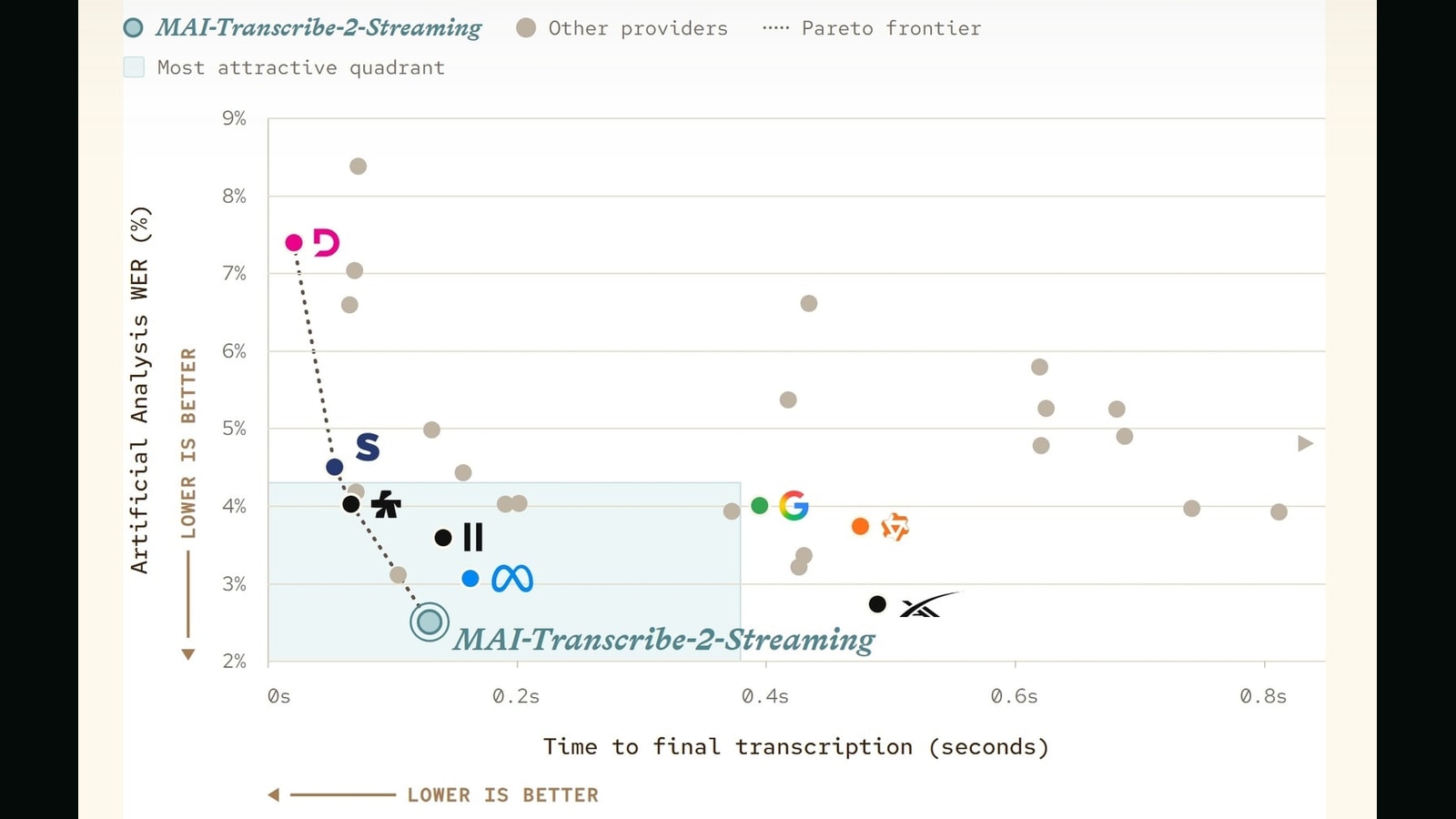
Microsoft's October 1 release of MAI-Transcribe-2-Streaming describes partial transcripts arriving in just over 100 milliseconds of received audio, followed by revisions and a stable result. The company says the model supports 60 languages and leads the cited Artificial Analysis evaluation for partial and final accuracy. It also explicitly presents mid-sentence reasoning and tool calls as uses for partial text. These are release and evaluation claims, not a hands-on test by Cyberdelia.
The engineering opportunity is easy to understand. Waiting through every stage of a spoken exchange makes an assistant feel slow. Earlier text gives an application time to search, prepare a response, or identify which information it will need. Captions and dictation can benefit even when no action is involved. The question changes when an application treats a developing transcript as sufficient authority to change something outside the conversation.
A partial transcript is provisional for two reasons. The recognizer can revise what it heard, and the speaker can revise what they intend. Better recognition reduces the first uncertainty. It cannot eliminate the second. People qualify requests, correct names, introduce exceptions, and change their minds while speaking. Sometimes the information that makes an action permissible arrives at the end.
Our analysis is that the latency budget should be divided between reversible preparation and consequential execution. An assistant might find Alex's address, locate the document, and prepare a redacted copy while listening. Sending that copy is a separate commitment. Saving time in the preparation stage need not require gambling on the unfinished instruction.
This creates a more useful evaluation target than speed alone. How often does the system commit before it has the necessary context? How reliably does it retract an obsolete interpretation? Does interruption stop a pending operation, or only silence the spoken response? A voice interface can appear responsive while its underlying workflow has already crossed a boundary the user expected to control.
The tradeoff is not imaginary. In some settings, waiting for a clear end to every utterance would make the system less useful. A live captioning tool should show developing text. A conversational assistant should be able to prepare likely answers. But applications can make different commitments with the same stream of words. The recognizer's performance does not determine the appropriate policy for every downstream tool.
That policy has to survive ordinary speech. “No,” a corrected name, or an added condition should not become an exceptional failure path that the user must phrase perfectly. A useful system needs to preserve the speaker's ability to finish defining the task. In an operational interface, that is part of listening.
Microsoft's release gives developers more time within a conversation. The durable benefit will come from using that time to prepare well, verify the developing request, and make a timely commitment once the meaning supports it. A fast transcript is an input. The authority to act still belongs to the completed task.
Performance and ranking statements remain attributed. The opening example and commitment-boundary argument are Cyberdelia analysis; no premature action by this model is alleged.