

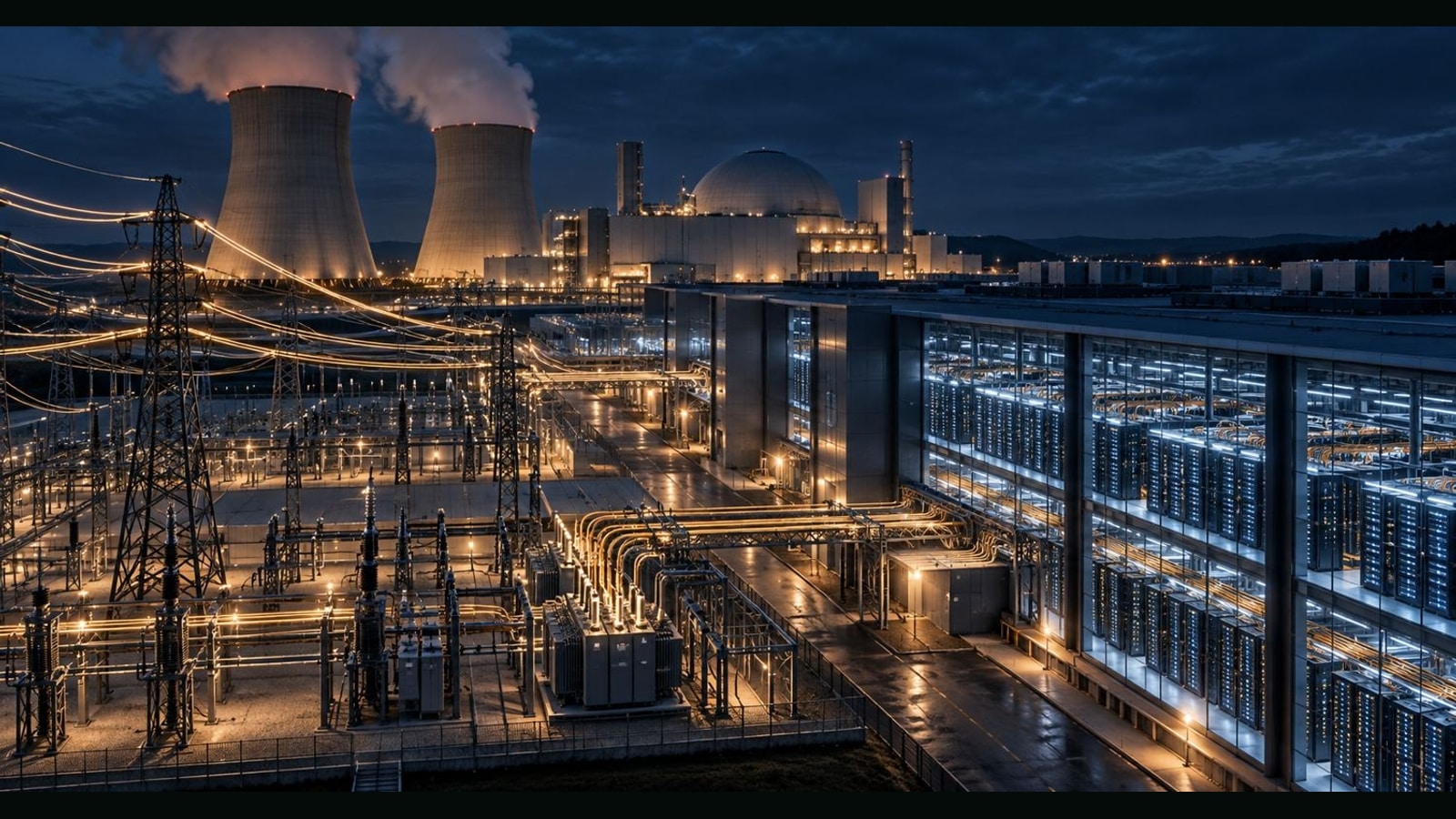
For most of the artificial intelligence boom, the industry talked about compute as though it were primarily a problem of silicon. Whoever could obtain enough GPUs, build the largest clusters, train the largest models and keep enough networking hardware moving between them would own the frontier.
That description is becoming obsolete.
The machines are still hungry for chips, but the facilities surrounding those chips are becoming hungry for something considerably less glamorous and considerably harder to manufacture on demand: electricity.
Google and Constellation Energy announced a long-term agreement this week covering roughly 3,590 megawatts of power, including a 20-year arrangement intended to produce 890 megawatts of additional nuclear capacity through upgrades at 11 existing reactors in Illinois, Pennsylvania and New Jersey. Constellation says the nuclear portion represents more than $4.3 billion in new investment. A separate 15-year arrangement covers another 2,700 megawatts within the PJM electricity market.
That is not somebody installing solar panels behind a server farm.
Three and a half gigawatts is infrastructure measured at the scale of cities.
And that distinction matters, because AI is entering the phase where software companies are beginning to collide directly with the physical limits of the systems underneath them.
Google's agreement is especially revealing because the company is not simply reserving electricity already sitting around waiting for a buyer. The nuclear component is designed to finance upgrades that increase the amount of electricity the plants can produce. Constellation expects the first additional nuclear capacity from those upgrades to arrive in 2028.
In other words, Google is helping create generating capacity because merely purchasing electricity is no longer enough.
That should change how we think about the AI race.
For several years, the industry's hierarchy has been described mostly in terms of models and processors. OpenAI, Google, Anthropic, Meta and others compete over model capability while Nvidia, AMD and specialized accelerator companies compete over the hardware required to run those systems.
Underneath that competition sits another stack that receives much less attention: substations, transmission lines, transformers, turbines, nuclear reactors, natural-gas pipelines, cooling systems and the regulatory machinery required to connect all of it.
AI does not live in a cloud. The cloud is an industrial facility connected to the electrical grid.
The U.S. Energy Information Administration expects American electricity consumption to reach record levels as data-center development and manufacturing expand. Its current outlook shows commercial and industrial demand doing much of the work. The exact annual forecast will move as new facilities arrive or slip, but the direction of the load curve is no longer subtle.
That demand creates an uncomfortable inversion of the traditional technology business.
Software was once attractive partly because it escaped many of the constraints associated with physical industry. Write the program once, distribute another copy at almost no marginal cost, and scale globally without building a steel mill every time another million people showed up.
Frontier AI does not behave that way.
Each expansion requires more accelerators. More accelerators require more buildings. More buildings require more cooling, more networking and more electrical capacity. Eventually the supposedly weightless software company finds itself discussing reactor uprates, transmission congestion and long-term energy contracts with utilities.
The digital economy has rediscovered physics.
PJM, the grid operator covering all or parts of 13 states and the District of Columbia, has already begun adapting to this new class of customer. Its large-load work now explicitly addresses data centers and pathways that pair major new electricity demand with new generating capacity. The language is bureaucratic because grid operators are professionally forbidden from saying "bring your own power plant," but that is increasingly close to the economic reality.
That may become the entrance fee.
And this produces a second consequence that deserves more attention than another round of arguments about which chatbot scored highest on a benchmark.
Electricity can become a competitive moat.
A company capable of signing a 20-year power agreement and helping finance billions of dollars in generation upgrades has options that a small AI laboratory does not. Even if open models continue improving and accelerator hardware becomes more widely available, access to dependable electricity, land, cooling, transmission and capital may increasingly separate organizations capable of training and operating frontier systems from everybody else.
The AI industry could therefore become technically more open while becoming physically more concentrated.
You may eventually be able to download extraordinary models. That does not mean you can economically reproduce the industrial machine that created them.
There is another loop here too.
Constellation's deal with Google does not stop at supplying electricity. The companies also announced an expanded technology partnership in which Google Cloud and Gemini Enterprise will be used to help develop what they describe as an AI for Energy blueprint intended to improve plant operations, dispatch, infrastructure planning and grid reliability.
So AI creates additional electrical demand. That demand finances new energy infrastructure. Then AI is deployed to optimize the infrastructure being expanded partly because of AI.
This is what technological transitions look like once they become large enough to stop being products and start becoming systems.
The same pattern occurred with railroads, automobiles, telecommunications and the early internet. Eventually the technology stopped fitting neatly inside its original industry. Roads changed cities. Telecommunications changed finance. Electricity changed manufacturing. The internet altered nearly everything that could be represented as information.
AI may be approaching that threshold now.
Its most important consequences may soon be found outside model architecture altogether.
Utilities will change how they build generation. Grid operators will change connection rules. States will compete for data centers while residents ask who is paying for transmission upgrades. Nuclear plants once regarded as aging infrastructure may become strategic computing assets. Natural-gas generation, batteries and renewable projects will increasingly be evaluated partly by how quickly they can satisfy industrial computing demand.
And somewhere inside that transition is a political problem nobody gets to solve by throwing more GPUs at it.
Electricity is shared infrastructure.
If enormous private computing facilities consume generation and transmission capacity faster than the system can expand, costs and reliability consequences can spill outward. That is precisely why agreements like Google's matter beyond corporate energy procurement. Google and Constellation structured the nuclear portion around adding capacity rather than simply claiming existing output, and PJM's large-load policies are increasingly framed around preventing new demand from shifting reliability and affordability problems onto existing customers.
Whether those protections work over time will matter more than the announcement language.
Because the question facing the AI industry is changing.
It used to be: Who has the best model?
Then it became: Who has the most compute?
Increasingly it may become: Who can actually power the machines?
That is a much more consequential contest.
Processors can be manufactured. Models can be copied. Algorithms can leak, improve or become obsolete in months.
Power plants, transmission lines and grid interconnections operate on timelines measured in years and decades.
Google's 3.6-gigawatt agreement is therefore less interesting as another corporate bet on nuclear power than as a marker planted in the ground.
The AI industry is beginning to build downward into the physical infrastructure beneath the internet.
And once the companies building intelligence begin financing the machinery that keeps the lights on, the boundary between the technology industry and basic infrastructure starts disappearing.
The next AI breakthrough may still happen inside a neural network.
The next AI bottleneck is increasingly likely to be outside the building.
This is not primarily a nuclear story. It is a systems story: frontier AI is becoming inseparable from generation, transmission, land, cooling and capital. The companies that control those dependencies may control more of the AI frontier than benchmark charts suggest.