

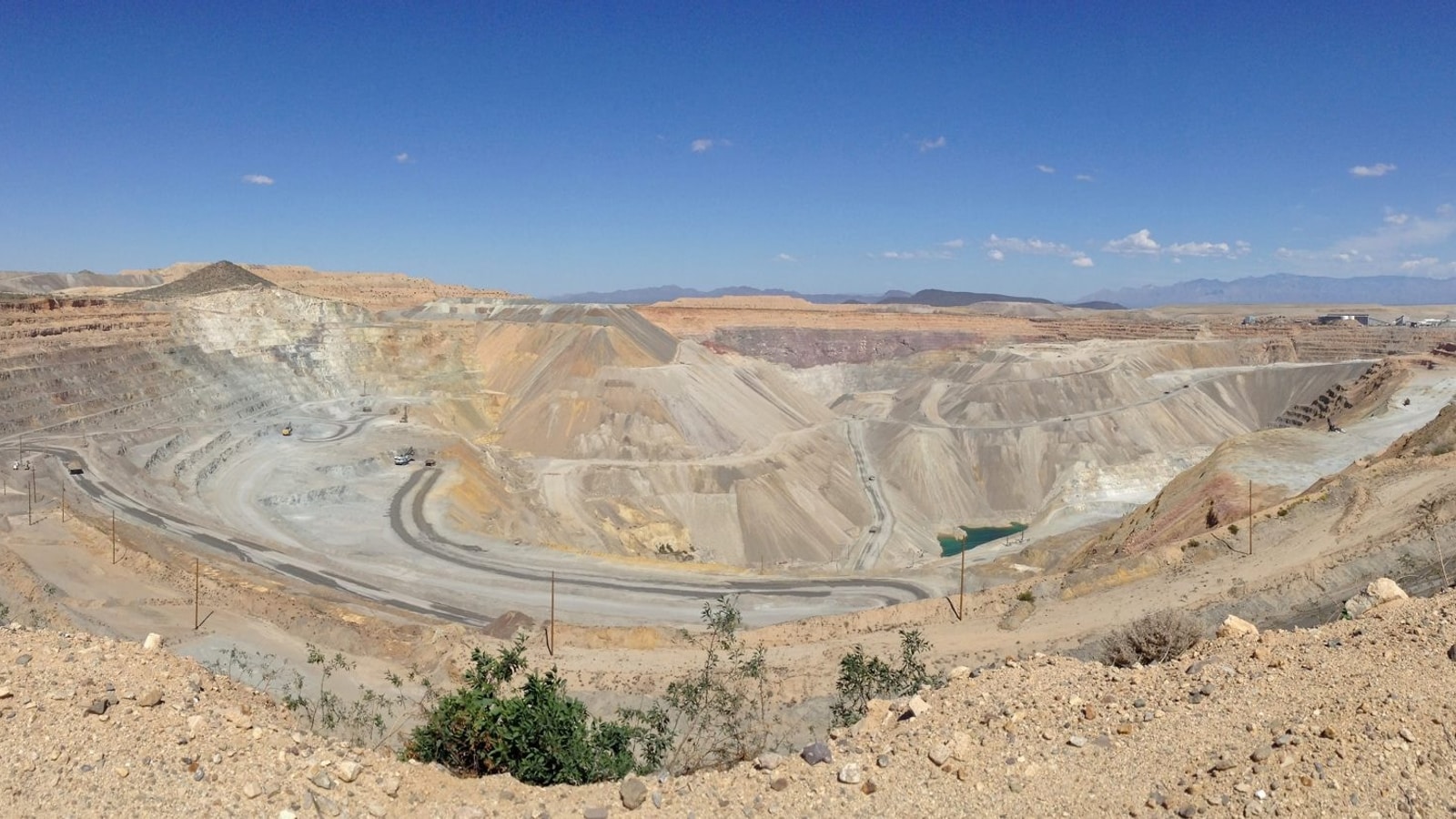
Artificial intelligence looks weightless when viewed from a browser window. The illusion disappears as soon as the model leaves the laptop and enters a hyperscale data center.
A serious AI cluster requires servers, cooling systems, substations, transformers, transmission, backup power, energy storage, networking equipment and industrial construction. Those systems require raw materials. The software stack eventually terminates in geology.
Copper is the first metal to watch.
Copper sits in the electrical path almost everywhere: power generation, transmission, transformers, switchgear, cooling equipment, cabling and the data center itself. The IEA's 2026 critical-minerals outlook says copper demand continues to grow strongly and projects the largest absolute volume increase among the major energy minerals through 2040.
That makes copper a broad infrastructure exposure rather than a pure AI trade. AI simply adds another large source of electricity demand to grids already being expanded for electrification, manufacturing and energy transition projects.
Lithium enters through the battery room.
Lithium is not inside every GPU. It matters because large compute facilities increasingly require storage, backup capability and grid-balancing systems. The IEA reported that global battery demand exceeded 1.5 TWh in 2025 and that stationary battery storage had become a major driver of demand growth. Lithium demand has been rising much faster than conventional base-metal demand.
Albemarle, one of the largest public lithium producers, explicitly links energy-storage demand to data-center electricity growth in its 2025 annual report. That does not make every lithium miner an AI company. It makes stationary storage one of the channels through which AI infrastructure can affect the lithium market.
Rare earths matter because machines still need motors and magnets.
Neodymium-praseodymium and other rare-earth elements feed high-performance permanent magnets used in robotics, advanced electronics, energy systems and defense equipment. MP Materials now operates the Mountain Pass mine and processing site in California and began manufacturing NdFeB permanent magnets at its Fort Worth facility in late 2025.
The strategic problem is concentration. USGS reported in 2026 that the United States remained heavily import-dependent on China for a significant group of critical minerals. The IEA separately warns that the refined supply of several minerals used in advanced computing and power electronics remains geographically concentrated.
TMC is not a conventional mining thesis.
The Metals Company is trying to recover polymetallic nodules from the Clarion-Clipperton Zone of the Pacific. Its U.S.-application areas are estimated by the company to contain measured, indicated and inferred resources totaling roughly 15.5 million tonnes of nickel, 12.8 million tonnes of copper, 2.0 million tonnes of cobalt and 345 million tonnes of manganese.
Those numbers sound enormous because they are enormous. They are also not the same thing as profitable production.
TMC's central variable is permission. NOAA published the company's consolidated exploration and commercial-recovery application in the Federal Register on August 19. Its USA-B exploration application is already in environmental review. TMC says its first commercial collection system, developed with Allseas, is targeted for commissioning in the fourth quarter of 2027, subject to regulatory approvals.
That makes TMC a permit-and-execution thesis before it becomes a mining-production thesis.
NAK is an even purer example of geology versus permission.
Northern Dynasty Minerals controls the Pebble project in southwest Alaska. The deposit contains a vast measured, indicated and inferred copper-gold-polymetallic resource. But the company itself warns that it has not established economically recoverable mineral reserves at Pebble and that the project cannot proceed as presently envisioned without reversing or overcoming federal permitting barriers.
The EPA Final Determination and Army Corps permitting decisions remain the center of the investment story. Litigation challenging those actions is active. The metal may be in the ground; whether shareholders ever receive value from mining it is a different question.
This distinction is useful far beyond NAK. A mining stock can represent geology, processing, construction, financing, commodity prices, permitting, politics and dilution all at once. Investors who evaluate only the ore body are analyzing half a company.
Gold belongs in the stack, but not in the headline.
Gold is used in high-reliability electronics because it conducts well and resists corrosion. But AI is not likely to become the dominant driver of global gold demand. Gold's role in electronics is strategically useful but economically smaller than its jewelry, investment and reserve functions.
The more interesting AI connection appears in polymetallic deposits where gold accompanies copper, silver, molybdenum or other useful materials. Pebble is one example. The deposit does not need AI demand to make its gold valuable; AI infrastructure simply increases the strategic relevance of the copper and electrical-material side of the system.
The investment hierarchy is not the periodic table.
Different materials sit at different layers of the AI infrastructure chain:
Copper is the broad electrical-network material.
Lithium is primarily an energy-storage input.
Rare earths matter through permanent magnets, motors and strategic electronics.
Nickel, cobalt and manganese matter through selected battery chemistries and alloy systems.
Gold and silver matter in specialized electronics and also carry large non-AI demand bases.
Gallium and silicon sit closer to power electronics and semiconductor systems.
The key analytical mistake is assuming demand for AI translates equally into demand for every material on that list.
The bottleneck may be time, not tonnage.
Mines take years to permit and build. Refineries and separation plants can be equally difficult. Data centers can move from announcement to operation much faster than a new mining district can move from discovery to commercial output.
That mismatch creates the real thesis: if compute, grids and storage expand faster than new mineral supply, the strategic value of existing production, permitted projects and credible near-term capacity rises.
The AI infrastructure trade is moving outward from chips into power, grids, storage and raw materials. The strongest mineral exposures will not necessarily be the companies with the largest resource slides. They will be the companies that can convert geology into permitted, financed, processed and sellable material before the infrastructure cycle outruns them.
What would break the thesis?
AI infrastructure spending could slow. Compute efficiency could improve faster than capacity expands. Battery chemistry could shift away from certain metals. Recycling and substitution could reduce primary demand. New supply could arrive faster than expected. And projects such as Pebble or deep-seabed mining could remain blocked indefinitely.
Those are not footnotes. They are the experiment.