

A conventional musical instrument begins with something comparatively cooperative. A string vibrates. A drumhead moves. A loudspeaker pushes air.
ArcAttack built instruments whose acoustic output begins with air breaking down under enormous electric fields.
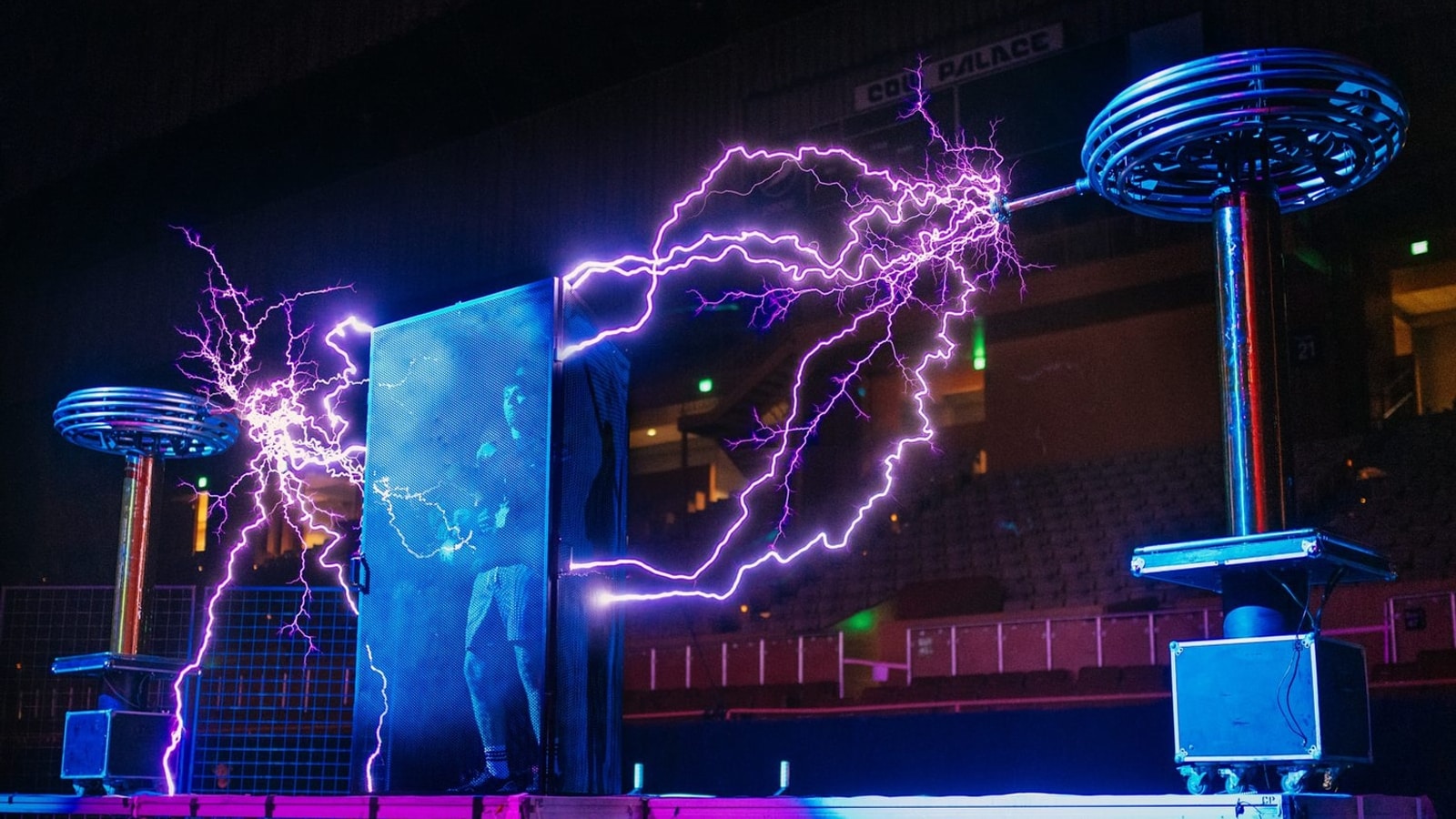
The Austin-based group has been developing and performing with musical Tesla coils since 2005. Onstage, electrical streamers erupt from resonators in time with music, robotic percussion joins conventional instruments, and performers can enter the discharge zone wearing conductive Faraday suits. The spectacle is immediate enough that the engineering underneath it is easy to overlook.
That would be a mistake.
The difficult part of ArcAttack is not merely producing artificial lightning. Tesla-coil builders had been doing that for more than a century. The difficult part is making lightning controllable enough to become an instrument, reliable enough to become production equipment, and safe enough to become theater without making the theater look safe.
That requires resonant power electronics, semiconductor switching, digital control, MIDI, fiber optics, electromagnetic-compatibility engineering, thermal management, robotics, show control, safety systems and an unusually high tolerance for debugging machinery that can throw lightning across a stage.
Humanity could have stopped at the piano. Naturally, it did not.
Before there was ArcAttack, there was a control problem.
Joe DiPrima's account of ArcAttack's beginnings places the crucial development in Austin in 2005. DiPrima had experience repairing consumer electronics, amplifiers and music equipment. He had also encountered early solid-state Tesla-coil work by builders including Steve Ward. Unlike a traditional spark-gap Tesla coil, a solid-state machine offered something immensely valuable to a musician: electronic control.
By the end of 2005, DiPrima had developed an early musical Tesla-coil system. The first version was comparatively primitive, using a transistor-based interface and an inexpensive keyboard. The system was later modified to accept computer-generated control, and in March 2006 an early singing-coil demonstration appeared at Art Outside in Texas.
The underlying insight was simple enough to fit in one sentence: if the electrical discharge can be switched with sufficient precision, the discharge itself can be used to make sound.
Everything after that sentence became the hard part.
What a Tesla coil is actually doing.
A Tesla coil is fundamentally a resonant electrical system. Energy is transferred through a primary circuit into a secondary resonator. The secondary coil, together with the capacitance of the system and its top-load, has a natural resonant frequency. Feed energy into that system at the appropriate timing and voltage can accumulate to extremely high levels.
Eventually the electric field becomes strong enough to ionize the surrounding air. The air stops behaving like an insulator. A streamer forms. Artificial lightning appears.
Modern solid-state Tesla coils replace the crude spark-gap switching of traditional designs with semiconductor electronics. ArcAttack's technical material describes several architectures, including single-resonant SSTCs and the more powerful dual-resonant solid-state Tesla coil, or DRSSTC. In a DRSSTC, a half-bridge or full-bridge drives a tuned primary circuit, allowing large amounts of energy to be transferred during short operating bursts.
That electronic switching is the door through which music enters. Traditional Tesla coils are spectacular but relatively indifferent to requests from MIDI controllers. Solid-state machines can be told what to do.
How lightning produces a musical note.
The sparks are not merely synchronized to music coming from hidden speakers. The discharge itself produces the sound.
When the Tesla coil creates an arc, the ionized channel rapidly heats the surrounding air. That creates a pressure disturbance. Trigger one discharge and the result is a crack, snap or pop. Trigger pressure events repeatedly and regularly enough and the ear perceives a pitch.
An A above middle C is conventionally 440 hertz. A musical-coil controller can therefore command discharge activity corresponding to that repetition rate. It is an almost absurdly literal form of synthesis:
electricity → ionized air → pressure waves → pitch
There is no conventional speaker cone generating the Tesla-coil melody. The visible discharge participates directly in the acoustic event. That is why musical Tesla coils have their distinctive, hard-edged timbre. They are extraordinarily good at creating sharp, pulse-like pressure events. Complaining that the result does not possess the tonal complexity of a cello is technically fair and culturally ridiculous.
MIDI goes into the rack. Lightning comes out.
ArcAttack's professional solid-state systems are designed as MIDI-controlled musical instruments. Their technical documentation describes control from standard MIDI-producing equipment and conversion hardware that allows conventional analog sources such as guitars and synthesizers to influence coil behavior.
This is one of the decisive transitions in the technology. Once the coil accepts a standard musical-control language, it no longer has to exist as an isolated laboratory curiosity. A composer can sequence it. Multiple coils can be coordinated. Conventional instruments can interact with it. Lighting and other stage systems can follow the same musical structure.
ArcAttack even developed software emulation so music could be composed for the Tesla coils without energizing giant high-voltage resonators every time somebody wanted to edit a phrase. That is not merely convenience. It is what happens when an unusual effect becomes part of an ordinary production workflow.
A machine that merely makes an extraordinary sound is an effect. A machine that fits into the rest of the production pipeline becomes an instrument.
The robot drummer belongs to the same architecture.
ArcAttack also incorporated robotic percussion into its performances. The group's drum system uses computer control and electromechanical actuators to strike physical drums in response to musical data.
The important point is not that robots are amusing, although humanity has spent an unreasonable amount of time waiting to give solenoids a rhythm section. The important point is architectural. ArcAttack was building a stage where software, electromechanical machines, high-voltage resonators and human musicians could all participate in one coordinated performance.
That makes the show less like a conventional rock band with an unusual effect and more like a cyber-physical musical system.
Then comes electromagnetic interference.
Building a digitally controlled instrument surrounded by giant electrical discharges introduces a delicious engineering problem. Tesla coils are exceptionally good at producing electromagnetic interference. Computers, digital audio equipment, lighting systems, networking hardware and video systems are exceptionally good at becoming offended by electromagnetic interference.
ArcAttack's own technical documentation discusses failures that can arise around high-power coils: lighting fixtures behaving unpredictably, noise entering audio systems, video equipment exhibiting artifacts and high-current pulses coupling into nearby cables.
The group therefore treats electromagnetic compatibility as part of the instrument.
Fiber-optic control links are particularly important. Control data can be transmitted optically, electrically isolating sensitive equipment from the coil environment and giving radiated interference much less opportunity to hitch a ride through conductive data wiring. ArcAttack also documents deliberate grounding practices, cable routing, ferrite suppression and optoisolation.
Then there is the arc filter. ArcAttack describes an inductive element placed at the breakout point where the visible streamer originates. Its reactance slows the discharge of energy stored in the top-load, moderating extreme current peaks and reducing some of the broadband electromagnetic noise generated when an arc connects to a target.
The group also describes primary-current envelope control. Lowering peak primary current reduces output voltage and stored top-load energy; extending the spark event can preserve useful arc length while reducing some of the violent current peaks responsible for interference.
The casual observer sees lightning. The engineer sees an effort to control how the lightning is allowed to dump its energy because otherwise somebody's production electronics may begin expressing themselves creatively.
The rack behind the lightning.
ArcAttack's current professional systems make another thing clear: these are not simply giant hobby coils dragged onto a stage. Each resonator is supported by dedicated control equipment.
The group's documentation describes a two-unit rack architecture containing a power supply and driver. The power supply uses active power-factor correction to provide a stable DC bus while limiting undesirable load behavior. The driver incorporates digital control and an H-bridge built around IGBTs, semiconductor power switches suited to controlling high voltages and currents rapidly.
ArcAttack uses water cooling in professional control equipment. The benefits are both thermal and mechanical: efficient heat removal permits denser packaging, which matters considerably when the hardware must travel and fit into stage environments.
The racks can remain accessible while the resonators are positioned remotely. That is touring-production logic in its purest form: build the spectacular hardware where the audience needs it and keep the controls where the operators can reach them.
High voltage has to become boring backstage.
There is a paradox inside every successful dangerous-looking stage effect. The audience should feel uncertainty. The operators should feel almost none.
ArcAttack's published procedures include safety operators, emergency-stop controls, explicit system-state communication, physical clearances, fire-retardant materials and attention to ozone and nitrogen dioxide in indoor environments.
That is what serious spectacle looks like behind the curtain. Nothing back there should be exciting. The audience may be watching artificial lightning hammer a human performer. The operator should be watching status, spacing, state and procedure.
The distinction between apparent danger and unmanaged danger is the whole profession.
Patrick “Parsec” Brown and the human target.
By the late 2000s, Patrick “Parsec” Brown had become one of ArcAttack's defining stage presences, serving as frontman and MC and entering the discharge environment in a conductive Faraday suit.
That contribution matters because the suit transforms an abstract electrical demonstration into theater. A Tesla coil throwing an arc into empty air is impressive. A Tesla coil apparently throwing lightning into a person is immediate.
The underlying principle is Faraday shielding: a sufficiently conductive enclosure provides a preferential path around the exterior rather than allowing a dangerous voltage difference to develop through the body. Modern ArcAttack suits are purpose-built systems, not a hardware-store stunt recipe, and the suit itself is only one part of the larger safety architecture.
The visual reads as a person standing inside lightning. The engineering target is a controlled current path, known clearances, known equipment states and operators who have reduced as much uncertainty as practical before the first arc fires.
Lightning plays “Iron Man” for Sharon Osbourne.
ArcAttack reached a wider audience during the fifth season of America's Got Talent in 2010. The group advanced to the semifinals and performed Black Sabbath's “Iron Man” for a judging panel that included Sharon Osbourne.
The celebrity connection is memorable. The engineering pressure is more interesting. ArcAttack later described the television run as a period of rapid development because every appearance was expected to become more elaborate while the machinery still had to satisfy the realities of a major live production.
Experimental equipment normally evolves according to engineering schedules. Television does not care about engineering schedules. The machine has to be better next week, and it still has to work when somebody says “live.”
That is a meaningful milestone: high-voltage hacker hardware had crossed into network television and had to behave like production equipment.
David Blaine changed the problem from spectacle to endurance.
For David Blaine's 2012 Electrified performance in New York, ArcAttack says it built nine solid-state Tesla coils designed to operate continuously through the three-day event, along with the associated truss integration and safety planning.
That changes the engineering target completely. A performance system can cool between songs. An endurance installation has to manage heat, component stress, faults and maintenance over a much longer duty cycle.
Reliability had become part of the art.
Then they built Titan.
In 2015 ArcAttack built Project Titan, which the group describes as the world's largest musical Tesla-coil system. ArcAttack reports Titan at approximately 20 feet tall with discharges exceeding 30 feet.
At that scale, the problems stop increasing politely. Structural loads change. Insulation distances change. Transport becomes its own engineering subsystem. Field geometry changes. Cooling requirements grow. Venue power and clearances become production constraints.
And somewhere inside all of that, the instrument is still expected to receive a musical instruction and respond on cue.
That last requirement is what keeps Titan from being merely an impressive electrical machine. It still has to perform.
The touring show became a technology platform.
ArcAttack now operates beyond the boundaries of a novelty act. The organization designs and installs high-voltage systems for concerts, museums, science centers and public environments, while offering smaller platforms derived from lessons accumulated through professional operation.
The difficult technology generated a show. The demands of the show improved the technology. The improved technology became useful outside the show.
That is a productive engineering loop.
The hidden achievement is repeatability.
A photograph of ArcAttack naturally emphasizes the sparks. That may be the least revealing way to understand what they built.
Generating a large electrical streamer once is a laboratory accomplishment. Generating it again tomorrow is engineering. Making it follow musical control is instrument design. Making several machines follow musical control together is systems engineering. Making them coexist with computers, lighting and audio equipment is electromagnetic-compatibility engineering. Making the system survive transportation is mechanical and production engineering. Allowing a human performer into the discharge environment adds safety engineering and costume fabrication.
Making the audience forget about all of those things and simply experience the spectacle is showmanship.
ArcAttack does not separate those disciplines particularly cleanly. That is probably why the result works.
Quality is what happens where the audience isn't looking.
There is a useful principle buried inside ArcAttack's history. High-quality fabrication is not merely adding more features. Complexity is cheap. Humans can make anything unnecessarily complicated before lunch.
Quality appears when complexity solves actual problems.
Fiber optics solve electrical-isolation and EMI problems. Water cooling solves thermal and packaging problems. Current-envelope shaping addresses discharge behavior and interference. Active power-factor correction stabilizes the power system. Emergency-stop architecture makes high-energy equipment manageable by operators. Standard MIDI makes unusual hardware accessible to ordinary music workflows. Modular rack architecture makes stage equipment serviceable.
None of those features produce the photograph people share afterward.
They make the photograph possible repeatedly.
ArcAttack's museum-installation material explicitly emphasizes that the quality of the interactive experience matters at least as much as merely generating lightning. That is the difference between building an effect and building a system.
Engineering is part of the performance.
Art and engineering are often discussed as though one begins where the other stops. ArcAttack is an unusually clean demonstration of why that distinction breaks down.
The artistic possibilities came directly from technical development:
semiconductor switching → control → modulation → musical pitch → digital sequencing → synchronized systems → repeatable spectacle
Fiber optics make reliable communication possible inside an electrically hostile environment. Better thermal management permits denser hardware. EMI mitigation lets the coils coexist with increasingly complicated stages. Reliability engineering lets experimental machines become touring equipment. Touring then forces still better engineering.
There is no clean point in that chain where somebody finishes the engineering and hands the machine to the artists.
The engineering is the instrument.
ArcAttack's durable technical contribution is not merely that Tesla coils can play notes. It is the professionalization of musical high-voltage systems: digital control, repeatability, electromagnetic compatibility, thermal management, serviceability, show integration and safety engineered tightly enough that the audience can forget the machinery and experience the lightning. The voltage is spectacle. Repeatable control at that voltage is the engineering story.
What the audience sees.
The audience should never have to think about an active PFC supply. They should not care about the IGBT bridge. They should not need to know why the control link uses fiber rather than copper. Nobody bought a ticket to admire cable separation.
They came because enormous bolts of artificial lightning are playing music.
But underneath that apparent madness is a machine designed around control.
ArcAttack did not merely discover that a Tesla coil could be musical. Musical Tesla coils exist within a broader community of builders, and ArcAttack's own history acknowledges the people and earlier work that helped make its first systems possible.
What ArcAttack did was push the concept toward professionalization: instruments that could be composed for, digitally controlled, transported, synchronized, installed, serviced, operated around other production technology and placed before large audiences without stripping away the reason anybody cared in the first place.
The lightning still looks feral.
Behind it is discipline.
Anybody can appreciate a bolt of lightning crossing a dark stage. The interesting question is what had to be engineered so it arrived on beat.