

China has already solved one humanoid problem that much of the world is still discussing in presentation decks: making a lot of them.
Reuters reports Chinese companies accounted for roughly 95% of the approximately 20,000 humanoid robots shipped worldwide in 2025. Government subsidies exceeded $230 million in early 2026, manufacturers are competing aggressively on price and deployment, and state-linked buyers are creating demand.
At the same time, the same reporting describes machines that remain slow, fragile, heavily scripted, and unreliable when asked to leave controlled demonstrations and do ordinary work.
Both things can be true. Industrial scale and machine competence are different variables.
A shipment is not an autonomous labor-hour.
Shipment counts tell us that factories, suppliers, financing, and customers exist. They do not tell us how long a robot can work without intervention, how often it fails, how much teleoperation hides behind the demonstration, or whether the same policy transfers to an unfamiliar task.
A useful robotics scoreboard therefore needs at least two axes:
production scale × autonomous competence
A company can lead one and trail the other. A country can dominate shipments while the machines still require an expensive human support layer.
The interesting possibility is that scale can attack the data bottleneck.
Embodied AI suffers from a resource problem language models did not: there is no pre-existing internet of synchronized robot experience. Physical interaction has to be generated by machines, humans, simulations, sensors, and deployments.
That makes China's manufacturing advantage potentially relevant even before humanoids are commercially impressive.
Ten thousand mediocre robots working in factories, showrooms, logistics environments, labs, and public demonstrations can encounter more edge cases than a few exquisite prototypes. If their data are captured well, normalized, and fed back into model development, deployment becomes part of the training system.
The loop looks like this:
manufacture → deploy → encounter failures → collect experience → retrain → update fleet → manufacture again
That is an inference about the strategic value of deployment, not proof that every Chinese manufacturer has built such a loop successfully.
Subsidies can buy iteration, but they can also buy inventory nobody needs.
Reuters describes a sector where government support and state-linked procurement are helping create demand before clear commercial economics exist. Critics cited in the reporting warn of bubble conditions and likely consolidation.
That does not make subsidies useless. Subsidies can preserve firms long enough to move down learning curves, build suppliers, reduce component cost, and accumulate field data. The same mechanism can also keep weak products alive and fill warehouses with machines whose unit economics never converge.
The difference is measurable. Watch utilization, intervention rate, maintenance burden, repeat purchases, and whether buyers expand deployments after pilots.
The Robot Games expose the distinction beautifully.
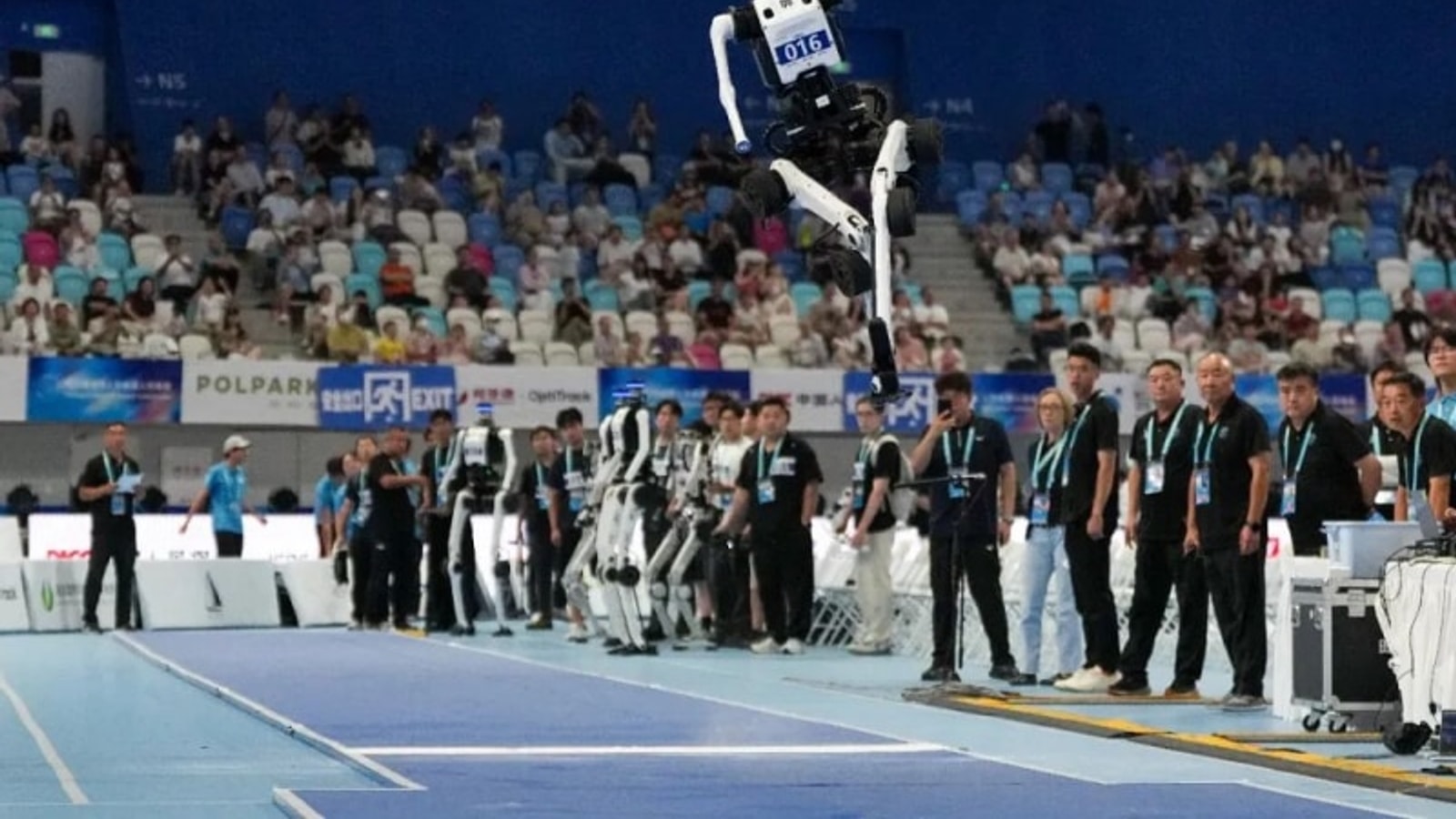
At the 2026 World Humanoid Robot Games in Beijing, Tiangong Ultra ran 100 meters in 8.64 seconds. Other events forced robots into restaurant, office, factory, charging, and manipulation tasks. Reuters noted the contrast directly: the machines can outrun humans in a sprint while still struggling with things as mundane as plugging in a cable.
That is not hypocrisy. Sprinting and generalized manipulation are different control problems.
The Games are useful because they make the capability vector visible. Locomotion may move quickly while dexterity, semantic understanding, recovery, perception under clutter, and long-horizon reliability improve at different rates.
China's real advantage may be the closed industrial loop.
Cyberdelia has argued elsewhere that invention is not industrial power until research, suppliers, factories, deployment, field data, and redesign form a closed loop.
Humanoids make that argument unusually concrete. Motors, reducers, batteries, sensors, hands, controllers, AI accelerators, castings, wiring, and final assembly all benefit from manufacturing scale. Model improvement benefits from deployment. Deployment benefits from cheaper hardware. Cheaper hardware enables more deployment.
The strategic object is therefore not the robot company in isolation. It is the rate at which the whole ecosystem can cycle through hardware and experience.
But there is no guarantee the loop closes.
Physical-world data are noisy, embodiment-specific, and expensive to label. Companies may hoard data in incompatible formats. State procurement may reward delivery counts rather than useful task-hours. Hardware can change faster than datasets remain comparable. Teleoperation can make performance look autonomous when it is not.
Mass production can therefore magnify bad measurement as efficiently as good learning.
The question is not whether China can put humanoids on factory floors. The question is whether those deployments produce transferable competence faster than they produce maintenance tickets.
China's 2025 shipment dominance demonstrates an industrial advantage, not a solved general-robotics problem. The more consequential possibility is that manufacturing scale becomes a data-acquisition engine: more robots create more physical experience, which can improve models, lower intervention, and justify more deployment. If that feedback loop closes, industrial scale may become an AI advantage. If it does not, the sector can still produce a spectacular quantity of expensive interns with actuators.
The metrics that will decide it.
Track autonomous task-hours between interventions, intervention minutes per operating hour, recovery from unexpected states, maintenance hours per hundred operating hours, repeat purchase rates, cost per useful task-hour, cross-task transfer, and how quickly fleet software improvements reduce failure across deployed machines.
Shipment share tells us who built the bodies. Those numbers will tell us whether the bodies are learning.