

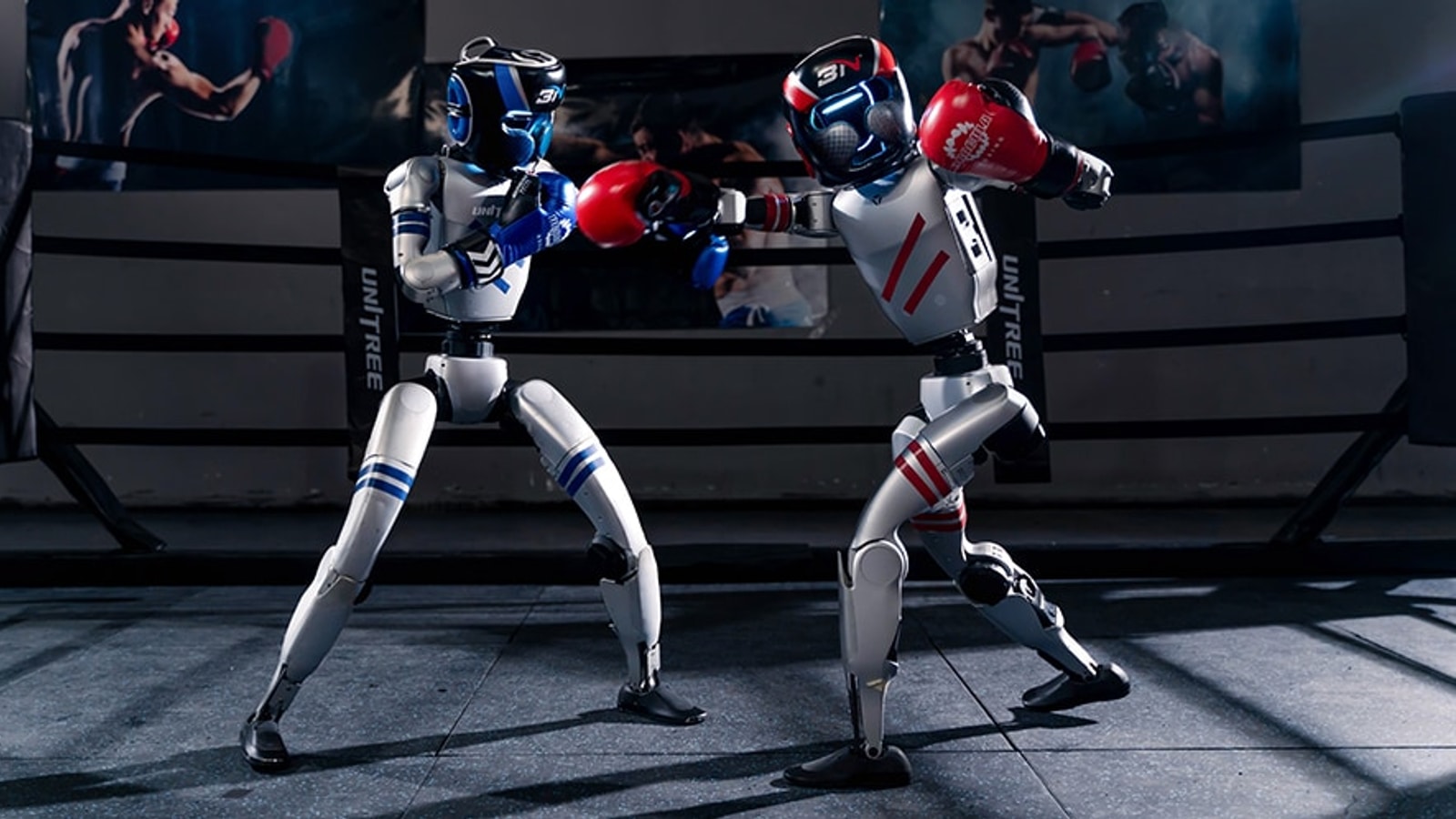
Humanoid robot fighting looks like spectacle because spectacle is what the audience sees. The engineering value is uglier. A fight is a forced audit of the control stack.
A clean laboratory demonstration can hold the environment still. The floor is known. The trajectory is rehearsed. An opponent does not cooperate. It changes distance and timing, interrupts planned sequences, collides at inconvenient angles and creates states the demonstration team did not select. Every exchange asks whether perception, planning, balance, actuation and recovery still agree about what the body is doing.
The useful unit is not the punch.
A punch is visible. The state transition around it is the technical object. The robot begins with some support geometry, joint velocities, available torque, battery state and estimate of the opponent. It commits to offense. That commitment changes what defensive actions remain reachable. Impact adds disturbance. The machine then has to return to a state from which it can perceive and act again.
A system that can generate a dramatic strike but requires a long recovery has purchased offensive output by borrowing against its future action space. Boxing coaches call versions of this reaching, falling in or admiring your work. Controls engineers can describe the same defect in state variables.
Standardized hardware makes the experiment cleaner.
URKL's current rules are unusually interesting because teams use the same T800 robot. Core hardware is fixed; teams differentiate themselves with software for motion control, balance, perception, decision-making and tactics. That moves the contest closer to an experiment in policy quality.
RoboStriker attacks the same problem from research. Its authors report that competitive learning directly in raw motor space can lead to physical collapse. Their hierarchical solution learns physically plausible motions first, then lets strategic self-play operate over a constrained latent action space.
The lesson is not that one architecture has solved robot boxing. It is that strategy cannot be separated from embodiment. A brilliant action that leaves the machine on the floor is not brilliant.
Failure needs a vocabulary.
Was the fall caused by perception error, foot placement, actuator saturation, collision impulse, latency, poor recovery policy or tactical overcommitment? Did performance degrade because of thermal limits or battery voltage? Did impact knock a successful motion outside the expected phase of the gait?
Those questions turn a fight card into a systems log. A serious league should eventually publish enough telemetry to distinguish tactical defeat from hardware fault.
Competition is adversarial testing with incentives.
A competitive opponent searches for weakness too. As opposing policies improve, they probe predictable timing, poor recovery, weak lateral balance and exploitable rules. The benchmark moves because success changes what everyone else prepares to punish.
Humanoid fighting should be treated as an adversarial control-system benchmark disguised as a sport. The scoreboard matters, but the high-value data are the transitions before each score: what the robot perceived, what it committed to, what state the opponent forced it into, and how much usable control remained afterward.