

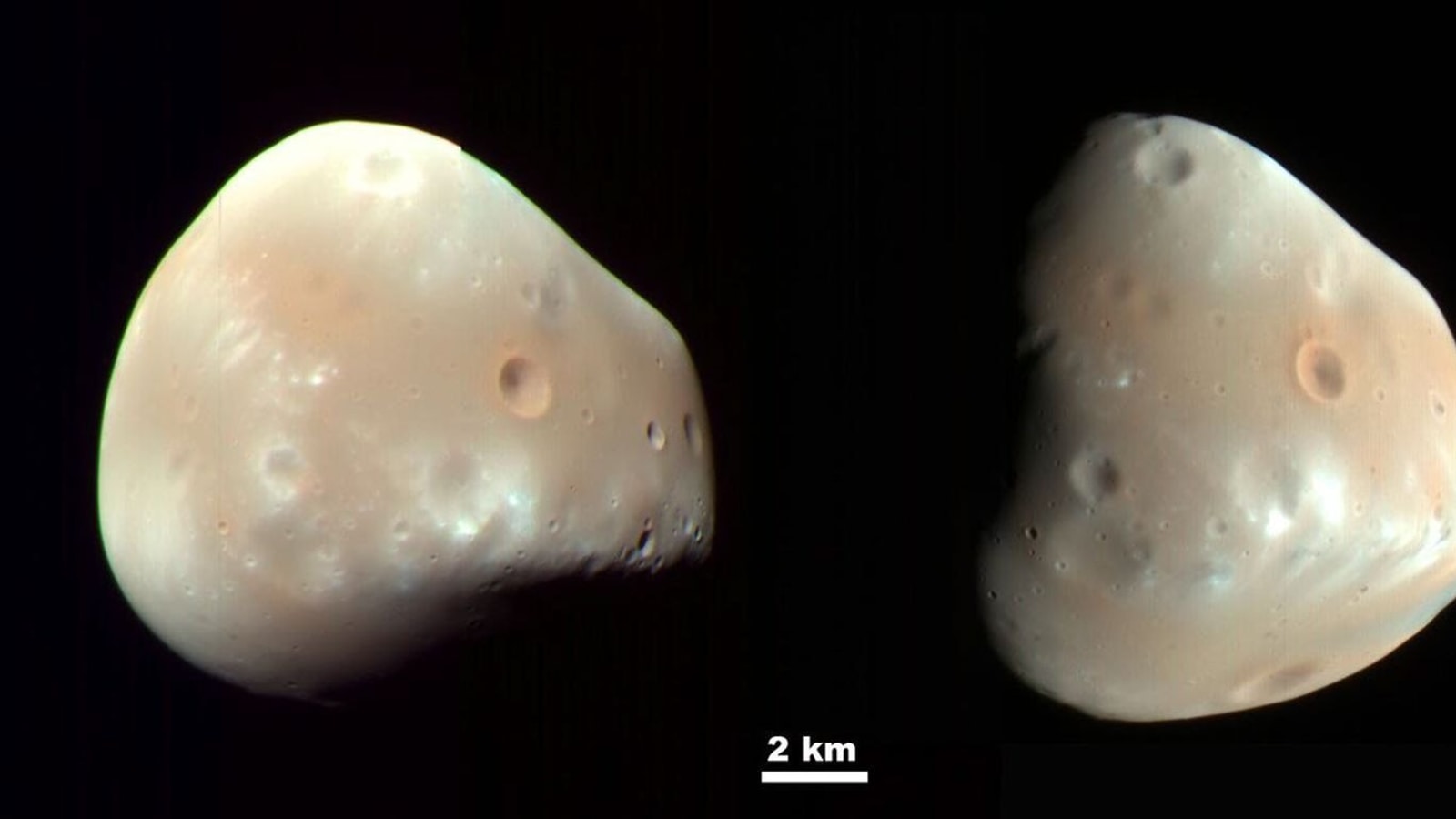
The headline version is easy: an asteroid hit Deimos. The useful version is stranger. The collision appears to have been energetic enough to throw material across much of the moon without tearing the body apart.
One event can explain two observations.
The Bern team varied impactor size, speed, impact angle, and Deimos's internal structure using its smoothed-particle hydrodynamics code. The university says the researchers ran about a hundred simulations, each requiring roughly a week of computation, then compared the outcomes with Hera observations.
The favored case uses an impactor about 320 meters across arriving at roughly 45 degrees. That scenario reproduces the south-polar depression while also lofting enough material to bury older features beneath regolith, locally to depths exceeding 200 meters.
The survival of Deimos is the mechanical clue.
If a small body takes a large collision and survives, its response depends on much more than diameter. Strength, porosity, internal void space, fragment contacts, gravity, and energy dissipation determine whether the impact excavates, deforms, redistributes, or catastrophically disrupts the target.
The Bern comparison points toward weak surface material and a porous interior. In mechanical terms, Deimos may behave less like a scaled-down solid moon and more like a gravitational aggregate whose structure absorbs and redistributes shock.
That matters to planetary defense.
NASA's DART mission and ESA's Hera mission exist partly because changing an asteroid's trajectory requires knowing how a real target responds to impact. A monolithic rock and a porous rubble pile do not convert impact energy into momentum transfer in exactly the same way.
Deimos is not an Earth-threatening asteroid, but the physics overlaps. Every well-constrained natural impact into a weak small body gives researchers another test case for models used in deflection planning.
It matters to landing and sampling too.
A surface mantled in weak, redistributed debris changes assumptions about traction, anchoring, excavation, dust motion, and instrument interaction. A spacecraft touching a compact rock is solving a different mechanical problem from one interacting with a deep, weak regolith over a porous interior.
The study therefore becomes useful because it predicts things a later mission can inspect: regolith thickness, distribution, and mechanical properties.
MMX can try to break the model.
JAXA's Martian Moons eXploration mission provides the next opportunity. The important scientific posture is not “Bern explained Deimos.” It is “Bern published a mechanism with testable consequences.” If MMX observations disagree with those predicted material properties or distributions, the model should lose confidence.
The strongest implication of the new Deimos work is mechanical, not cosmetic. A single sub-catastrophic impact can plausibly explain both the basin and global regolith if Deimos is weak and highly porous. That makes the moon a natural laboratory for rubble-pile collision physics, planetary-defense modeling, and future surface operations.
What remains unresolved.
A good impact reconstruction does not settle origin. The researchers explicitly note that rubble-pile-like physical properties do not prove Deimos is a captured asteroid. Material ejected from Mars could also produce a body with unusual internal structure. Composition and future mission data still matter.