

The scientific payload was four people
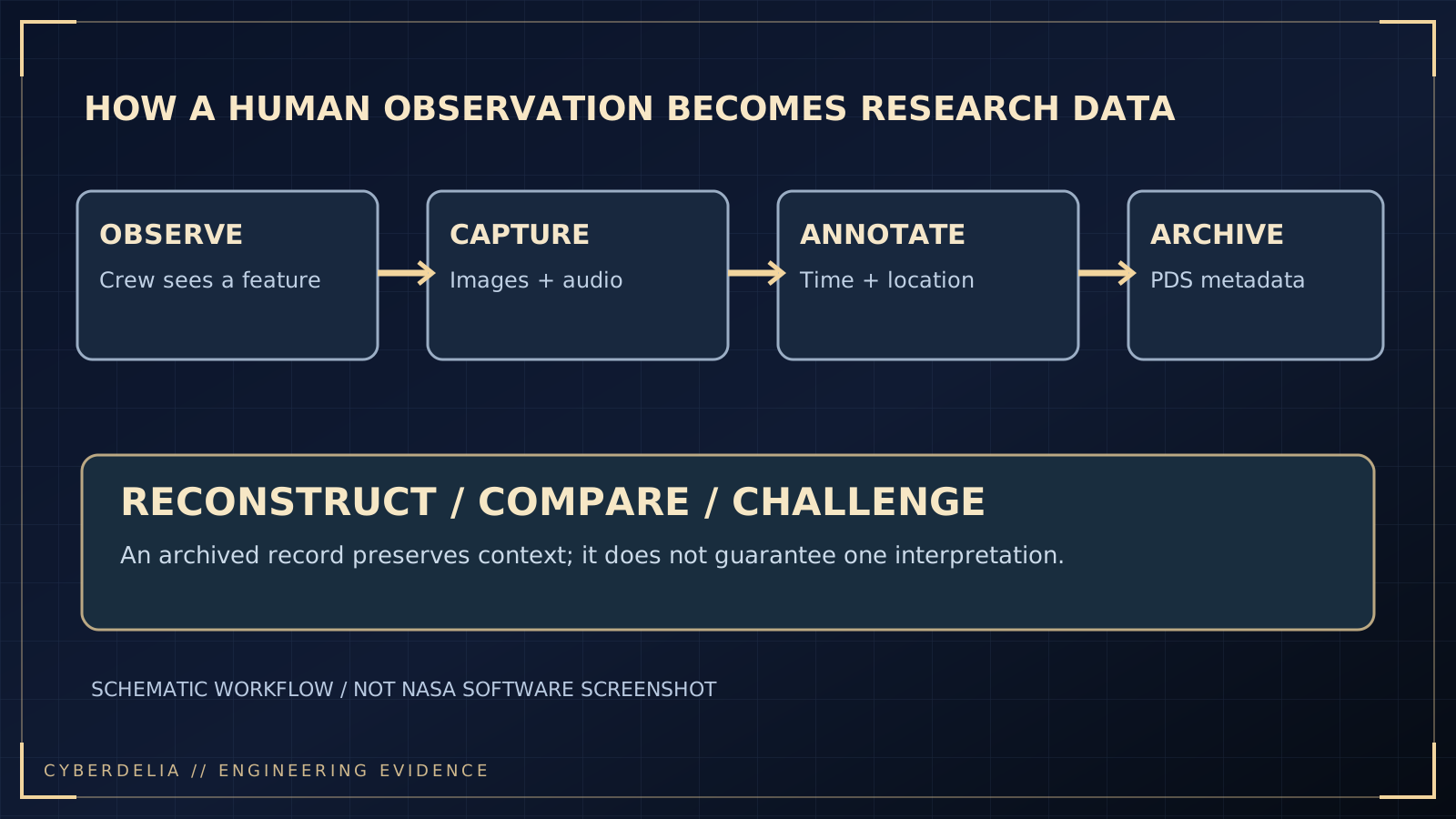
NASA's October 7 release of more than 800 gigabytes of Artemis II lunar data sounds, at first, like a storage announcement. It is not. Behind the volume are more than 11,000 full-resolution images and video files, roughly eight and a half hours of astronaut audio observations, and annotations that explain what the crew saw and why particular features mattered to them. The more interesting question is how those human observations become evidence that someone else can inspect, challenge and use.
The crew flew around the Moon and returned to Earth in April 2026. NASA says the new archive combines handheld photography, spacecraft cameras, spoken descriptions and crew-marked images, accompanied by a preliminary lunar science report, an operations report and a data user guide. The release went into the Planetary Data System, a public repository built for long-term access to mission records. That is a different achievement from simply posting a gallery of beautiful Moon pictures.
Planetary science depends on observations that survive their observers. A spectacular image becomes more useful when its timing, viewing geometry, target identification and acquisition circumstances are recoverable. A recorded impression becomes more useful when another researcher can trace it to an image and a mission phase. Artemis II's dataset offers unusually direct opportunities to examine not just what a camera captured, but how a trained human crew selected and interpreted what to document.
Those choices were not magic and were not improvised without preparation. NASA trained the astronauts in lunar geography and geological observation. Its published lunar targeting plan was designed around expected illumination and viewing geometry during the flyby, while allowing decisions in response to conditions. The distinction matters: the crew was neither a pair of unthinking cameras nor a completely free-ranging expedition. It was a trained observational system guided by a plan and adjusted in real time.
Why the raw record matters
NASA's Planetary Data System lists the Artemis II mission release on October 7 and identifies its camera, mission and audio components. An archive matters because a preliminary interpretation can be revisited when a better question arrives. Researchers can compare different frames, scrutinize time sequences, listen to original observations and revisit assumptions. The mission team's immediate conclusions remain valuable, but a public data release makes them subject to a broader and longer scientific conversation.
The first task for an independent investigator is not to download all 800 gigabytes. It is to understand the catalog. Identify the instrument or camera, distinguish raw from processed files where the metadata allows, locate acquisition times, and read the user guide before comparing images that were taken under different conditions. A file's dramatic appearance is not evidence that two scenes are directly comparable. Lighting and geometry can make unchanged terrain look startlingly different.
A useful quantitative sanity check begins with the reported scale. If we simplify 800 gigabytes to 800,000 megabytes and divide by 11,000 images and videos, the quotient is about 73 megabytes per item. That is not the average file size of the imagery. The 800-gigabyte figure includes more than images, video items vary enormously in size, and the totals are rounded. The calculation demonstrates how little one summary statistic tells us about the composition of a real scientific archive.
A better inventory would separate still-image formats, video files, mission records, audio, transcripts and annotations; then count bytes and records for each class. It would identify which products have relevant calibration and context information. It would also document any missing or amended items rather than silently assuming a complete chronology. The analytical value lies in reproducible selection, not in reaching the largest possible download counter.
NASA's published preliminary report adds a bridge between files and phenomena. It highlights the lunar terminator, where sunlight meets darkness, casting long shadows that expose slopes, rims and relief. The crew examined terrain under illumination that matters for future polar exploration, where low Sun angles can make apparently familiar landscapes visually deceptive. The underlying physics is straightforward: a small change in lighting direction can transform the shadows without altering the rock.
Five pinpricks on the dark Moon
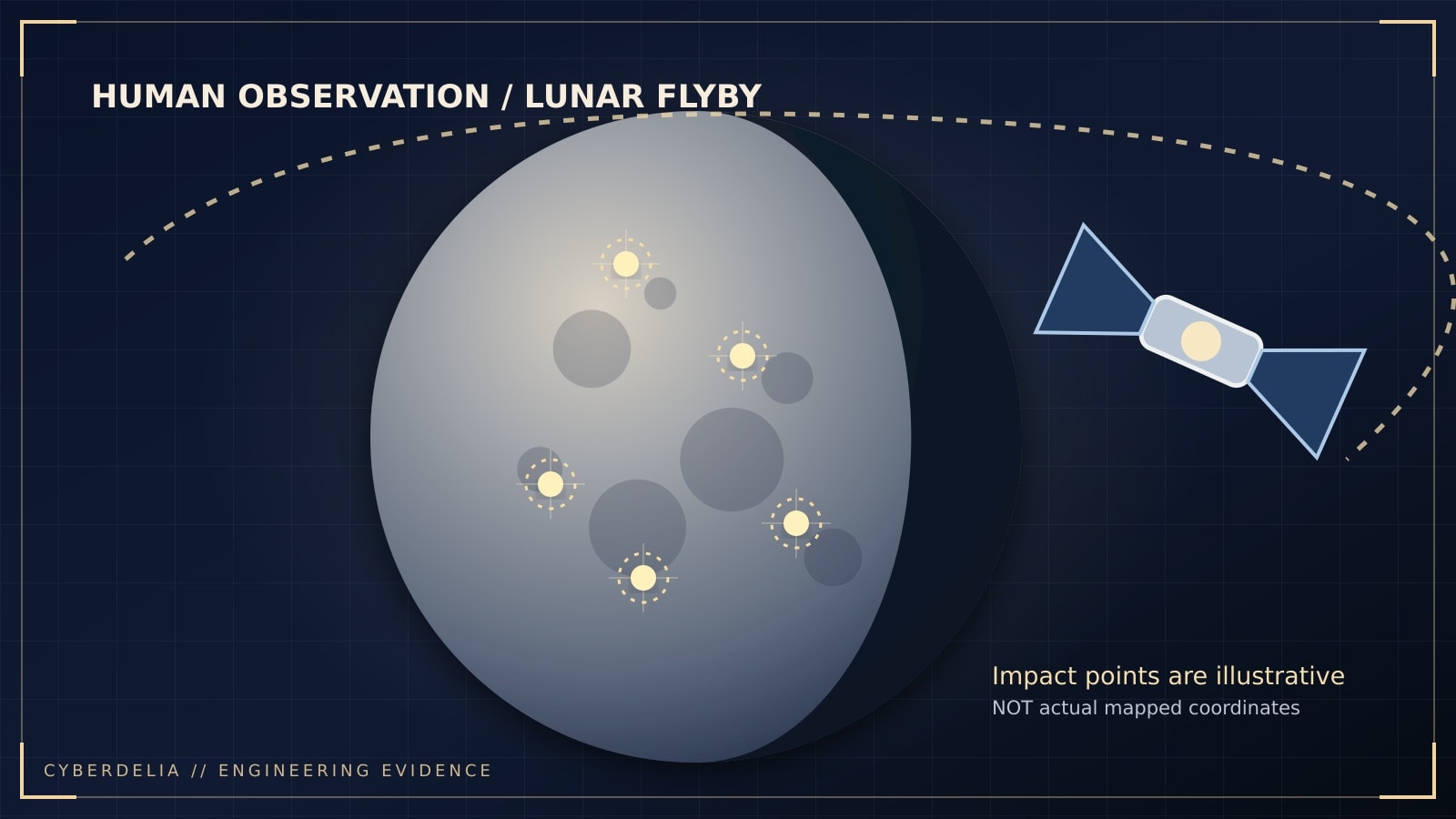
One of the mission's most distinctive reported observations occurred when the crew saw extremely faint impact flashes. NASA's science account describes five pinprick bursts noted from Orion at a distance of about 46,000 miles from the Moon. Astronauts recorded locations on a visualization during the mission. NASA says its science team assessed alternative explanations, including spacecraft reflections and cosmic-ray effects, before confirming the observations as impacts.
There is an important epistemic boundary here. The crew saw transient lights and documented them. The interpretation that they came from meteoroids striking the lunar surface is the science team's conclusion after analysis, supported by the observation record. It would be poor reporting either to dismiss the sightings as mere anecdotes or to claim that every physical property of the impactors is known. Flash brightness alone cannot provide a complete account of mass, speed or crater formation without additional assumptions.
These are difficult events to observe, partly because the signal can be brief and faint. An impact flash is not a glowing meteor streaking through Earth's atmosphere. The Moon's nearly airless environment allows rocky fragments to reach the surface, releasing energy on collision, and a tiny portion of the event may be visible as light. Detection depends on observing geometry, darkness, instrument sensitivity and the location of the collision relative to the observer.
The value of multiple crew witnesses is not that agreement makes error impossible. It is that separate sightings, times and marked locations can narrow competing interpretations. If observers independently identify approximately the same location, that helps an investigator distinguish a physical event from a perception or display artifact. The strongest follow-up would compare the annotated sequence with spacecraft timing, any available imagery and ground-based monitoring that overlapped the event.
NASA-funded citizen-science observers were looking for lunar flashes from Earth during the Artemis II period as well. That parallel effort is a useful demonstration of the scientific network around a human mission. Multiple vantage points can, when timing and visibility cooperate, add constraints on events that a single camera cannot fully characterize. That does not mean every flash recorded by the crew has a matching ground record; the available evidence must be checked case by case.
A camera and a witness are different sensors
A digital camera captures a measurable pattern of light within the limits of its optics, detector, exposure and processing. A human observer can notice a contrast, color impression, pattern or change that prompts a new imaging decision. Human perception, however, is not a calibrated photometer. The observation can be scientifically useful as a lead, a contemporaneous record or a cross-check, but interpretations of color and brightness need to be evaluated against physical images and instrument conditions.
A revealing example is the lunar terminator. To a crew member, an oblique ridge may become conspicuous because its shadow lengthens into an unusual shape. A camera frame records that shape, but the astronaut's spoken report can preserve why it drew attention. The report can guide researchers toward a geological question that might otherwise be overlooked in thousands of files. That is not human superiority over machinery in every circumstance. It is complementarity in observation and target selection.
The planned loss of communication as Orion moved behind the Moon made the process even more interesting. Crew members continued their science activities while out of ordinary contact with Earth, then brought those records back into the mission's analysis stream. The method has a useful parallel in autonomous exploration: an observer operating with delayed feedback needs enough training, context and discretion to collect valuable evidence without waiting for every instruction.
Robotic spacecraft already do extraordinary planetary science. Cameras and instruments can observe at wavelengths humans cannot see, repeat measurements for years, and survive missions no person could endure. Humans bring contextual interpretation, rapid selection and a different class of qualitative testimony. The false argument would be to declare one category obsolete. A better mission architecture asks which work benefits from each, and how the resulting evidence is reconciled.
The archive is a laboratory, not a victory lap
The preliminary science report and its companions are explicitly early analyses and operational documentation. Future research may refine the interpretation of particular observations. Some images will prove less useful than hoped. Some will be valuable only when compared with orbital datasets from other missions. The release's real advantage is that future teams can return to the evidence without relying solely on a press conference, a promotional film or one scientific summary.
Independent study should begin with a defined question. Suppose a researcher wanted to examine an illuminated crater rim. The workflow would locate frames with known view geometry, reconcile camera timestamps, inspect exposure changes, identify the relevant surface feature and compare against prior orbital mapping. Conclusions would carry uncertainty associated with resolution, image processing and the viewing angle. Without that method, visual resemblance can be a particularly seductive liar.
For transient impacts, the pipeline differs. Investigators would seek precise sighting times, witness annotations, spacecraft orientation and the geometry of the observed lunar region. They would compare the visible and dark portions of the surface, screen plausible instrumental artifacts, and look for independent records. A measured positional uncertainty should survive into any mapped impact location. The visually satisfying act of placing a dot on a Moon map is not a substitute for uncertainty propagation.
The other essential question is preservation. Scientific archives outlive the hardware and software used to create them only when file formats, metadata, documentation and stable identifiers remain usable. Releasing files is the beginning of stewardship, not its end. The Data User Guide is therefore as important to future research as an eye-catching image. A file nobody can interpret is merely a collection of expensive bits.
The October release also changes the public relationship with the mission. Anyone with appropriate tools and patience can examine selected evidence directly rather than accepting a neat illustration as the entire story. Access is not the same as expertise, and a publicly downloadable file does not make every speculative interpretation credible. But inspectability makes genuine independent work possible, which is more valuable than a thousand arguments over whether a photograph feels real.
What would change our assessment
Cyberdelia's assessment will strengthen when published analyses connect specific claims to exact archived products, acquisition geometry and independent comparison. It would weaken if key files lack the provenance needed for a proposed reconstruction or if apparently striking observations cannot be distinguished from imaging artifacts. The five reported impact flashes should be judged against the full evidence trail, not treated as either unassailable miracles or presumptive illusions.
There is no reason to exaggerate the case. NASA did not return an 800-gigabyte verdict on every unresolved problem in lunar geology. It returned a body of raw and interpreted observations that other people can interrogate. The archive captures a rare conjunction: a human crew, a constrained observation window, detailed cameras and the judgment calls that connected them. Its scientific value will emerge in the work it enables, not in the promotional size of the download.
The Moon has not changed because we published its pictures. What changed is the number of people who can now examine a moment when four humans looked outward, made choices, and left their working notes behind. That is what makes a mission record durable: the beautiful scene remains, but the evidence can still argue back.
CYBERDELIA ASSESSMENT
The decisive achievement is the preservation of a testable human observation record with images, audio, annotations and documentary context. Quantity alone is not proof of scientific discovery; provenance and reproducible analysis will determine the archive's long-term importance.
SOURCE TRAIL
- NASA Artemis blog, October 7, 2026, primary dataset announcement.
- NASA Artemis II Preliminary Lunar Science Report, science interpretation and links to formal reports.
- NASA Planetary Data System release registry, independent archive-listing confirmation within NASA's data system.
- NASA Lunar Targeting Plan, observation-planning background.
- NASA citizen-science impact flash program, contextual independent observation effort.
METHOD / REPRODUCIBILITY
Compare NASA's October release notice, the PDS release registry, the preliminary science account and targeting-plan documentation. Separate crew sighting, science-team interpretation and potential later physical reconstruction. Data inventory and the illustrative file-size quotient use rounded headline totals; this feature does not claim a completed independent reanalysis of the 800 GB dataset.
CORRECTIONS & UPDATES
First published October 16, 2026. Subsequent analyses may refine reported impact-flash interpretation or archive composition. Corrections can be submitted via the Corrections Ledger.