
“Who owns the data?” sounds like one question.
In a networked service, it is at least five.
title → access → licensed use → sharing → retention → legal process
Flock's current terms make that decomposition unusually visible.
The customer owns Customer Data.
Section 4.1 of Flock's Aug. 21 Terms and Conditions says that, as between Flock and the customer, all right, title, and interest in Customer Data belong to and are retained by the customer.
Flock's plain-English data-ownership guide says Customer Data includes images, audio, video, customer-entered content, and certain third-party data provided at the customer's direction.
That is the ownership layer.
Ownership does not mean nobody else has rights.
The same contract grants Flock a limited, non-exclusive, royalty-free, irrevocable, perpetual worldwide license to use and disclose Customer Data to provide Flock services and to use Customer Data to support and improve its products and services.
Flock's explanation says the license exists so the service can process, store, surface, and improve from customer data. It says those two purposes are the ceiling and that the data may not be used for unrelated marketing or sale.
The important analytical point is not whether this structure is normal for software vendors. It is that title and licensed use are separate rights.
Sale is a third question.
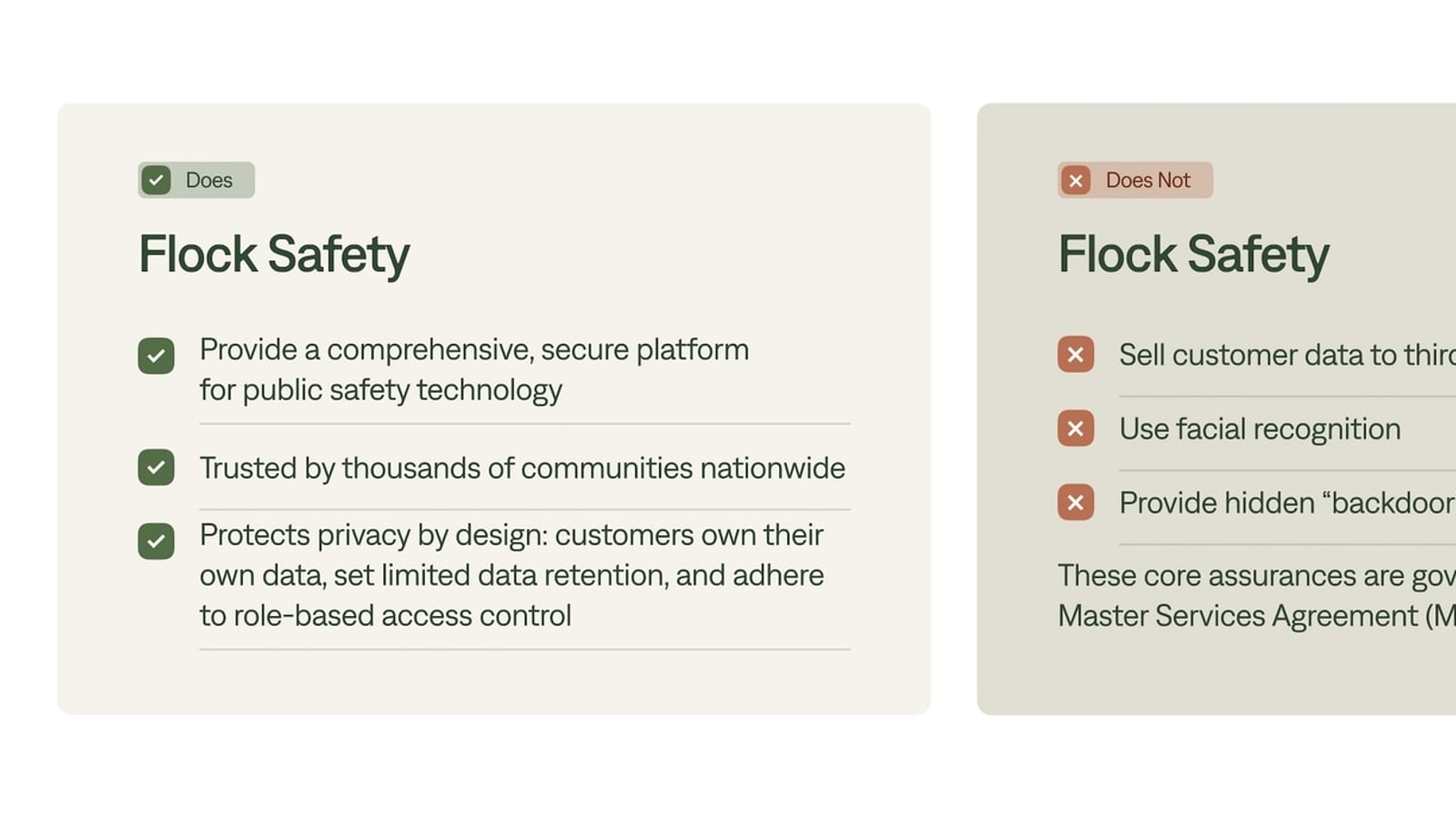
The current terms explicitly say Flock shall not sell Customer Data and characterize unauthorized sharing outside the agreement or separate customer authorization as a breach.
So “Flock owns the data” and “Flock sells the data” are claims that should be tested against the actual contract, not repeated because they fit somebody's prior position.
Sharing belongs to the customer control plane.
Flock says customers decide who can access, search, and share their data and can revoke access. In practice, the surveillance reach of one city's cameras therefore depends on the city's sharing configuration and agreements as much as on physical camera placement.
A locally owned dataset can still participate in a very broad network if the owner authorizes broad access.
Ownership does not tell you the effective border.
Retention comes from another document.
The terms say authorized users can access Customer Data during the applicable Retention Period, which is defined by the Order Form. Flock's Evidence Policy says LPR data are permanently deleted and irretrievable after the customer's retention period expires.
Flock has separately announced a seven-day recommended default. Those facts can coexist because a recommended product default is not the same thing as the retention term in every existing customer agreement.
Legal process adds another actor.
Flock's Evidence Policy says it considers the customer the proper recipient of subpoenas, warrants, court orders, and similar legal process seeking customer data; the company says it redirects requests to customers and only discloses when required by law.
That policy is relevant because a service provider may possess or process data without being the entity the company believes should make the disclosure decision.
Ask the six questions separately.
For any ALPR deployment, residents should ask: Who owns the records? Who can access them? What license does the vendor have? Who can share them? When are they deleted? Who responds when legal process arrives?
If a public meeting answers only the first question, it has not answered the data-governance question.
This article describes Flock's current published contract and policies. Individual customers may have older, negotiated, state-specific, product-specific, or order-form terms that differ. The signed agreement controls.