
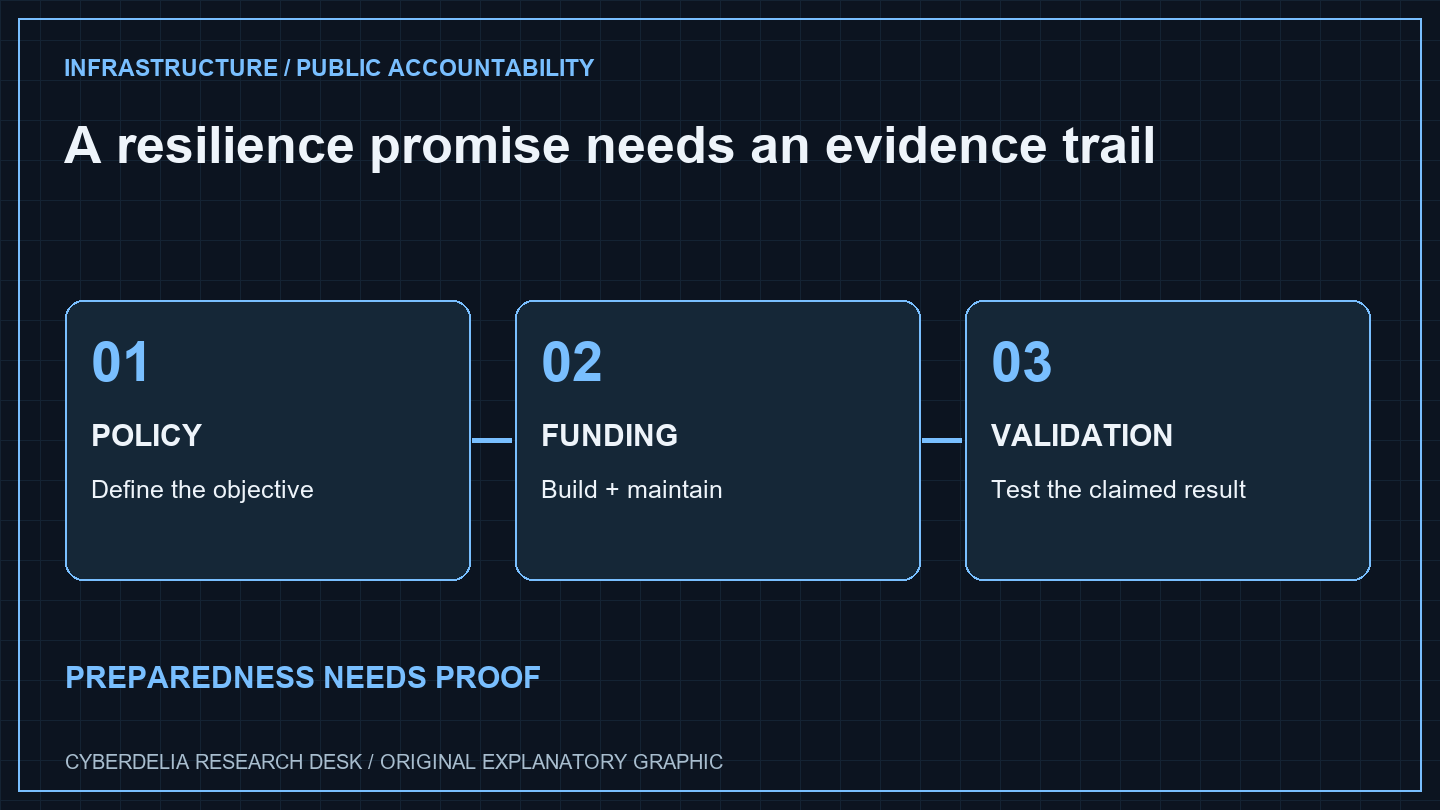
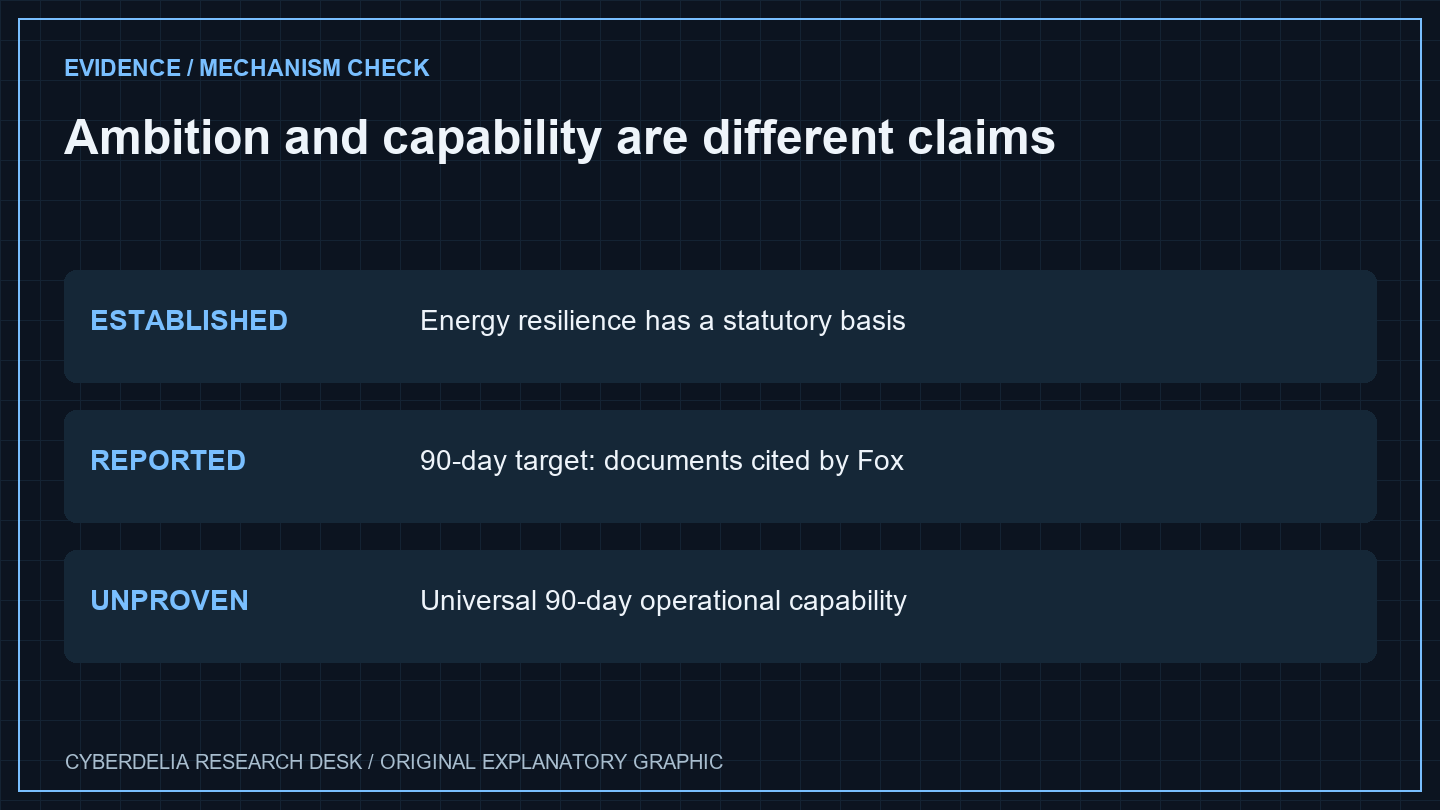
The most revealing thing about the Pentagon's latest preparedness initiative is not what it supposedly predicts. It is what the military admits it still needs. A program called FORTRESS America aims to make major American military installations less dependent on outside electricity, water, fuel, communications and supply chains. An October 25 report from Fox News, based on documents its journalists said they reviewed, described a target of sustaining essential operations independently for at least 90 days. The War Zone reported the following day that the precise 90-day requirement had not been explicitly confirmed in the public statements it examined. The initiative is real; the specific three-month benchmark is reported, not proof of a completed or universally implemented capability.
The more consequential question is practical. Why did a country that can project military force around the planet leave major defense installations dependent on power lines, municipal utilities, fuel deliveries and transportation networks that could fail locally or be deliberately attacked? The answer is less cinematic than conspiracy, and more consequential. We have been working on the problem for years. We have not solved it.
The warning was already on the books
Energy security was not discovered in September 2026. Under 10 U.S.C. § 2920, enacted in 2021 and subsequently amended, the Department of Defense must plan for energy resilience at military installations. The law explicitly favors diverse energy supplies, generation originating on installations, microgrids and working power sources rather than mere emergency generators. It requires officials to identify critical missions, the energy those missions need, likely interruption durations, dependencies and alternative supply options. It also calls for black-start exercises: controlled tests in which outside energy is disconnected and the installation must demonstrate that its backup systems can actually support critical functions.
This distinction is essential. Keeping a runway's essential operations powered is not the same as sustaining every home, shop and recreational facility on a base. The statute defines critical missions separately from military housing and several nonessential facilities. A claim that bases can sustain essential operations independently must never be inflated into a claim that their entire populations can live normally for three months without outside help. The Air Force had already warned in a 2021 energy strategy that outages could last 30 days or longer in extreme circumstances. A 2020 U.S. Army account of resilience exercises already described unclear critical loads, communications and buildings not consistently connected to backup power, and generator failures associated with maintenance or insufficient loading. Some bases have built or pursued microgrids, which can disconnect from the wider grid and keep selected functions operating. These efforts predate FORTRESS America and span different administrations.
The public record therefore undercuts the claim that a secret catastrophe must be imminent simply because a resilience program was announced. We did not suddenly learn that the power can fail. We have documented that possibility, tested for it and repeatedly found weaknesses.
The diesel problem
Ordinary backup power sounds reassuring until the arithmetic begins. Generators need fuel, maintenance, functioning controls and an electrical system configured to carry the right loads. If a blackout lasts days, a tank may suffice. If it lasts weeks, fuel deliveries become part of the emergency. If the road network, pipelines, pumping equipment or commercial supply chains have failed, a contractual promise of delivery is not a physical fuel supply. The Defense Department has acknowledged this in unusually plain technical language. A long-duration energy storage solicitation describes the existing 14-day critical-load target and observes that depending heavily on diesel generators creates unacceptable mission risk at many installations. The government document says commercial fuel supplies may not arrive during extended outages despite contractual guarantees. The vulnerability is not speculative. It is embedded in the design problem the department has asked researchers and contractors to solve.
Ninety days is not merely a longer version of a two-week outage. Long-duration independence changes the architecture of a base: how electricity is generated, how energy is stored, how cooling and water pumping function, how fuel is replenished, what parts are stockpiled, how communications are sustained, and whether the systems can be repaired without relying on the same disrupted civilian networks. Every claimed layer of independence is another opportunity to discover a dependency nobody modeled. A base may be electrically self-sufficient but unable to run its water treatment plant. It may have fuel stored but lack access to replacement components for a failed control system. It may maintain its critical missions yet rely on external workers who cannot reach the installation. True resilience is not possession of a generator. It is proof that the whole chain holds together when the surrounding system does not.
Why didn't we do it sooner?
There is no single documented answer, and reducing years of policy and procurement history to one villain would reproduce the same bad reasoning unsupported speculation invites. The evidence points to several overlapping obstacles. First is scope. The military's installations differ dramatically in geography, climate, electrical load, available fuel, mission criticality and existing infrastructure. A solution that makes sense for one base may be costly, impractical or inadequate at another. An Air & Space Forces Magazine report on October 20 quoted a senior defense official saying planners were still trying to determine the cost and needs of roughly 500 continental U.S. bases, and that full implementation of FORTRESS America could take decades. This is not the same as saying no work has been done. It is recognition that the gap between a policy requirement and hundreds of integrated physical systems is enormous.
Second is the procurement and budgeting cycle. Power projects are construction projects, not software patches. They require site assessments, engineering, permits or approvals, utility coordination, specialized equipment, contracts and commissioning. Even a correctly designed microgrid can take years to finance and build, while demands for immediate operational readiness compete against projects whose value is mostly demonstrated by a disaster that does not occur. Third is fragmented responsibility. A military installation can have separately managed facilities, utilities, information systems, logistics contracts and mission owners. Each may meet its own requirements while the integrated system remains fragile. This is why black-start exercises matter. A paper plan that assumes every component will cooperate during an outage is not equivalent to a test showing they do.
Fourth is incomplete planning and funding. The Government Accountability Office reported in February 2026 that some installations could not pursue desired resilience improvements during disaster recovery because they lacked necessary data or sufficient money. The office also found gaps in how natural-disaster costs were tracked and how resilience information appeared in installation planning. That report examined natural-disaster recovery, not FORTRESS America directly, but its findings offer a documented window into the practical machinery through which installation resilience gets delayed. Fifth is that the risks evolve. A grid built around peacetime cost and convenience can face extreme weather, cyber intrusion, physical sabotage and cascading failures. Threat actors can target civilian facilities that support military operations without directly attacking a hardened base. Recent Defense Department officials have cited exactly this interdependence when explaining FORTRESS America. Plans made around a local outage do not automatically protect against a sustained regional disruption.
There is a difference between having known the danger and having prioritized eliminating it. For years, backup generators and partial continuity plans offered enough apparent protection to sustain the status quo. FORTRESS America raises the declared ambition. Whether it raises actual performance depends on funding, independent testing, transparent milestones and functioning systems, not the size of the announcement.
The more important civilian question
If major military installations need their own electricity and water arrangements to withstand a disruption, what does that say about the towns around them? Hospitals, water districts, data centers, food distribution warehouses, local emergency services and households often depend on the same commercial grids and transportation networks. A military installation can harden itself while the surrounding community remains vulnerable, or it can coordinate investments that improve resilience for both. Both outcomes are possible. The current reporting does not establish which will prevail. The question is not whether the civilian United States could literally survive without the Pentagon. It is whether civilian infrastructure would remain functional through the sort of cascading event military planners now say they must be able to outlast. The answer differs by region and system, and should be measured rather than guessed. But there is a compelling public-policy question in the contrast: what would a 90-day resilience standard mean for a municipal water system or a regional hospital network, and who would pay for it?
There are legitimate concerns about pouring public money into military independence while utilities and emergency services outside the fence depend on short-lived backup plans. There are equally serious reasons to preserve military readiness during a crisis. These are questions about budgets, accountability, coordination and public benefit. They deserve real data, not a forced choice between blind trust and conspiratorial certainty.
Skepticism with standards
A good conspiracy investigator would not accept the Pentagon's explanations simply because an official offered them. They would ask for the program memo, implementation schedules, appropriations, procurement records, completed resilience assessments and results of black-start testing that can be released without compromising security. They would look for vendors with unusual influence, projects priced beyond reason, and metrics that flatter planners without demonstrating operational capability. But an investigator also does not get to replace those documents with a prophecy. A screenshot of soldiers hauling supplies is not a record of a secret timetable. A plan for responding to an attack is not evidence that planners intend to stage one. A date confidently posted in a comment thread is not improved by the fact that forty people repeat it. A serious accusation requires a mechanism, corroboration and evidence that could actually distinguish it from ordinary preparedness.
Question authority. Question the contractors. Question the money. Question whether the promised resilience survives the first genuine outage. Those are not naive questions. They are the questions naive conspiracies avoid, because answering them would require trading the thrill of certainty for the burden of evidence. The Pentagon did not discover that civilian infrastructure can fail in 2026. It is announcing a more ambitious attempt to stop that failure from disabling its missions. The biggest unanswered question is not what disaster has been secretly scheduled. It is why a vulnerability documented for years remains so difficult to eliminate, and why the nation seems less willing to ask for the same resilience beyond the military fence.
The real scandal, if one emerges from the evidence, will not be that government planners prepared for an emergency. It will be that they knew the dependencies, understood the consequences, and still took too long to make the systems work. That investigation begins with a question far more demanding than 'What aren't they telling us?' Why haven't we done it sooner?
Source trail
- U.S. Army, Cutting the Cord to Test Energy Resilience (2020)
- 10 U.S.C. 2920, energy resilience and security
- Air & Space Forces Magazine, October 20, program scope
- The War Zone, October 26, reported target and caveats
- Fox News, October 25, original 90-day reporting
- GAO-26-107786, disaster recovery and resilience planning
- DoD long-duration energy storage solicitation
Corrections and updates
Published November 13, 2026. Send specific corrections and supporting evidence through our corrections page. Material revisions will be recorded here.