
The nuclear fuel cycle begins considerably farther from a reactor than most people imagine.
It begins beneath the ground, in geological formations containing uranium, where industrial machinery extracts the raw material upon which an extraordinarily complicated energy infrastructure depends.
On November 20, 2026, that infrastructure encountered a distinctly modern problem in Wyoming.
Someone compromised part of its digital operating environment.
Peninsula Energy has confirmed a cybersecurity incident at its Lance Uranium Project. In a November 25 announcement to the Australian Securities Exchange, the company disclosed that its American subsidiary, Strata Energy, identified a cybersecurity incident affecting plant and wellfield operating and control systems.
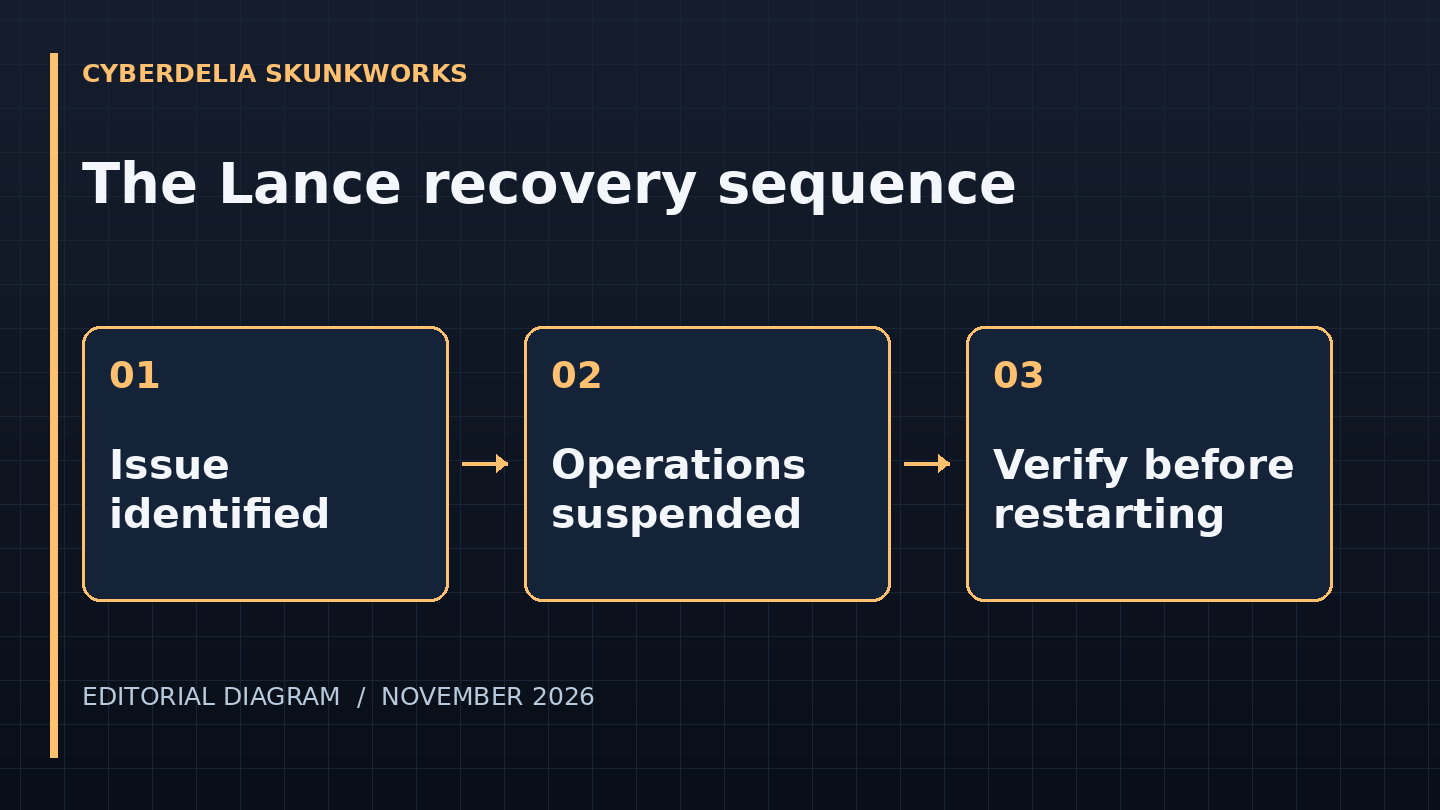
The company suspended operations and isolated affected systems. It said operations would remain suspended until a recovery and verification program established that the affected systems could safely return to service.
The disclosure establishes an important distinction from countless conventional corporate cybersecurity incidents: the affected environment supported industrial operations rather than merely administrative computing.
There is no verified evidence that the incident caused a radiological release, endangered the surrounding community or compromised an operating nuclear reactor. Lance is a uranium production facility, not a nuclear power station.
But the intrusion raises questions that extend well beyond Wyoming.
As governments pursue energy independence, nuclear expansion and diversified supplies of strategic materials, are they adequately protecting the industrial infrastructure that makes those ambitions possible?
Before the reactor
Public discussions of nuclear security tend to concentrate on reactors, radioactive waste, weapons proliferation and the protection of highly sensitive facilities.
Those subjects deserve their prominence.
But a nuclear reactor is the final consumer in a much larger industrial system.
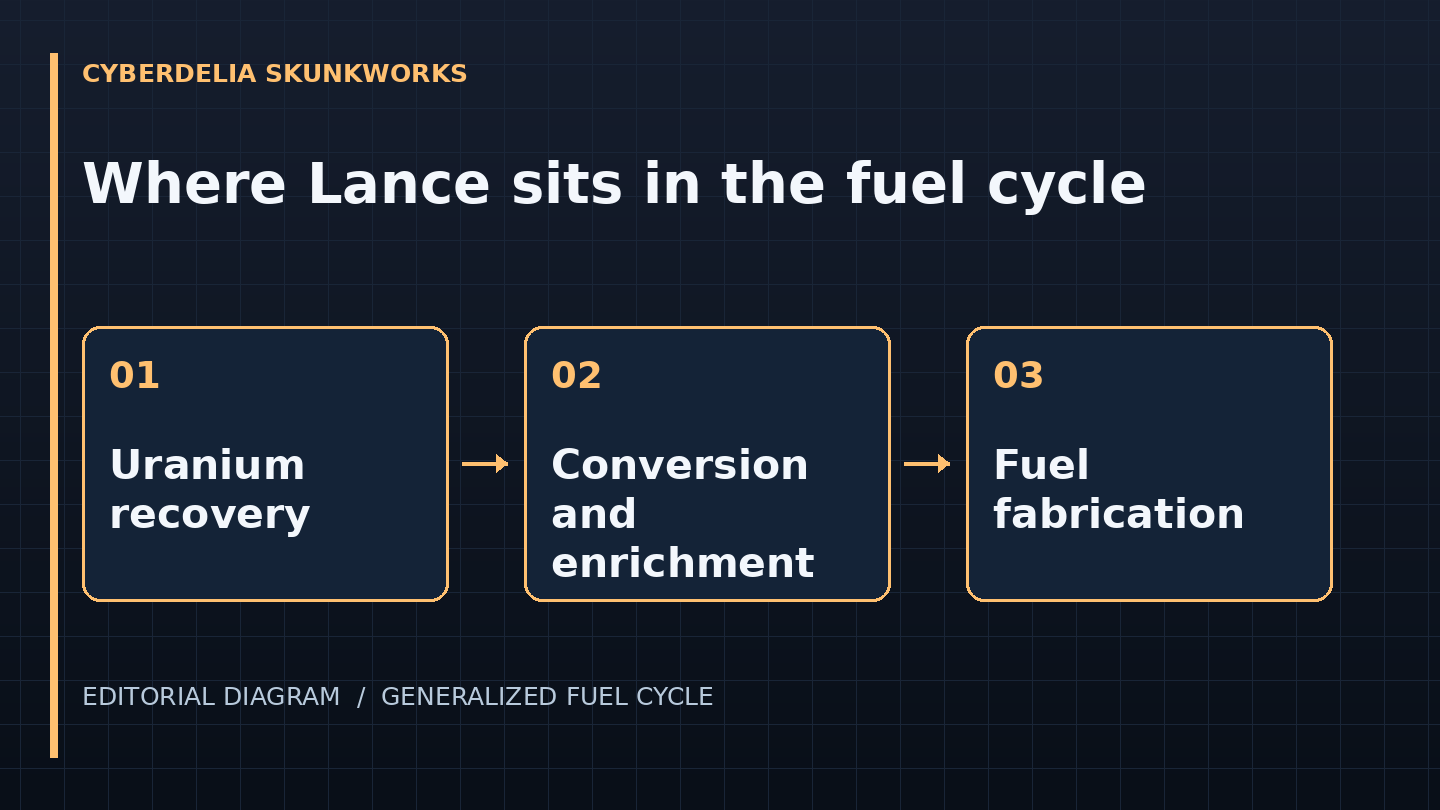
Natural uranium must be recovered from geological deposits and processed into a suitable chemical form. Material destined for conventional commercial light-water reactors generally undergoes conversion, enrichment and fabrication before it becomes usable nuclear fuel.
Every stage involves specialized infrastructure.
Every stage also involves information.
Industrial equipment requires monitoring. Operators must manage inventories, chemical processes, maintenance schedules, quality assurance, transportation and regulatory compliance.
The resulting digital environments are fundamentally different from ordinary commercial computing systems.
An accounting application's failure may delay financial records. The failure of industrial monitoring equipment can interfere with an operator's ability to establish whether a physical process remains within acceptable parameters.
This difference makes cybersecurity an engineering concern rather than merely an information-management concern.
The Lance incident illustrates why that distinction matters.
The Wyoming intrusion
Peninsula Energy's November 25 announcement provides a clearer account of the incident than initial reports.
The company identifies November 20 as the date its subsidiary discovered the cybersecurity problem. Affected infrastructure included systems associated with the production plant and wellfield, and operations were suspended as a precaution.
Earlier reporting by The Northern Miner described statements from company leadership indicating that administrative computing environments were unaffected.
The company had already faced operational challenges involving production well performance before the cybersecurity incident occurred.
Accordingly, existing difficulties and their financial consequences must not automatically be attributed to the intrusion.
The cybersecurity event introduces another source of operational uncertainty into an already complicated production environment.
The publicly available evidence does not establish the identity of the attacker, the precise mechanism of intrusion or the complete extent of damage.
Nor does it establish a relationship between the Wyoming incident and other cybersecurity events recently affecting American intelligence agencies, international shipping or government departments.
Simultaneous incidents do not constitute proof of a coordinated campaign.
What the company has established is sufficiently significant without speculation: a cybersecurity incident affected industrial operating systems at an American uranium project and prompted a suspension of operations.
Extracting uranium with chemistry and computation
The Lance project uses in-situ recovery, an extraction method that differs substantially from conventional underground and open-pit mining.
Rather than excavating large quantities of uranium-bearing rock, in-situ recovery uses a circulating solution to dissolve uranium from suitable underground geological formations. Production wells recover the solution, which is then processed at surface facilities.
The process depends upon carefully managed physical and chemical conditions.
Operators must monitor fluid movement, production characteristics, equipment performance and environmental conditions.
Computing systems assist with the observation and management of these processes.
That does not mean every industrial function is completely automated, nor does it mean the cybersecurity incident necessarily interfered with every production activity.
The detailed control architecture of Lance has not been publicly established in the reporting examined for this article.
Nevertheless, the characteristics of in-situ recovery demonstrate why industrial cybersecurity cannot be reduced to familiar concerns about stolen files.
The information flowing through a production facility describes physical reality.
Its measurements inform decisions about machinery, chemical processes and regulatory compliance.
The reliability of that information matters even when its contents have little conventional intelligence value.
A compromised measurement system can be consequential without revealing a single commercial secret.
The difference between stopping and breaking
The temporary suspension of operations deserves careful interpretation.
An industrial facility may cease production because equipment has been physically damaged. It may also cease production because management cannot yet establish that continued operation is sufficiently safe or reliable.
These are different circumstances.
A precautionary shutdown can represent the successful operation of an incident-response plan rather than evidence of catastrophic failure.
When the integrity of an industrial control environment becomes uncertain, responsible operators must establish what happened, which systems remain trustworthy and whether the facility can continue functioning within its established operating requirements.
This process may require considerable time even when physical equipment remains undamaged.
The restoration of a conventional computing environment is often described in terms of recovering files, rebuilding servers and reestablishing network access.
Industrial recovery requires additional assurance.
Operators must establish that digital instructions correspond to intended physical behavior, that monitoring systems provide reliable observations and that protective mechanisms remain effective.
A computer may appear to function normally without providing sufficient confidence that its industrial environment is ready for service.
The distinction explains why the economic impact of a cyberattack can exceed the direct technical damage.
Restoring production is not simply a matter of restoring electricity to a server.
Energy independence has a software dependency
Governments frequently frame domestic uranium production as a component of national energy security.
The underlying argument is straightforward. A country that depends heavily upon external sources of strategic materials may become vulnerable to geopolitical conflict, trade restrictions, supply interruptions and changes in international commercial relationships.
Expanding domestic production can reduce some of these exposures.
It does not eliminate technological dependency.
A domestic industrial facility may rely upon equipment manufactured internationally, software maintained by external suppliers, specialized contractors, commercial communications infrastructure and geographically distributed technical support.
Its production systems may incorporate technology with operational lifespans considerably longer than the support cycles of conventional computing products.
The result is a form of dependency that cannot be measured solely through the nationality of a mine's owner or the geographic location of its mineral deposits.
A resource can be extracted domestically while its production remains dependent upon an internationally connected technological ecosystem.
This should influence the way governments evaluate industrial resilience.
Building more facilities is only one component of securing a supply chain.
Ensuring that those facilities can continue operating through technological disruption is another.
The industrial concentration problem
Strategic resource production frequently involves specialized companies operating sophisticated infrastructure under demanding regulatory and economic conditions.
Expanding production capacity can require substantial investment, technical expertise, geological evaluation and years of development.
These barriers constrain the ability of markets to respond immediately when an existing facility loses productive capacity.
Cybersecurity introduces an unusual challenge into that arrangement.
A digital incident may develop over a comparatively short period while the industrial capacity affected by it may have taken years to establish.
Restoring confidence in a compromised environment requires specialized resources. Replacing unavailable production capacity may be more difficult still.
The consequences depend upon the scale of the affected facility, available inventories, contractual arrangements and the broader supply environment.
A single uranium project experiencing a temporary shutdown does not demonstrate an imminent national fuel shortage.
But resilience planning must consider how multiple disruptions could interact.
The loss of production at one facility, delayed transportation elsewhere and constrained processing capacity at another stage of the fuel cycle could collectively create problems that none of those events would produce independently.
This is the characteristic behavior of complex industrial systems.
Their vulnerabilities are distributed across relationships.
Ransomware, espionage or something else?
The public naturally seeks an explanation after an industrial cybersecurity incident.
Was the motive financial? Was it espionage? Was it an attempt at sabotage? Was the facility deliberately targeted, or was it affected by a broader opportunistic campaign?
At present, there is insufficient public evidence to answer those questions regarding Lance.
The mining sector has experienced ransomware and other cybersecurity incidents, and industry reporting documents the exposure of companies providing services to mining operators.
But the existence of ransomware elsewhere does not establish ransomware involvement in Wyoming.
Likewise, the strategic value of uranium does not establish that a foreign intelligence organization was responsible.
This distinction is especially important when cybersecurity reporting intersects with nuclear infrastructure. The political and emotional significance of the word nuclear can overwhelm the technical characteristics of the actual incident.
A breach of industrial uranium extraction infrastructure is serious on its own terms.
It does not require an invented connection to nuclear weapons, reactor sabotage or international espionage to justify investigation.
The evidence should determine the narrative, not the other way around.
Engineering resilience into industrial systems
Conventional cybersecurity often emphasizes preventing unauthorized access.
Industrial cybersecurity must also emphasize maintaining safe behavior when prevention fails.
That requires an understanding of how computerized systems interact with physical equipment and how operators can preserve essential functions when portions of the digital environment become unavailable.
The design considerations include appropriate network separation, carefully controlled remote access, reliable monitoring, tested recovery arrangements and clear operational responsibility during incidents.
A facility must understand not merely which computers it owns, but which physical processes those computers support.
This is particularly difficult in environments containing equipment installed across multiple technological generations.
Industrial machinery can remain useful for decades. Its associated software may become unsupported considerably sooner.
Replacing a production control system is not equivalent to replacing an office laptop. Extensive engineering validation, compatibility testing and operational planning may be required.
The consequences of introducing a defective update can be significant even when no attacker is involved.
Industrial cybersecurity must therefore avoid treating technological modernization as automatically synonymous with improved resilience.
More connectivity can increase operational efficiency while introducing additional relationships requiring protection.
Better visibility can improve maintenance while creating dependencies upon monitoring infrastructure.
Automation can improve consistency while reducing the visibility of certain processes to human operators.
These are engineering tradeoffs, not arguments against technological progress.
The objective should be resilient modernization: improving capability without introducing unacceptable dependency.
Regulation and the nuclear label
Nuclear facilities operate under regulatory requirements appropriate to their activities and materials.
But the regulatory obligations of a uranium recovery project are not identical to those of a commercial nuclear power reactor.
Different stages of the fuel cycle involve different hazards, operating conditions and licensing arrangements.
Cybersecurity discussions must respect those distinctions.
The United States Nuclear Regulatory Commission, state regulatory authorities and other government institutions possess responsibilities that vary according to facility type and jurisdiction.
Determining the precise cybersecurity obligations applicable to Lance would require examining its licenses, regulatory arrangements and relevant operating documentation.
Cyberdelia has not independently completed that facility-specific regulatory review.
The broader policy question remains important.
Are cybersecurity expectations across the nuclear supply chain sufficiently coordinated to account for the economic and operational consequences of attacks on upstream industrial infrastructure?
A framework that concentrates exclusively on the protection of reactors may overlook disruptions capable of affecting fuel availability and industrial confidence without directly threatening reactor safety.
Supply-chain security requires consideration of more than the most visibly hazardous component.
A broader warning from Wyoming
The Lance incident arrives during a period of considerable attention to cybersecurity across American institutions.
Recent reporting describes intrusions affecting intelligence infrastructure and suspected attacks against commercial maritime vessels.
There is no established forensic connection between those incidents and the Wyoming intrusion.
Their collective significance lies elsewhere.
Each illustrates how digital compromise can affect institutions whose primary functions are not ordinarily described as computing.
Intelligence agencies produce assessments.
Merchant ships transport physical commodities.
Uranium facilities recover strategic materials.
Computing supports all three activities.
The modern economy has embedded digital infrastructure so deeply into its physical operations that the distinction between cybersecurity and operational security becomes increasingly difficult to maintain.
A computer intrusion can become an intelligence problem, a transportation problem or an energy production problem depending upon the environment in which it occurs.
The underlying technology may be similar.
The consequences are not.
The foundations of the atomic age
Nuclear energy is frequently presented as a technologically sophisticated response to the demand for reliable electricity.
Its sophistication is undeniable.
But technological sophistication does not eliminate vulnerability. It frequently changes where vulnerability resides.
The industry depends upon geology, chemistry, metallurgy, transportation, industrial engineering, regulatory oversight and human expertise.
It also depends upon trustworthy digital systems.
The Lance incident is not evidence that America's nuclear energy infrastructure is collapsing. It is evidence that even the upstream facilities supporting future nuclear ambitions participate in the same vulnerable digital environment as the rest of modern industry.
The proper response is neither panic nor complacency.
It is a recognition that energy security must include the security of the information and control systems that make energy production possible.
The nuclear age began with an understanding of matter.
Its continued operation increasingly depends upon an understanding of information.
Both deserve protection.
Sources and further reading
The Northern Miner, November 23, 2026, Cyberattack Hits Peninsula's Wyoming Uranium Mine
U.S. Nuclear Regulatory Commission, Uranium Recovery
Cybersecurity and Infrastructure Security Agency
Editorial disclosure: The incident is supported by Peninsula Energy's corporate disclosure. Attacker identity, motive, technical mechanism and full operational consequences remain unverified in the sources examined. No connection to other contemporary cybersecurity incidents has been established.