

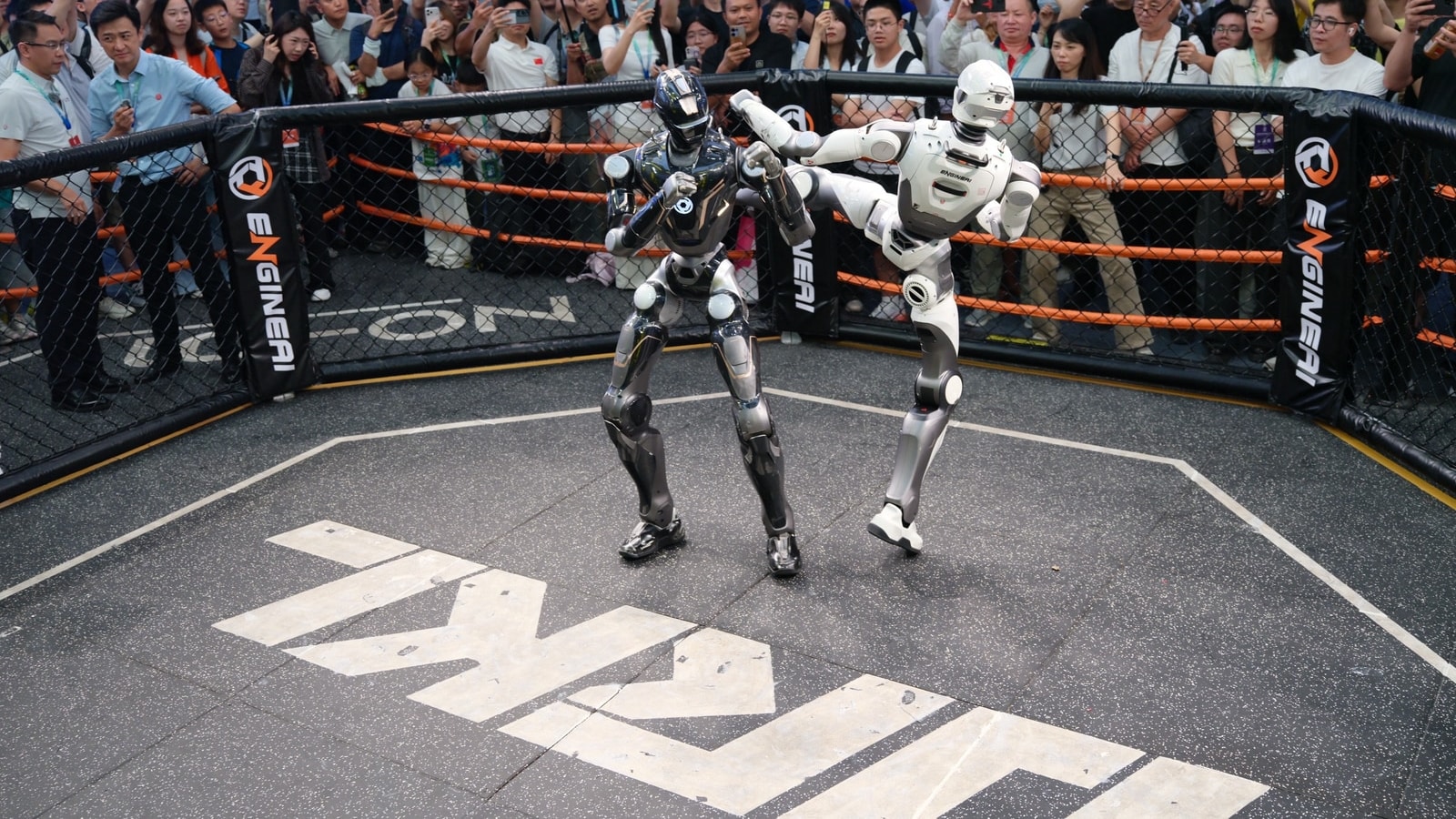
Gravity has an excellent career record. It has defeated every organism, machine, empire and architectural mistake eventually presented to it, yet a surprising amount of engineering consists of politely asking mass not to go where gravity would prefer. We stand upright, build towers, fly aircraft and make humanoid robots balance on two narrow feet, all of which are variations on negotiating with a force that has never once needed a software update. Fighting adds another participant to the negotiation: somebody else is now actively trying to make your agreement with gravity collapse.
Judo makes that truth unusually visible. Spectators remember the throw because the throw is dramatic, but the important part often happened before the feet left the floor. Balance changed. A direction became weak. A recovery step became necessary. One leg became loaded. The opponent's structure was persuaded into a state where fewer good answers remained. That is kuzushi, usually translated as breaking balance, but for robotics the useful idea is broader. Kuzushi is the deliberate creation of a mechanical state in which the opponent's recoverable options are shrinking.
Balance is not a yes-or-no property.
Humans speak casually about being balanced as though it were a switch. Real bodies are continuously moving through degrees of stability. A fighter leaning forward may still be standing comfortably, but one direction of recovery has become more expensive. A person transferring weight onto one leg has not fallen, but a future step is now constrained by where the mass has gone. A torso rotating during a turn is not unstable in the ordinary sense, yet the available responses are different from the responses available a fraction of a second earlier.
Robotics gives us a precise language for what martial artists have been sensing for centuries. A humanoid controller can estimate center of mass, foot pressure, joint angles, angular velocity and the location of the support polygon. It can calculate whether a disturbance can be recovered through ankle motion, hip correction, a step or some combination of those strategies. Once an opponent begins estimating the same variables, grappling changes character. The question is no longer merely whether the other robot is balanced. The question becomes how many recoveries remain cheap, how many remain possible, and which small perturbation removes the largest number of them.
The loaded leg is a confession.
Movement requires options, and weight distribution spends them. When a fighter commits strongly to one leg, that commitment creates information. That leg matters now. The other leg may be freer to move but less structurally useful. The torso carries momentum. The center of mass is migrating. The fighter has not announced exactly what will happen next, but the body has narrowed the menu. Experienced fighters often describe timing as though it were intuition because the relevant window is too short for a conscious checklist. In reality, a great deal of timing is simply recognizing when the opponent has already committed resources somewhere else.
A humanoid robot could make this brutally explicit. Foot-pressure estimation and motion tracking could identify loading patterns. A state estimator could infer likely recovery steps. The controller could act during the transition instead of after the transition is complete. That distinction is enormous. Pushing a stable machine requires power. Redirecting a machine already moving requires understanding. The second approach is not magic and it is not softness. It is an efficient exploitation of a system that has temporarily reduced its own options.
Good throwing is a form of theft.
A beautiful throw often feels unfair because the person being thrown contributes much of the energy. Their step creates momentum. Their attempt to recover creates another line. Their own structure supplies mass and motion that the thrower redirects. The attack steals mechanical work already present in the coupled system. Humans learn this through feel, repetition and the occasional educational encounter with the floor. Robots may eventually calculate it directly.
Once two machines establish grips or strong contact, they stop being entirely separate systems for a moment. Mechanically they become one unstable structure with too many actuators and competing controllers. Each machine can inject force into the combined system, but neither owns the entire result. That makes grappling an extraordinary control problem. The attacker is not simply deciding how hard to pull. It is estimating how the combined system will evolve if pressure changes here, rotation begins there, or one support point disappears. The sophisticated grappler is therefore not the machine that can move the most mass. It is the machine that best understands the temporary machine created when both bodies connect.
The grip is also a sensor.
Grappling language often treats the grip as control, but the grip is equally valuable as information. Once a robot establishes secure contact, force direction becomes observable. Changes in tension reveal motion before gross displacement occurs. Rotational intent can appear in the forearm or shoulder before the torso visibly turns. Load transfer can be felt through the contact point. A grip is therefore not only a way to make the opponent obey. It is a high-bandwidth measurement channel the opponent cannot easily shut off without first changing the relationship.
This suggests that future robotic grappling may become an unexpectedly rich laboratory for tactile intelligence. A machine might choose contact based partly on what that contact tells it. Wrist control may reveal rotational intent. Upper-arm contact may provide better information about shoulder commitment. Torso contact may expose changes in center of mass. The strategic question becomes partly epistemic: where should I touch the opponent to know what the opponent is about to do? Martial artists have been answering that question through feel for generations. Robotics can finally make the answer visible in data.
Efficiency looks unimpressive until it works.
Humans have an odd relationship with effort. We tend to trust visible exertion because struggle looks sincere. If somebody moves a heavy object with obvious strain, we respect the labor. If somebody changes the geometry and moves the same object with little effort, the result can look less dramatic even though the understanding is greater. Judo repeatedly offends this intuition. The best action may look almost casual because the opponent was already standing in the wrong answer.
Robot sports could make that distinction public. Imagine one machine using enormous actuator torque to lift an opponent and another creating the same result by shifting the opponent's balance, preventing a recovery step and rotating around a favorable axis. The first machine is stronger. The second may be better. In a mature league, efficiency should matter because energy, heat, structural load and actuator life are competitive resources. The elegant machine spends less because it understands more. That is not weakness. It is a refusal to pay full price for a problem geometry already discounted.
A throw is not complete until the machine survives it.
Robots introduce a complication that combat sports can usually treat as background until an ambulance arrives. Machines have to survive the landing as hardware. A robot that wins exchanges but repeatedly destroys actuators, cable routes or protective housings when it falls is not a successful fighter. It is an expensive percussion instrument. This means grappling competition will force engineers to treat falling as a first-class skill rather than a failure state.
That opens an entire technical field around machine ukemi: fall detection, impact prediction, joint positioning before contact, energy absorption, sacrificial armor, battery isolation, automatic motor compliance and perhaps rolling strategies that spread load instead of accepting it through one structure. The philosophical symmetry is beautiful. Martial arts has always contained two intertwined subjects: how to impose mechanical consequences on another body and how to remain functional when consequences are imposed on yours. Robot sports cannot hide the second half behind adrenaline. The repair bill will print the truth.
The best robot grappler may look patient.
People unfamiliar with grappling often expect constant movement because stillness looks like inactivity. Good grappling can be disturbingly quiet. Two bodies appear almost motionless while both are fighting over posture, pressure, future steps and structural advantage. A robot may become even more patient because it does not need to pretend that visible busyness equals progress. It can maintain precise pressure, wait without fatigue, continuously estimate the opponent's stability and choose not to move until the state becomes favorable.
Then the geometry changes all at once. A foot unloads, a shoulder rotates, a support edge disappears, and the audience sees half a second of violence after ten seconds of invisible negotiation. That is the version of robot combat worth taking seriously. It turns a throw from spectacle into a public demonstration of embodied reasoning. The machine is not merely powerful enough to move another machine. It understands when the other machine has already begun to fall.
The point of this series is not to make robots perform prettier human choreography. It is to ask what combat systems become when structure, timing, pressure, balance, contact and prediction can be sensed, measured and optimized by a body that is not human.