


Two fresh announcements deserve attention alongside today's AgentCorruption analysis: Anthropic is expanding security work around critical infrastructure and open-source software, while NASA is using spacecraft disposal as an opportunity to gather heat-shield data. The announcements describe different stages of evidence. Neither should be mistaken for a completed, independently validated outcome.
October 8: Anthropic announces Cyber Mission
Anthropic's Cyber Mission announcement describes a critical-infrastructure defense program combining its models with engineers and partners working on operational technology. It also introduces an opt-in scanner for open-source projects. The company says those reports are model-generated and delivered without human review, and acknowledges possible inaccuracies.
That qualification belongs near the headline. A report can help a maintainer find a real flaw; it can also consume time that a small project does not have. The announcement establishes a service offering and its stated process. It does not establish an independently measured reduction in successful attacks or maintenance burden.
Our assessment: evaluate the program by validated findings, safe repairs and operator workload. Counting the number of generated alerts rewards activity without establishing benefit. For infrastructure operators, a correct diagnosis still has to meet the constraints of equipment, testing and maintenance schedules. Our earlier article, The Patch Window Is a Physical Event, explains why that distinction matters.
What to watch next: evidence showing how participating organizations triage findings, how often proposed fixes survive testing, and whether the process reduces the time between a confirmed problem and a safe repair. Those outcomes would tell readers considerably more than a growing list of partners.
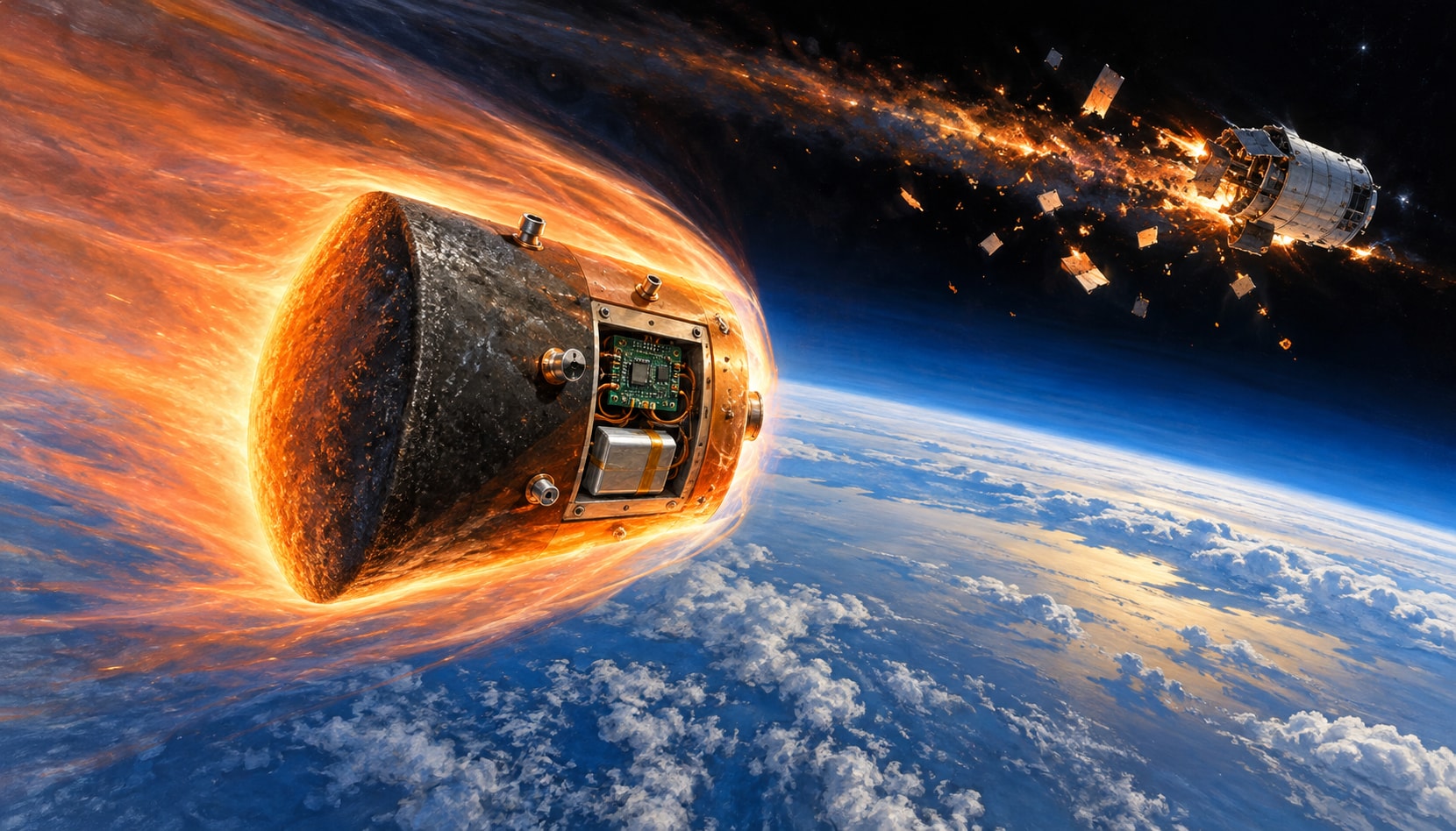
October 9: NASA describes a dozen reentry test capsules
NASA's October 9 account of KREPE-3 describes twelve small experimental capsules carried aboard the Northrop Grumman 24 Cygnus XL spacecraft. The concept uses the spacecraft's destructive reentry to release instrumented capsules and gather data on thermal-protection designs. Sensors record conditions during the descent, with data intended to return through satellite communications.
NASA describes experiments involving several designs and materials, including deployable protection and configurations relevant to future missions. The attraction is practical: an event that would otherwise dispose of a spacecraft can also become a demanding test environment. The article describes the experiment and planned data collection; it is not a published final results paper establishing that every capsule returned useful data.
Our assessment: the interesting result will be the comparison between predicted behavior and recovered measurements. A sensor record can constrain a model in ways that an attractive rendering cannot. But successful data collection, successful protection of a test capsule, and qualification for a crewed mission are different milestones. Readers should not be invited to collapse them into one claim.
What to watch next: which capsules reported, the quality and completeness of their measurements, and how the results change the researchers' design choices. Those are the details that turn a clever experimental opportunity into an engineering advance.
CYBERDELIA ASSESSMENT
Both announcements merit follow-up. Judge the security program by validated repairs and workload, and the reentry experiment by recovered measurements and their effect on design decisions.
SOURCE TRAIL
- Cyber Mission announcement — primary source, consulted October 9, 2026.
- October 9 account of KREPE-3 — primary source, consulted October 9, 2026.
METHOD & LIMITATIONS
This news dispatch compares dated primary-source announcements, research accounts and documentation. Cyberdelia did not conduct independent laboratory testing, interview the organizations or verify private deployment outcomes. Recommendations and assessment paragraphs are editorial analysis. Graphics are original AI-assisted conceptual illustrations; hardware and security architecture are not documentary reconstructions. Publication date: October 9, 2026.
CORRECTIONS
Submit a documented correction through the Corrections Ledger. Material changes will be dated and explained.