

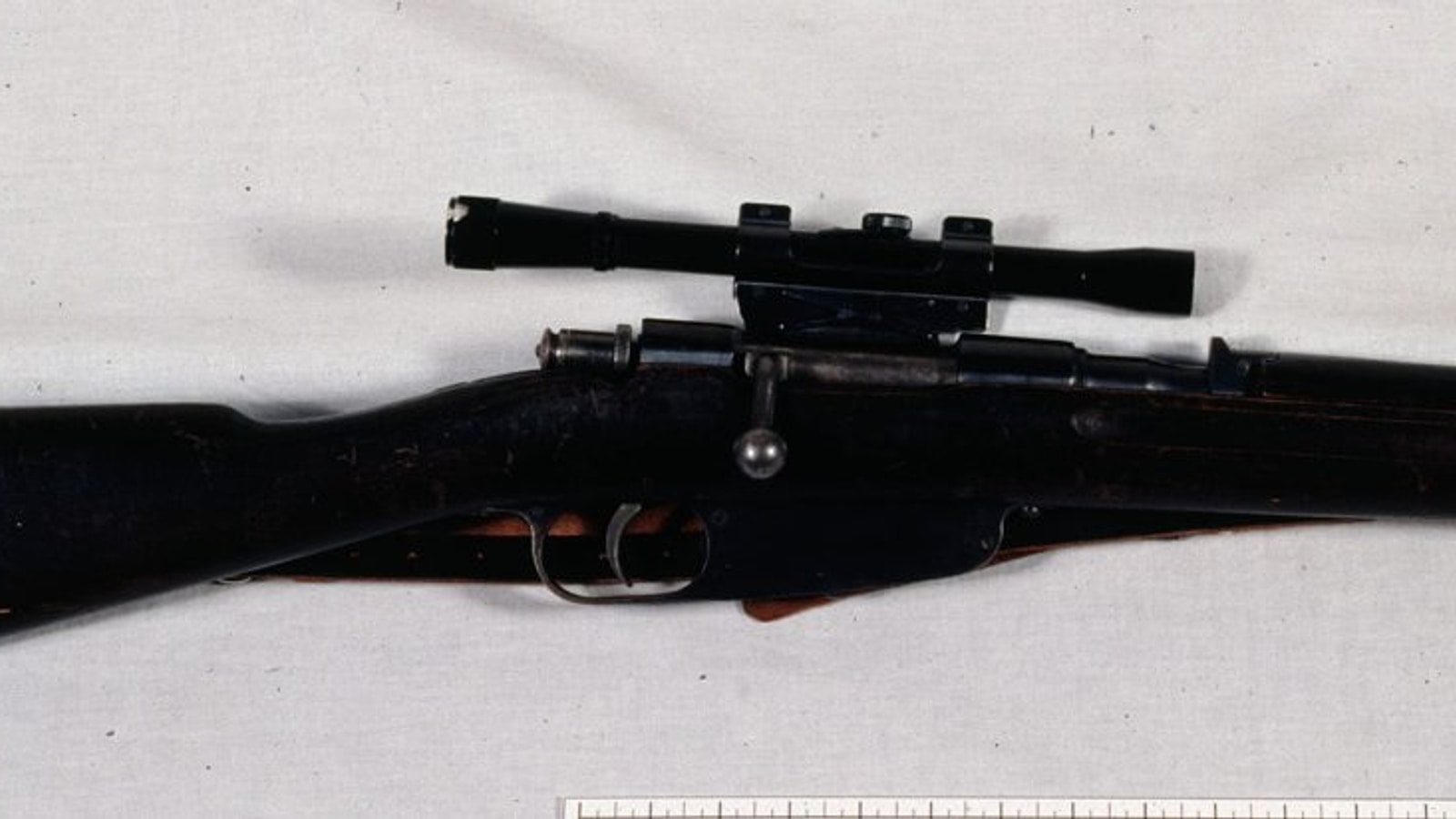
The Kennedy assassination is full of arguments that quietly substitute one proposition for another. One of the most persistent is this: if the shots attributed to Lee Harvey Oswald were extraordinarily difficult, then the official account becomes mechanically implausible. The inverse is also abused: if the shots were feasible, then every conspiracy claim must collapse.
Neither follows.
Mechanical feasibility is a bounded technical question. It can be examined on its own terms: distance, target motion, geometry, weapon function, sighting system, shooter training, and time available. That is where we start.
The range was not long.
The Warren Commission's Chapter 4 describes the shots from the sixth floor of the Texas School Book Depository as being taken at a target approximately 177 to 266 feet away. That is roughly 59 to 89 yards.
Popular retellings often make the scene feel like a distant precision-rifle engagement. It was not. The distances were inside 100 yards.
Distance alone does not make a shot easy, but it immediately changes the scale of the problem. At these ranges, small errors in range estimation matter far less than they would at several hundred yards.
The car was moving in a favorable direction.
The limousine was not crossing the shooter's field of view at highway speed. The Commission described it as moving on a downgrade, almost directly away from the firing position. Its Appendix 12 gives an average speed of approximately 11.2 miles per hour during the relevant period.
That geometry matters because lateral motion is what usually forces a shooter to estimate lead. A target moving mostly away changes angular position relatively slowly. The downhill grade also reduced part of the vertical adjustment that would otherwise accompany increasing distance.
Marine marksmanship witnesses quoted by the Commission explicitly described the target geometry as favorable and the relevant hits as not particularly difficult.
The first round did not require cycling the bolt.
The rifle was already loaded before the first shot. For a three-shot sequence, the shooter needed to operate the bolt twice between shots, not three times. This sounds obvious, but internet stopwatch arguments regularly forget it.
The Commission concluded that at least about 2.3 seconds were required between aimed shots in its testing with the telescopic sight. The exact assassination timing depends on which of the three shots missed. Its reconstruction produced two broad possibilities: a compressed total span around 4.8–5.6 seconds if the middle shot missed, or a longer minimum total span around 7.1–7.9 seconds if the first or third shot missed.
What happened when experts used the rifle?
The Infantry Weapons Evaluation Branch had experienced marksmen fire the assassination rifle at silhouette targets at approximately 175, 240, and 265 feet. According to the Commission, three master-rated marksmen fired two three-shot series each. Their recorded times ranged from 4.6 seconds to 8.25 seconds.
One shooter completed three-shot strings in 4.6 and 5.15 seconds while achieving the relevant hit performance. FBI firearms examiner Robert Frazier also fired rapid groups with the rifle at 25 and 100 yards in times that overlapped the assassination timing envelopes described by the Commission.
These tests do not recreate Lee Harvey Oswald's exact performance, stress, posture, target appearance, or familiarity on November 22. They do answer the narrower claim that the rifle was mechanically incapable of producing accurate fire on that timescale. The historical test record does not support that claim.
Oswald was not an untrained civilian.
Oswald received Marine Corps rifle training. The Commission records that he qualified as a sharpshooter in 1956 and later as a marksman in 1959. Those classifications do not make him an elite sniper. They do establish basic military marksmanship training and demonstrated competence.
The Commission also cited testimony that Oswald practiced manipulating and sighting the rifle after leaving the Marines. Whether every recollection is given equal weight is a separate evidentiary question; the larger point is that the attributed shooter was not starting from zero.
The scope was imperfect, but imperfection is not impossibility.
Testing found a defect or misalignment in the telescopic sight. That fact is often presented as if it ends the mechanical question. The Commission's firearms testimony was more nuanced: a familiar shooter could compensate for the offset, and the particular alignment could even reduce the need for some lead against a target moving away.
Again, this is not proof that Oswald used the scope exactly as assumed, nor proof of authorship. It is evidence against the stronger claim that the sight condition made the shot inherently impossible.
The honest conclusion is narrower than either camp wants.
The physical problem was not obviously beyond Oswald's demonstrated skill. The range was short by rifle standards. The target was moving slowly and largely away. The rifle could be cycled and fired within the relevant time windows. Test shooters using the weapon produced comparable strings. Oswald had military marksmanship training.
That means one popular argument against the official account is weak: “Oswald could not possibly have made those shots.”
But physics cannot establish who gave orders, who knew what, whether anyone assisted him, whether institutions concealed embarrassing information afterward, or whether a separate actor existed. Those claims require different evidence.
The Dealey Plaza shots attributed to Oswald were mechanically feasible and were not the near-impossible feat often portrayed in popular culture. That finding removes one argument from the table. It does not settle the entire assassination. A technically possible shot and a historically complete explanation are different propositions.
Why this matters beyond Kennedy.
Public controversies rot when one dramatic but testable claim is allowed to carry the weight of an entire theory. The cure is decomposition. Ask the rifle question as a rifle question. Ask the evidence-chain question as an evidence-chain question. Ask the conspiracy question as a conspiracy question.
If one piece fails, discard that piece. Do not protect a preferred conclusion by making every subclaim sacred.