
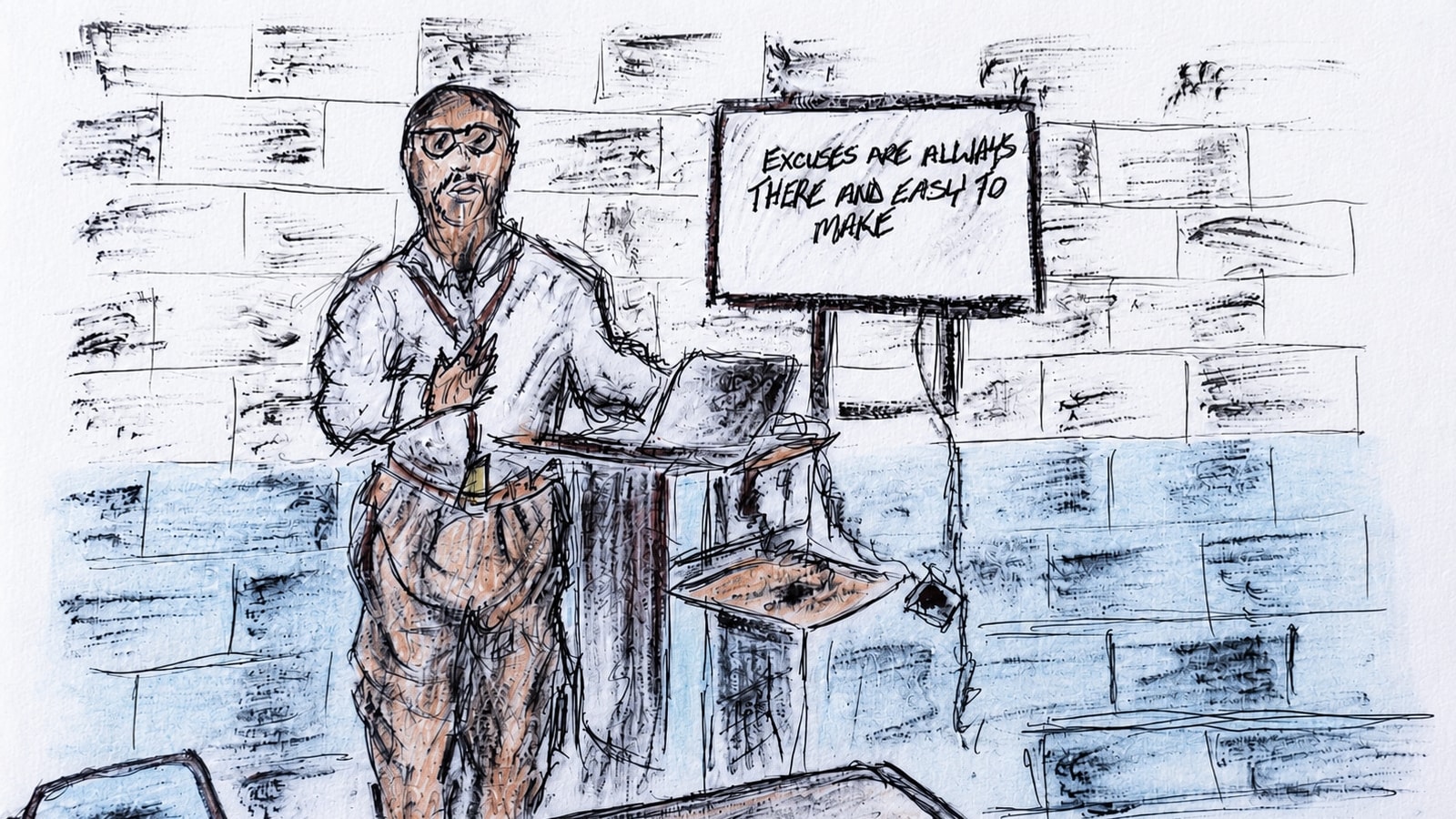
The first thing I remember clearly about the classroom is the whiteboard.
It was old, half broken, and stained with fragments of marker that had been erased so many times they had become part of the surface. The room around it was exactly what you would expect from a jail classroom: cinder-block walls, institutional paint, a swinging door, and just enough space to remind you that somebody had decided education could happen there. The whole room screamed where we were.
I was already in the Military Veterans Program at Tarrant County's Green Bay facility before One CommunityUSA and Pathways to H.O.P.E. came into that space. That distinction matters. The Military Veterans Program was not created by One CommunityUSA, and several people were already doing work with us through other organizations. Chris Woodruff and Dave Sakamoto were there through Pathfinders. LaJon MacDonald was with the Military Veteran Peer Network. Mitchell “Mitch” Stephens was with DE-CRUIT. Tom Sheppard and Fred Mesch were with Turn-Key Outreach. They were not one organization, and I do not want the story to collapse their work into a single banner.
Later, Tom Cruz and the people who would build Pathways to H.O.P.E. started coming in. I caught Pathways early. I was one of the veterans who volunteered for the first class Cruz ran there, and I volunteered as soon as the opportunity was put in front of me.
What drew me in was not a sales pitch. It was hope, and I do not mean that in the cheap motivational-poster sense. It was the feeling that there were people coming through that door who understood that veterans tend to recognize one another differently. There is a camaraderie to military service that does not disappear because somebody is wearing jail clothes. There was a sense that if nobody else was going to look out for us, maybe some people from the veterans community still would.
More importantly, they talked to us like we were not idiots.
That matters more than people on the outside may realize. There is a difference between being taught and being processed. The classes brought in information that had some relationship to the world we were eventually supposed to return to. We had programming five days a week in the Military Veterans Program. Pathways later became one of the days we looked forward to, but it was one part of a larger veterans-program environment that already existed. Chris Woodruff and Dave Sakamoto were already doing work with us through Pathfinders before One CommunityUSA came into the picture. LaJon MacDonald was connected through the Military Veteran Peer Network, Mitch Stephens through DE-CRUIT, and Tom Sheppard and Fred Mesch through Turn-Key Outreach. Different organizations had different roles. People came into a jail classroom and asked questions that assumed there would be a future in which the answers mattered.
Pathways to H.O.P.E. stands for Helping Offenders Pursue Excellence. Public reporting says the program was announced in 2021 and began operating in the jail after pandemic-related delays, with a focus on personal improvement, mental-health readiness, workforce preparation, career development, and mentoring before and after release. It remains active today. That description is useful, but it still does not explain what it feels like to be sitting inside the first version of something while everybody is figuring out what it is going to become.
I remember the name itself still being discussed in the room. I remember people voting. By the end, it had become Pathways to H.O.P.E. I remember a class that mixed veterans and civilian reentry participants, roughly split between the two groups. I missed the graduation because I had court that day, which is about as appropriate a detail as you can get for a jail reentry story.
There were people in that broader veterans-program environment who left an impression on me, and they did not all work for the same organization. Tom Cruz, with Pathways to H.O.P.E., gave me planning. Chris Woodruff, with Pathfinders, gave me preparation. Dave Sakamoto, also with Pathfinders, taught me to ask better questions. Mitch Stephens, with DE-CRUIT, brought the right attitude. Tom Sheppard and Fred Mesch, with Turn-Key Outreach, pushed strategy. LaJon MacDonald was there through the Military Veteran Peer Network. Judge Roy Kurban came through the class too. I knew of him through the martial-arts world and had trained with some of the same people he had. When he recognized me and bowed, I bowed back. A few guys looked at me like I had some mysterious pull nobody knew about.
It changed absolutely nothing about the amount of time I still had to do.
That is important.
Recognition is not a plan. A connection is not a plan. A person promising to help you is not a plan. Somebody may mean every word when they tell you they are going to be there. They can still die. They can get sick. They can lose their job. They can get hit by a truck. Life does not need somebody to betray you in order to destroy the thing you built around them.
That became one of the deepest lessons I carried out: never build a plan that requires one person, one job, one vehicle, one piece of equipment, one address, or one lucky break to remain intact.
Everything is going to go wrong.
That sounds cynical until you understand what I mean. I do not mean nothing works. I mean that if you are coming out of incarceration and your entire future depends on Plan A happening exactly the way you pictured it, you do not have a plan. You have a wish.
I learned that difference after I got out.
I was released in Denver on September 7, 2023, after more than two years locked up. I came out in institution-issued clothes and shoes with almost none of the normal infrastructure of daily life. Whatever plans I had made were built around support systems and people that were not in Denver. My network was elsewhere. I was not.
I headed for the VA.
It took most of the day to get there. I walked. By that evening I finally made it to the VA and started getting bounced from desk to desk until I found social services. That part deserves credit. I got food. I got help from donated supplies. Soldiers' Angels packs helped feed me. I was fortunate enough to get a donated phone almost immediately, and that phone mattered. A phone is not a luxury when you are trying to rebuild your identity, contact family, coordinate transportation, find services, handle money, or simply prove to another human being that you can be reached tomorrow.
My family overnighted identification to me. I had jail paperwork and older identification, but I still had to rebuild the ordinary machinery people take for granted.
For about a week, I slept outside near the VA.
There were other homeless people around me. Drug use was happening in plain sight. One of the first things I remember seeing out there was somebody using cocaine. I rolled over and went back to sleep.
That may sound cold. It was not. It was triage.
I had been out only hours. I was tired. I had nowhere else to go that night. I could not solve Denver, homelessness, addiction, the VA, reentry, and the rest of my life before morning. So I slept.
That first week I walked enough that one of my toenails eventually came off. I walked around Denver, learned where things were, ate where I could, handled whatever piece of the day was directly in front of me, and waited for my van to be brought back to me.
When the van finally arrived, freedom became physical.
I could drive to a store instead of walking across town. I could carry my things. I could move. I could leave. The first week I had it, I spent time between Golden and Black Hawk, parked in a pull-off along Clear Creek.
I remember getting out of the van and feeling one thing: freedom.
Then came the first practical question of freedom: where the hell do I go to the bathroom?
The answer was a gas station.
That sounds stupid until you have lived it. Reentry is full of huge ideas such as employment, housing, identity, treatment, responsibility, family, and purpose. But life is built out of smaller questions. Where do you sleep? Where do you shower? Where do you use a bathroom? Where can you charge a phone? Where can you park without getting moved? How much gas is left? What happens if the van breaks? What happens if somebody steals your computer? What happens if the person who promised to help you disappears?
The classroom can teach you how to think. The street tests whether your thinking survives contact with logistics.
The first month outside was surreal. Everything felt louder. People shouting made me look. Sudden movement got my attention. After years of institutional noise, I was still automatically checking whether something nearby was about to happen. The world had opened back up, but my body did not immediately believe it.
It took about a month before I felt even a little stable.
For a long time, the van was home. I got a cheap laptop from my mother because I needed access to my data and the technology required to do ordinary work. It was stolen not long afterward. Later, more property disappeared. Somebody broke into the van. At one point I found a man who had a substantial amount of my stuff. I had every emotional reason in the world to escalate that situation.
I let him leave.
That was not weakness. That was arithmetic.
Once you have a record, the rules are different whether anybody admits it or not. I knew that one confrontation could cost me more than the property was worth. Nobody else would do the time for me. Nobody else would absorb the charge, the lawyer, the jail, the lost years, or the consequences. I was not giving him my property. I was deciding that my future cost more.
I wish I could tell you that realization solved everything.
It did not.
By late 2024 and into 2025, I made more mistakes. I spent time around people I should not have been around. I let myself believe that because some obligations had ended, I had earned some room to drift. After more than two years locked up, a little leeway felt reasonable.
Leeway became exposure.
I picked up new charges. I went back to jail for seven more months and eventually accepted a sentence that put me on ten years of probation, two supervised and eight unsupervised, rather than gamble years more of my life on a worse outcome.
There is no elegant way to write what that felt like.
Fuck.
That was about the size of it.
Sitting there with new charges and realizing how quickly the ground had disappeared again made one lesson painfully simple: focus on yourself.
That phrase can sound selfish. I mean almost the opposite. I mean understand that when consequences arrive, they arrive in your name. Other people can love you, advise you, help you, mentor you, send you money, mail you an ID, give you a phone, bring you a van, offer you a job, or promise to invest in you. Those things matter. Some of them saved me.
But nobody else serves your sentence.
Nobody else can maintain your situational awareness for you. Nobody else can decide who gets into your vehicle, what environment you walk into, which invitation you accept, what risk you ignore, or when you need to leave.
One of the men I knew from the veterans pod got out after doing about as much time as I had. He died from an overdose on his second day out.
I do not tell that story to turn him into a lesson. He was my friend.
I tell it because it could have been me.
I was doing some of the same things. I was around the same kinds of risks. It is easy to imagine that survival proves judgment. Sometimes it proves you survived. That is all.
Pathways could not prepare me for every person I would meet, every bad decision I would make, every piece of equipment that would fail, every connection that would vanish, every charge, every loss, or every night in a van. No program can.
What it could do was start changing the questions.
Tom Cruz taught planning. Dave Sakamoto taught me to ask the right questions. The people who came into those classrooms gave us tools that were meant for a world outside the walls. Those tools did not prevent every failure. Some of the lessons only made complete sense after I failed.
That may be the part reentry programs need to say louder.
Expect that you are wrong about something.
Expect that something you think is secure is not secure. Expect a deadline to move, a person to disappear, a job to fall through, a vehicle to break, a phone to die, a document to be missing, a relationship to become dangerous, a plan to fail, or your own judgment to be worse than you thought it was.
Then build around that possibility.
Have another route. Have another number. Have another place to sleep. Back up your data. Protect your tools. Know where your documents are. Know who is in the car. Know whose car you are getting into. Know what environment you are walking into. And when you cannot know, understand that uncertainty itself is part of the risk.
That is not living scared. It is adaptability.
It is situational awareness.
When I came home again, rebuilding did not look cinematic. I inventoried what was left. I borrowed money for another computer. I went back to work I had started while locked up. I scanned handwritten pages into a computer and fought with bad OCR that turned my writing into garbage. Then I corrected it. Page after page. Problem after problem.
That is what rebuilding has looked like for me more often than not. Not one grand redemption scene. A series of small corrections.
There is one image I keep coming back to from Colorado. I was by the creek, watching the water roll past. For once there was nothing I had to solve in that exact second. I was just watching water move.
The thought that landed was simple: be here now.
That sits beside the other lesson without contradicting it. Plan for failure, but do not spend your entire life living inside disasters that have not happened yet. Be adaptable. Pay attention. Keep backups. Protect your future. But when you finally get a quiet minute beside the water, take the damn minute.
I do not think reentry is about becoming the person a program tells you to become. I think it is about becoming somebody capable of absorbing reality without letting every failure become the end of the story.
I volunteered for that first class because I thought it might give me something useful for later.
It did.
Just not always in the way I expected.
The lesson I would give somebody coming out now is the same one I had to learn the expensive way: expect that you are going to be wrong. Expect that you are going to make mistakes. Plan for the mistakes. Plan for the plan to fail. Then when it does, adapt, look around, and make the next move.
And if you get a moment where the water is just moving past you, be there for that too.
Reentry is not a clean transfer from classroom plan to outside reality. The useful skill is not believing the plan will work. It is building enough awareness and redundancy to keep moving when part of it does not.