

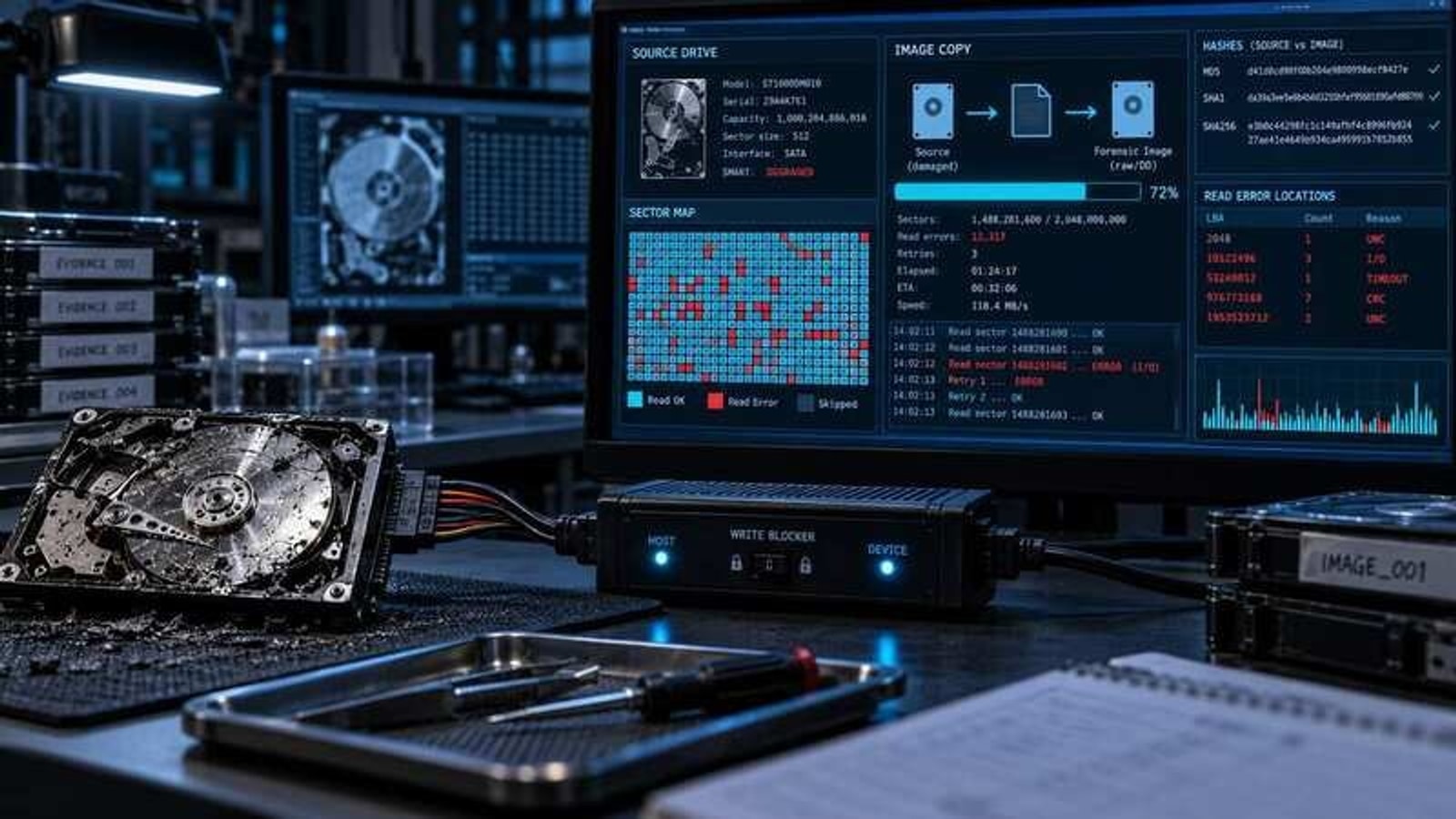
Eight old hard drives on a desk are not eight filesystems. They are eight unknown histories.
Some will be healthy. Some will contain duplicate backups. Some will have half-dead bridges, damaged metadata, stale operating systems or deleted files. One may spin up and then make the entire storage stack reconsider its career choices. The first mistake is treating all of them like cooperative volumes waiting to be browsed.
Lazarus starts with preservation.
The alpha is deliberately read-first. It lists disks on Windows and Linux, inspects partition tables and common volume signatures without mounting or repairing the source, and clones a source device into an image file. The clone produces an append-only JSONL map of successful ranges, failures, cursor positions and retry results.
Unreadable regions remain explicit. They do not silently vanish from the story.
Fast salvage first. Aggressive retries later.
A failing disk may have regions that read quickly and regions that trigger repeated timeouts. Grinding on the first ugly patch can waste the remaining life of the device while perfectly readable data sits elsewhere. Lazarus therefore supports a coarse first pass, records bad ranges, and then retries those ranges down to smaller configurable blocks.
That is not magic. It is scheduling.
Carve the image, not the original.
The current carver recognizes JPEG, PNG, PDF and ZIP-family signatures. ZIP candidates can be relabeled as DOCX, XLSX or PPTX when internal markers identify an Office Open XML container. Recovered filenames encode the source byte offset and a SHA-256 prefix, and a manifest records offset, type, size, digest and output path.
Filesystem-aware recovery comes next because metadata recovery and raw carving answer different questions. Metadata can preserve names and directory structure. Carving can survive damaged metadata but loses context and can produce false positives. A serious workbench needs independent passes whose outputs can be compared.
Know where software ends.
Lazarus can catch ordinary read errors and short reads. It cannot force a dead mechanism, hostile USB bridge, frozen SATA controller or wedged kernel I/O path to respond. If attaching a disk causes multi-minute system hangs, repeated full scans of the original are not persistence. They are gambling with the remaining readable surface.
The recovery rule is simple.
Acquire first. Analyze the copy. Hash the image. Preserve the journal. Keep destructive wipe and format tools somewhere else entirely, preferably behind an explicit arming step. A recovery utility should not become a disk eraser because someone mistyped one argument at three in the morning.
Lazarus v0.1.0-alpha is intentionally narrow: preservation before cleverness. The design target is not one perfect recovery algorithm. It is a workbench where multiple imperfect methods can leave auditable receipts and disagree without destroying the source.