

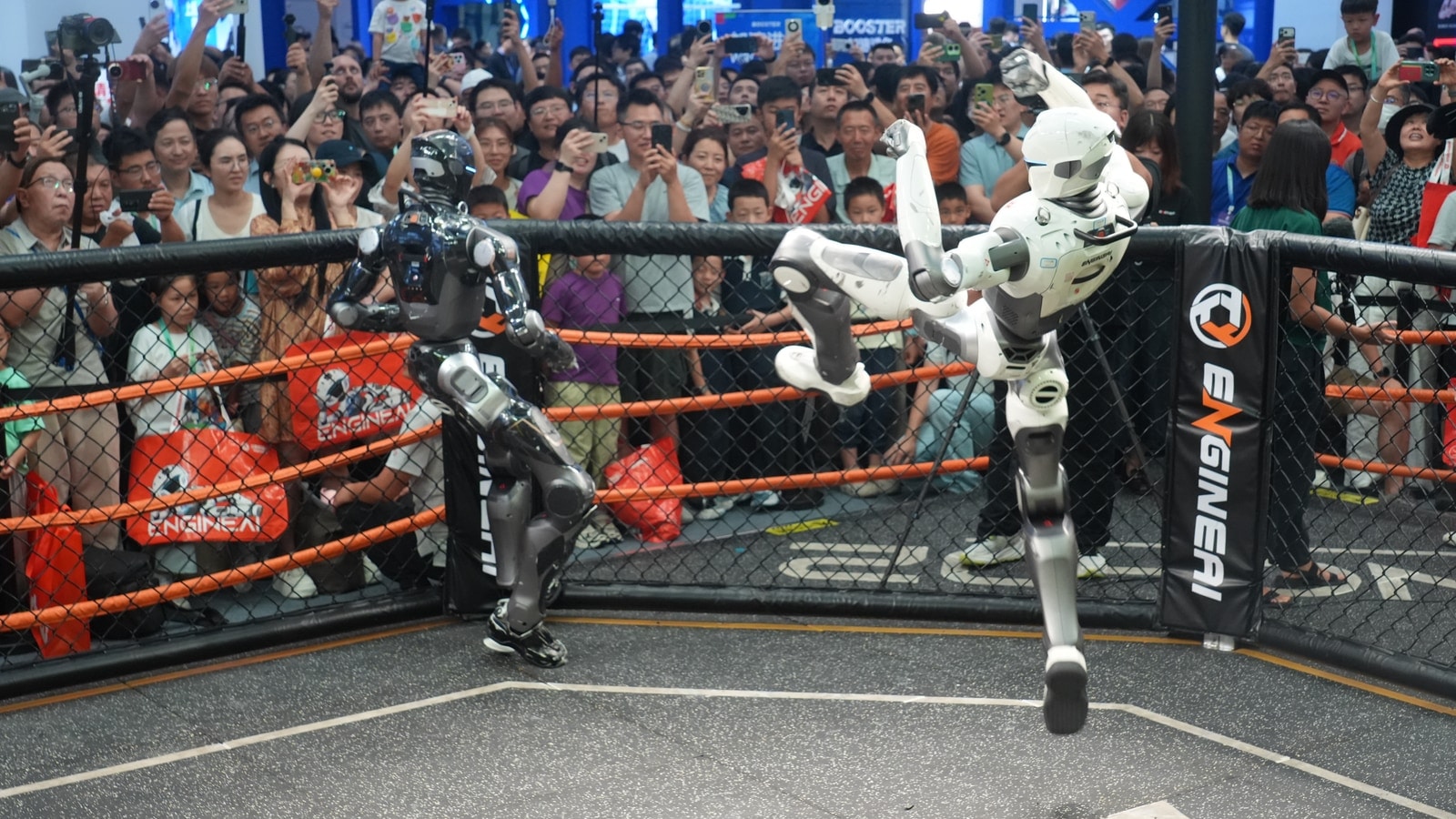
Humans become morally suspicious of deception right up until we put ropes around it and sell tickets. Then a feint becomes craft, a trap becomes intelligence, and a fighter intentionally presents false information to another fighter while a crowd applauds the quality of the lie. That is not hypocrisy so much as recognition that deception inside a competitive system can be a legitimate form of control. Both participants know the information environment is hostile. The point is not to tell the truth. The point is to make the opponent believe the wrong future for just long enough to regret it.
Robot combat will become genuinely interesting when machines stop being evaluated only on mechanics and begin being evaluated on what they can make another controller expect. A robot with the strongest punch may lose to a robot that can convince it the punch is coming from somewhere else. A machine with the fastest reaction time may still be late if it reacts to a prediction deliberately planted by the opponent. At that stage the fight is no longer only between bodies. It is between models of bodies, models of behavior and models of what each machine thinks the other machine believes.
Combat is prediction under hostility.
Most ordinary robotics assumes an environment that is indifferent. A staircase does not fake left and then go right. A warehouse shelf does not study your last ten approaches and deliberately shift because it noticed a habit. Combat changes the contract. The environment has opinions, and worse, it is watching you. Every action reveals information. Every repeated pattern becomes exploitable. Every defensive preference can become bait.
This turns fighting into adversarial control. A machine predicts the opponent, but the opponent is predicting it. Each controller changes behavior partly because it knows the other controller is observing. Then both systems can begin manipulating the observations themselves. Human beings have spent thousands of years turning this recursive nonsense into war, poker, diplomacy, markets and family gatherings. Boxing offers a cleaner laboratory because the feedback arrives faster and the consequences are easier to score.
The jab is a question before it is an answer.
Beginners often see every punch as an attempt to damage the opponent. Experienced fighters understand that some attacks are probes. A jab can score, interrupt, occupy vision and establish range, but it can also ask a question. Do you parry outward? Do you retreat? Do you cover? Do you counter immediately? Does your rear hand drop when your lead hand moves? Does your lead foot shift? The jab is valuable partly because it can purchase information at relatively low cost.
A robot could formalize that idea as active sensing. Send a small offensive stimulus, observe the response, update the opponent model and choose the next action based on what the first action learned. Now a combination stops being a prerecorded string and becomes a decision tree. The first movement may exist mainly to classify the defense. The second is selected because of the answer. Humans already do this through ringcraft. Machines may eventually do it with enough precision that a few exchanges reveal tendencies a human corner would need rounds to identify.
Rhythm is dangerous because prediction is efficient.
Brains and controllers both love patterns because prediction saves time. Repeated timing teaches the opponent when to expect the next event, which sounds like a mistake until you remember that an expectation can be weaponized. Establish a cadence. Repeat it until the other system becomes confident enough to prepare early. Then alter the interval. Half beat, double beat, pause, step without striking, strike without the expected step. The opponent has not merely reacted slowly. It has spent resources responding to an event that never arrived.
There is something philosophically satisfying about that because the decisive error occurs before the visible exchange. The body loses because the model of the future became wrong first. This is why reaction time by itself is an impoverished way to talk about fighting. If you wait until the attack is fully obvious, you are already paying for information that could have been inferred earlier. Good timing is not supernatural speed. It is acting while certainty is still expensive for the other side.
Prediction creates the need for deliberate unpredictability.
A perfectly rational combat controller may become exploitable precisely because it is perfectly rational. If the machine always chooses the locally optimal response under a known policy, an opponent that models the policy can anticipate it. That creates a strange requirement: an advanced fighter may need to choose the second-best action occasionally because repeated optimal behavior exposes the decision rule. Humans call this variation, broken rhythm, feinting or simply not becoming readable.
For machines, deliberate uncertainty could become part of the policy. Not chaos and not random flailing, but controlled variation designed to prevent the opponent from converging on a reliable prediction. A robot might intentionally show a familiar entry and cancel it. It might vary the timing of an otherwise identical movement. It might occasionally take a route that is slightly less efficient mechanically but more valuable informationally because it corrupts the opponent's model. The amusing result is that a robot may need to behave a little less predictably rational in order to become more strategically intelligent.
Footwork edits the battlefield.
One of the persistent misunderstandings about boxing is treating footwork as transportation. Move closer, move farther, move left, move right. That description misses the point. Footwork changes relationships. A small angle can alter which weapon reaches first. A pivot can move a body off the opponent's strongest line. A retreat can encourage overextension. A lateral step can force the opponent to reset. The feet are not merely carrying the weapons around. They are editing the geometry in which those weapons are allowed to matter.
That distinction is crucial for humanoid robotics because ordinary locomotion planning often optimizes stability, efficiency and destination. Combat locomotion needs another variable: advantage. The shortest path may be tactically stupid. The most stable position may surrender initiative. The closest distance may place the robot directly inside the opponent's strongest structure. A combat planner therefore has to understand that space is not neutral. Different locations change the future action set of both machines, and the best step may be the one that makes the opponent's next decision worse.
Close range should become stranger, not simpler.
This is where boxing logic and a My Jhong Law Horn-informed close-range perspective begin to fuse in useful ways. At distance, rhythm, angles, entries and straight-line efficiency matter. As range collapses, contact itself becomes information. Forearm position matters. Frames matter. Hand control matters. The useful line can change faster than the eyes can comfortably narrate it. A machine does not need to care whether a human textbook would classify the next action as a parry, a trap, a frame, a clinch or the beginning of a throw.
The controller can treat all of those as variations of the same problem: which action improves my mechanical position while degrading the opponent's? A parry becomes contact. Contact becomes control. Control becomes a strike. The strike shifts balance. The balance shift creates a throw. Human pedagogy separates these events because categories help people learn. A machine can operate across the boundaries continuously. That may make advanced robot fighting look less like a mashup of styles and more like one uninterrupted control problem expressed at changing ranges.
Styles may emerge from hardware rather than tradition.
One of the most compelling possibilities in robot sports is that recognizable styles may appear without anyone programming a style by name. A platform with exceptional tactile sensing may become a pressure fighter because contact gives it better information. A light machine with fast limbs may become an outside striker. A robot with superior balance estimation and strong hip actuators may become a grappler. Another with fragile armor but excellent predictive control may develop a highly evasive game built around making opponents commit first.
At that point engineering decisions become athletic identity. Fans may begin saying things like this machine likes the clinch, that one constantly breaks rhythm, this chassis gives ground until it finds the angle, or that platform always attacks the loaded leg. Those statements sound like sports commentary because they are sports commentary, but underneath them sit actuator maps, sensor distributions, control policies and failure tolerances. Culture emerges because repeated competitive behavior becomes recognizable. Personality, in a machine sport, may simply be the public face of optimization.
Eventually the visible fight will be the least interesting layer.
The fists will remain important. So will motors, armor, heat management and structural durability. But as robotic combat matures, the visible exchange may become only the surface. Underneath it, two controllers will be building models of one another, testing assumptions, creating expectations, breaking expectations, manipulating position and trading information under uncertainty. The audience will see a jab. The system will see a probe. The audience will see a pause. The system will see a prediction trap. The audience will see a pivot. The system will see a geometric reconfiguration of future attack probabilities.
Somewhere in the middle of all that abstraction, one robot will still punch another robot square in the head, which is reassuring. No matter how sophisticated intelligence becomes, physics eventually closes the argument. The difference is that the punch will not be the whole story. It will be the final visible consequence of an information contest that began several decisions earlier.
The point of this series is not to make robots perform prettier human choreography. It is to ask what combat systems become when structure, timing, pressure, balance, contact and prediction can be sensed, measured and optimized by a body that is not human.