

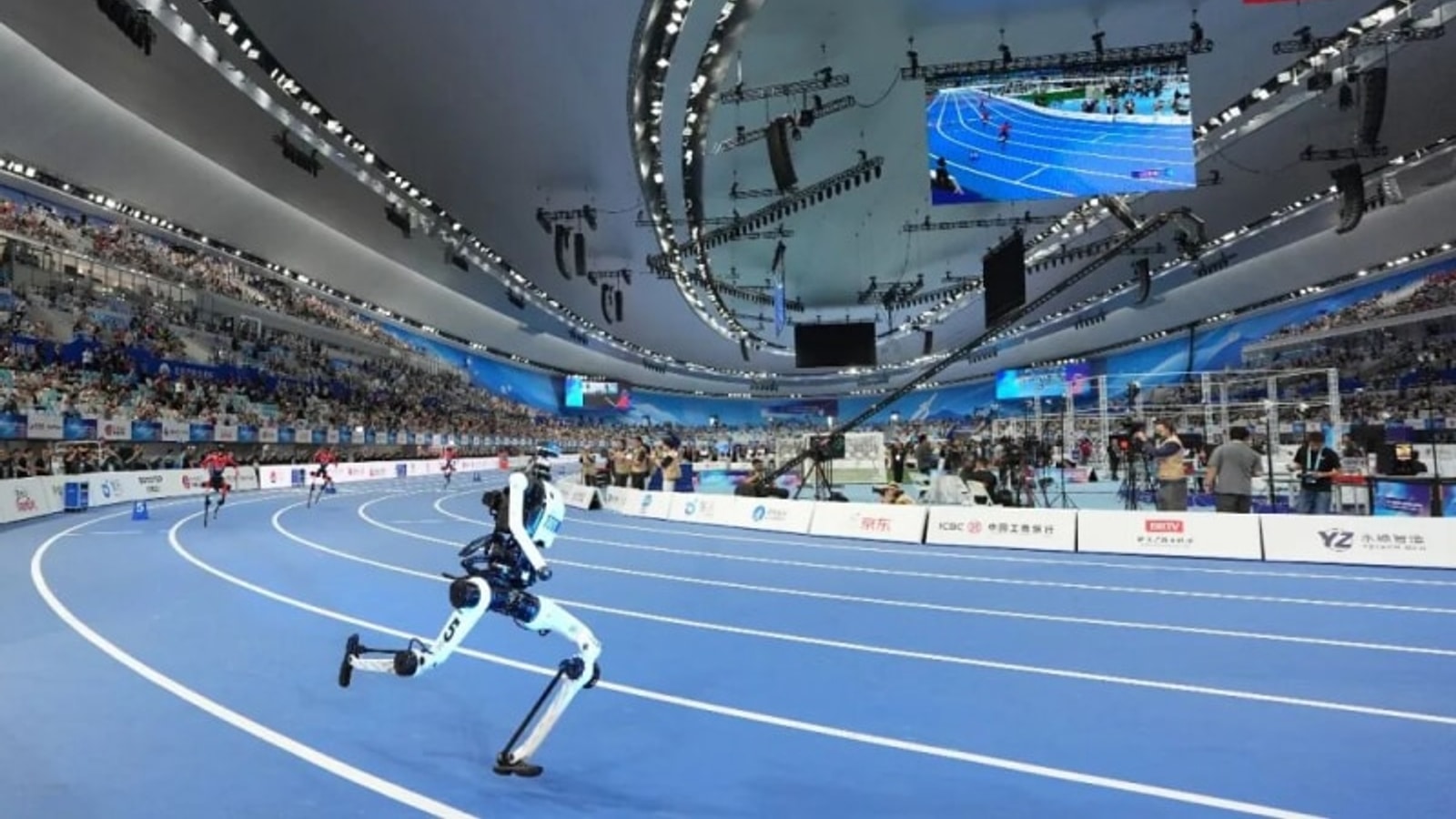
The first thing everybody notices is the number: 8.64 seconds.
The second thing Cyberdelia cares about is what had to improve for that number to exist.
The 2026 World Humanoid Robot Games in Beijing turned humanoid locomotion into something resembling a real sports benchmark. Tiangong Ultra, developed by the Beijing Humanoid Robot Innovation Centre, finished the 100 meters in 8.64 seconds at the close of the event. Earlier in the same meet, the benchmark had already moved through 9.39 and 8.86 seconds.
The sport is forcing an engineering stack.
A sprinting humanoid does not win because it has one good motor. It needs coordinated actuation, balance control, foot placement, state estimation, trajectory planning, recovery and enough structural margin to survive repeated high-load runs.
power → gait → balance → perception → control latency → recovery → finish time
The public record is already revealing where the technology is strong and where it is ridiculous. The robots can accelerate brutally. Some still need padded walls because deceleration remains less graceful than the headline time.
Competition changes the development loop.
Last year's best 100-meter performance at the Games was dramatically slower. Beijing's official material described 21.5 seconds in 2025. A year later, the benchmark is below nine seconds.
That does not mean humanoids are suddenly superior human athletes. It means a standardized event created a target every team can attack, compare and improve against.
That is what makes this sports coverage.
We are going to track records, teams, hardware, control strategies, rule changes, failures, injuries to machines, repairs, autonomy requirements and what each competition actually measures.
The scoreboard is engineering data wearing a jersey.
Robot track is useful precisely because it is unforgiving. A fast prototype that cannot stop, recover or repeat the performance has not solved athletics. It has solved one slice of locomotion under load.