

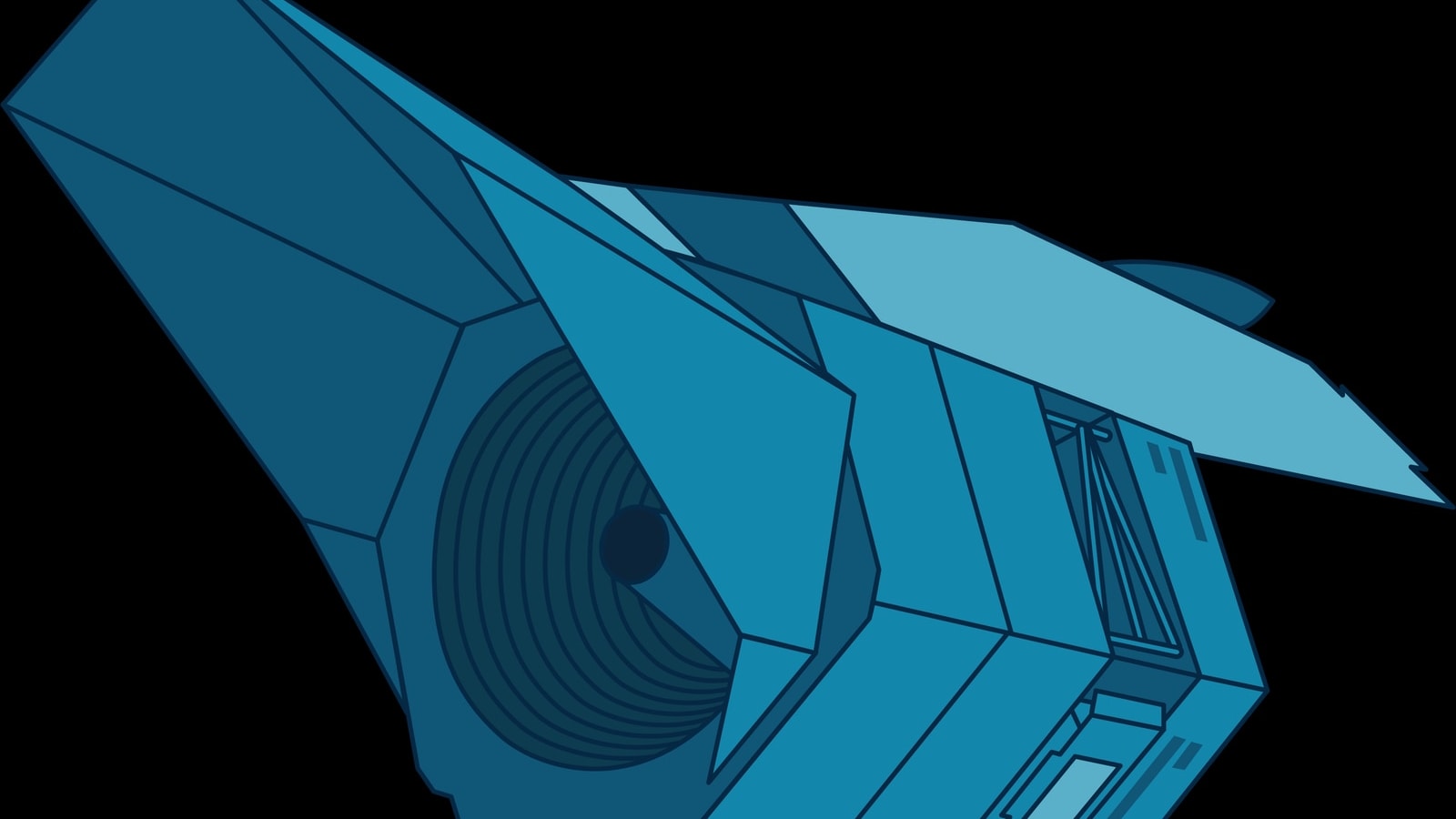
A telescope is usually sold to the public through optics: mirror diameter, wavelength, sharpness, distance, breathtaking image.
Roman deserves a different frame.
Its 2.4-meter primary mirror is the same diameter as Hubble's. The revolution comes from pairing sharp imaging with a vastly larger field of view. NASA says Roman will survey at least 100 times more sky per exposure than Hubble while sending roughly 11 terabits of science data to Earth every day.
That means Roman is not merely another eye. It is a change in scientific throughput.
The observatory is now on the launch rail.
NASA reported that Roman, already encapsulated inside its Falcon Heavy payload fairing, moved from the Payload Hazardous Servicing Facility to SpaceX's hangar at Launch Complex 39A on Aug. 25. The next major gate is the Aug. 28 Launch Readiness Review, followed by the current target of 7:26 a.m. EDT Sunday, Aug. 30.
That changes the status of this article without changing its thesis. The data-system question is no longer a distant design exercise. If launch and commissioning proceed, the projected survey throughput becomes an operational system we can measure rather than a specification we can only model.
Scarcity moves downstream.
When observations are scarce, telescope time dominates the economics of discovery. Astronomers compete for narrow windows, collect small datasets, and spend enormous intellectual effort extracting value from every exposure.
A survey telescope changes that balance. Roman is designed to repeatedly map large regions of the sky with stable, high-resolution imaging. NASA expects about 1.4 terabytes of science data to reach Earth every day and more than 20 petabytes over the five-year primary mission.
The raw number is less important than the consequence: the bottleneck moves from getting observations toward finding the meaningful pattern inside observations.
The ground system becomes part of the telescope.
Roman will use Ka-band links capable of hundreds of megabits per second and multiple ground stations operated with NASA, ESA, and JAXA support. The data then move into a distributed science-operations architecture for calibration, processing, archiving, and public access.
That chain should be understood as part of the observatory. A detector can perform perfectly and still produce less science than expected if the downstream system cannot calibrate, index, query, cross-match, or reproduce the results efficiently.
The effective telescope is therefore:
mirror → detector → onboard storage → downlink → ground station → calibration pipeline → archive → query tools → researcher or algorithm
Every stage has latency, capacity, failure modes, and assumptions.
Twenty petabytes is not “big data” because the number sounds impressive.
Twenty petabytes is manageable by modern computing standards. Humanity has built far larger commercial data systems. The scientific difficulty comes from the need to preserve meaning.
Astronomical data are not interchangeable blobs. Each observation carries time, pointing, detector state, calibration history, uncertainty, processing version, masking decisions, coordinate transformations, and relationships to other surveys.
If those relationships are poorly managed, storage survives while scientific provenance decays.
That makes metadata architecture, pipeline versioning, and reproducible analysis as important to Roman's legacy as disk capacity.
Roman will manufacture transients faster than humans can personally inspect them.
A wide, repeated survey naturally creates a stream of change: supernovae, microlensing events, variable stars, moving solar-system objects, tidal disruption events, active galactic nuclei, and phenomena nobody built the survey specifically to find.
The old romantic image of the astronomer noticing something strange in an image does not scale cleanly to this regime. Automated detection, ranking, cross-survey comparison, anomaly scoring, and machine-assisted triage become necessary simply to decide what deserves a human's attention.
That does not mean “AI discovers the universe.” It means an increasingly large fraction of observational reality will first pass through software filters before a person decides it is interesting.
That creates a new epistemic hazard.
Algorithms are good at finding what their objective functions reward. Survey science therefore faces a familiar systems problem: a filter can increase efficiency while quietly narrowing perception.
If anomaly detectors are trained on known classes, truly unusual events may be discarded as noise. If pipelines optimize aggressively for throughput, edge cases can disappear into quality flags. If catalogs become the default interface, researchers may stop looking at the underlying images.
Roman's abundance makes this a scientific-design question: how do we automate enough to survive the data rate without automating away the unexpected?
Public data changes who can make discoveries.
NASA says Roman's processed science data will be publicly available. That means the observatory's output can support research far beyond the teams that originally proposed specific surveys.
The practical barrier shifts toward compute access, software literacy, archive usability, and the ability to formulate good questions against large datasets. In other words, democratizing the photons does not automatically democratize the analysis.
A university with a small astronomy group may have access to the same archive as a major institution while lacking the staff, GPU time, storage, or pipeline expertise required to interrogate it at scale.
The next inequity in astronomy may therefore be less about telescope ownership and more about analytic infrastructure.
Roman and Rubin together make the problem more interesting.
Roman will not exist in isolation. Large survey programs such as the Vera C. Rubin Observatory create opportunities for cross-matching observations across wavelengths, cadence, and observing platforms.
That multiplies scientific value but also multiplies the systems problem. Coordinate systems, time domains, calibration conventions, event identifiers, data rights, and software interfaces all have to cooperate. Discovery increasingly happens not inside one dataset but at the intersection between them.
What is still unknown before launch.
This analysis cannot establish the mission's actual operational bottleneck before Roman flies. Commissioning may reveal constraints in detector behavior, downlink scheduling, calibration, archive software, cross-survey tooling, or areas not anticipated here. NASA's projected data volume establishes scale, not future failure. The claim is deliberately testable: if observational throughput rises as planned, downstream information handling should become a larger fraction of the scientific system.
Roman's most important technological contribution may be forcing astrophysics to behave like a mature data-intensive science. The telescope expands observational throughput so dramatically that calibration, provenance, automated triage, archive design, and researcher compute become visible parts of the instrument. The photons are only the beginning of the measurement chain.
What we will measure after launch.
Cyberdelia will track launch and commissioning, but the longer ledger is more useful: actual daily downlink volume, pipeline latency, public-release cadence, archive uptime, alert rates, calibration revisions, unexpected software bottlenecks, and the first discoveries that emerge from secondary analysis rather than the mission's headline science programs.
Launch coverage tells us whether the spacecraft survives Sunday. The next five years tell us whether astronomy successfully absorbs what it built.