

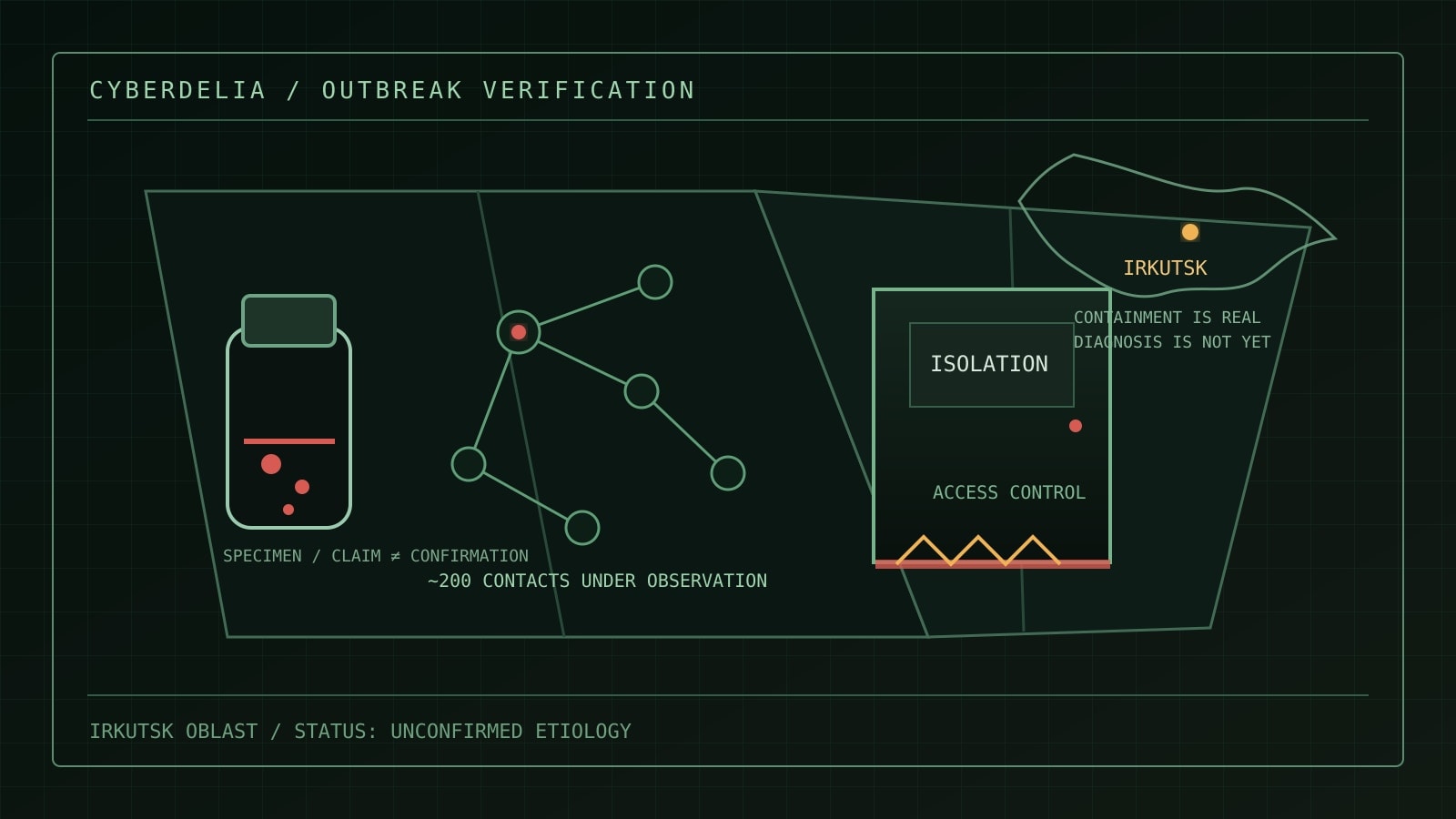
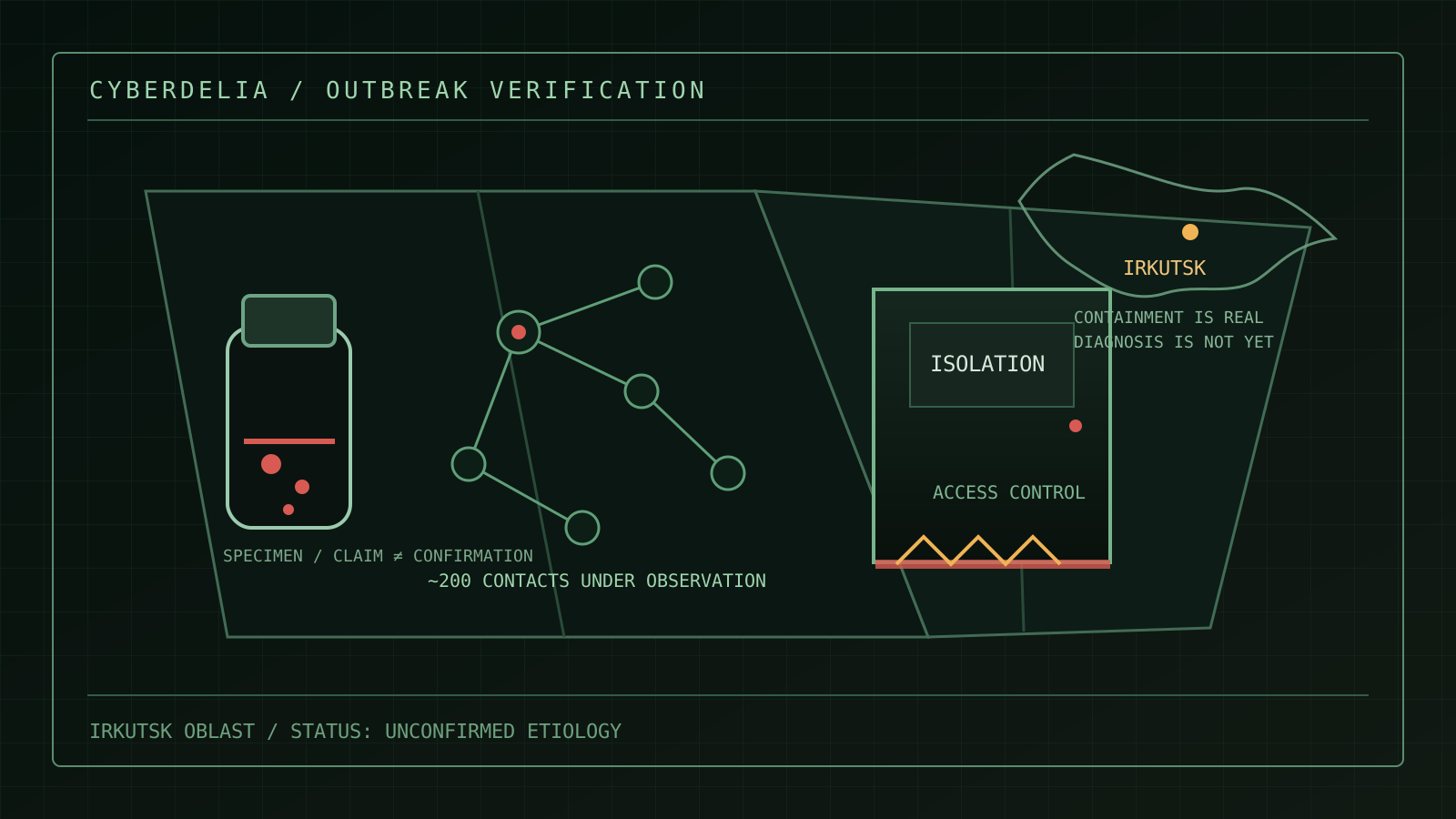
The most important fact in the Russian plague story is not that somebody has proved a plague outbreak. Nobody has. The important fact is that a worker from one of Russia's anti-plague research institutions died after a rapidly serious pneumonia, authorities imposed a large contact-observation response, and the public explanation remains narrower than the containment footprint.
On October 5, Reuters reported that 28-year-old Darya Shipilova of the Irkutsk Anti-Plague Research Institute had died from pneumonia of unknown origin. Around 200 people who had contact with her were being monitored, while Russian health officials said testing had not produced evidence of a laboratory accident or a plague infection linked to her work. The Associated Press reported the same basic split: a serious precautionary response on one side, and no confirmed occupational pathogen exposure on the other.
That does not make the official account false. It also does not make the laboratory-accident rumor true. It creates a verification problem.
Containment is evidence of concern, not evidence of diagnosis
Public-health systems are supposed to act before certainty arrives. If a person dies from severe pneumonia after working around dangerous pathogens, contact tracing, isolation, testing and temporary access restrictions can be rational even when the final diagnosis is unknown. The existence of those measures tells us officials considered the event serious enough to manage as a possible high-consequence infection. It does not tell us which pathogen caused the illness.
This distinction matters because outbreak coverage tends to collapse precaution into proof. A quarantined ward becomes evidence of plague. A mask advisory becomes evidence of airborne spread. A sealed door becomes evidence of a leak. None of those conclusions follows automatically. Precautionary controls are chosen partly because authorities do not yet know enough.
The reverse mistake is just as bad. If authorities say testing is negative, that statement should not be inflated into proof that every alarming report was invented. The public record still has open questions: what samples were tested, when they were collected, what assays were used, whether the deceased received antibiotics before sampling, what occupational materials she handled, and how the response criteria were triggered. Those are ordinary outbreak-investigation questions, not conspiracy prompts.
The lab-accident claim remains a claim
Several media reports have repeated an account that Shipilova broke a test tube containing the plague bacterium, Yersinia pestis, on September 25. Reuters and AP both described the laboratory-accident story as unconfirmed. Russian officials have said they found no evidence linking her illness to pathogens used in her professional work.
Cyberdelia is therefore not treating the broken-vial story as established fact. It is a reported allegation that matters because it can be tested against records: incident logs, laboratory inventory, staff exposure documentation, biosafety reports, medical timelines and diagnostic results. Until evidence from those categories is made public or independently verified, the claim belongs in the "reported" box rather than the "known" box.
The distinction is especially important because the institution's name itself does narrative work. An employee of an anti-plague institute dying from unexplained pneumonia sounds self-evident in a headline. It is not. Such institutes work across dangerous and unusual pathogens, diagnostic systems and surveillance programs. Occupational proximity raises the stakes of the inquiry; it does not identify the cause.
Pneumonic plague is serious enough without mythology
The World Health Organization describes plague as an infection caused by Yersinia pestis. Pneumonic plague is the lung form and can spread between people through respiratory particles. It can progress quickly and is dangerous without prompt treatment, but antibiotics are effective when diagnosis and treatment occur early. Laboratory testing is required for confirmation.
That last sentence is the useful one here. Pneumonic plague is not diagnosed by atmosphere. It is not diagnosed by a lab worker's job title. It is not diagnosed by a quarantine perimeter. It is confirmed by evidence from the patient or a validated epidemiological chain.
Reuters reported that some people under observation tested positive for common respiratory infections including COVID-19 and rhinovirus, while no new plague infections had been confirmed. That does not close Shipilova's case. It does reduce the justification for talking as though person-to-person plague transmission has already been demonstrated.
The information gap is now part of the event
When a dangerous-pathogen institution is involved, transparency has operational value. Officials do not need to publish sensitive laboratory procedures or security details to provide a useful public account. They can publish the timeline of illness, broad exposure category, diagnostic methods, number of contacts, status of contact testing, and what evidence would change the current assessment.
Those details let outside experts distinguish a controlled investigation from a widening outbreak. They also reduce the market for invented certainty. In an information vacuum, the most cinematic explanation tends to win because it is easier to repeat than "the etiology remains unresolved."
The United States has said it is monitoring the situation. Reuters reported that the World Health Organization assessed the public-health risk as low while investigation continued. A low present risk assessment and a demand for better information are not contradictory. Risk is a function of what is happening now; confidence is a function of how well the event has been characterized.
What would change the assessment
There are several developments that would materially change this story. A confirmed Y. pestis result from Shipilova or a close contact would move the event from suspected exposure into a confirmed plague investigation. Evidence of occupational exposure would make laboratory biosafety the central question. Additional pneumonia cases among epidemiologically linked contacts would raise concern even before a final organism was identified. Conversely, a confirmed alternative diagnosis with a documented negative plague workup would substantially narrow the event.
Until one of those things happens, the responsible position is irritatingly unspectacular: monitor the contacts, preserve the timeline, demand specific evidence, and refuse to promote an unconfirmed lab-leak story into a confirmed plague outbreak.
This is why the Russian plague scare belongs on Cyberdelia. The failure mode is not only biological. It is epistemic. A dangerous disease, a secretive institution, incomplete official information and international attention create ideal conditions for certainty to outrun evidence. The job is to keep the categories separate long enough for reality to catch up.
For now, the containment response is real. The death is real. The plague diagnosis is not confirmed. The laboratory-accident story is not confirmed. If that changes, the article should change with it.
The containment response is real, but a plague diagnosis and laboratory-accident mechanism remain unconfirmed. The correct posture is active verification: track diagnostic evidence, linked cases, contact outcomes and official risk assessments without promoting an allegation into a fact.
Sources and reporting limits
Reuters, Oct. 5: Dozens quarantined in Siberia after plague institute lab worker dies; Associated Press, Oct. 5: Russia reports a worker at a Siberian plague institute got pneumonia from an unknown cause and died; World Health Organization: Plague fact sheet, updated Sept. 29, 2026. Cyberdelia has not independently examined clinical specimens, laboratory incident records or internal Russian biosafety documentation. Claims about a broken vial remain unverified.