

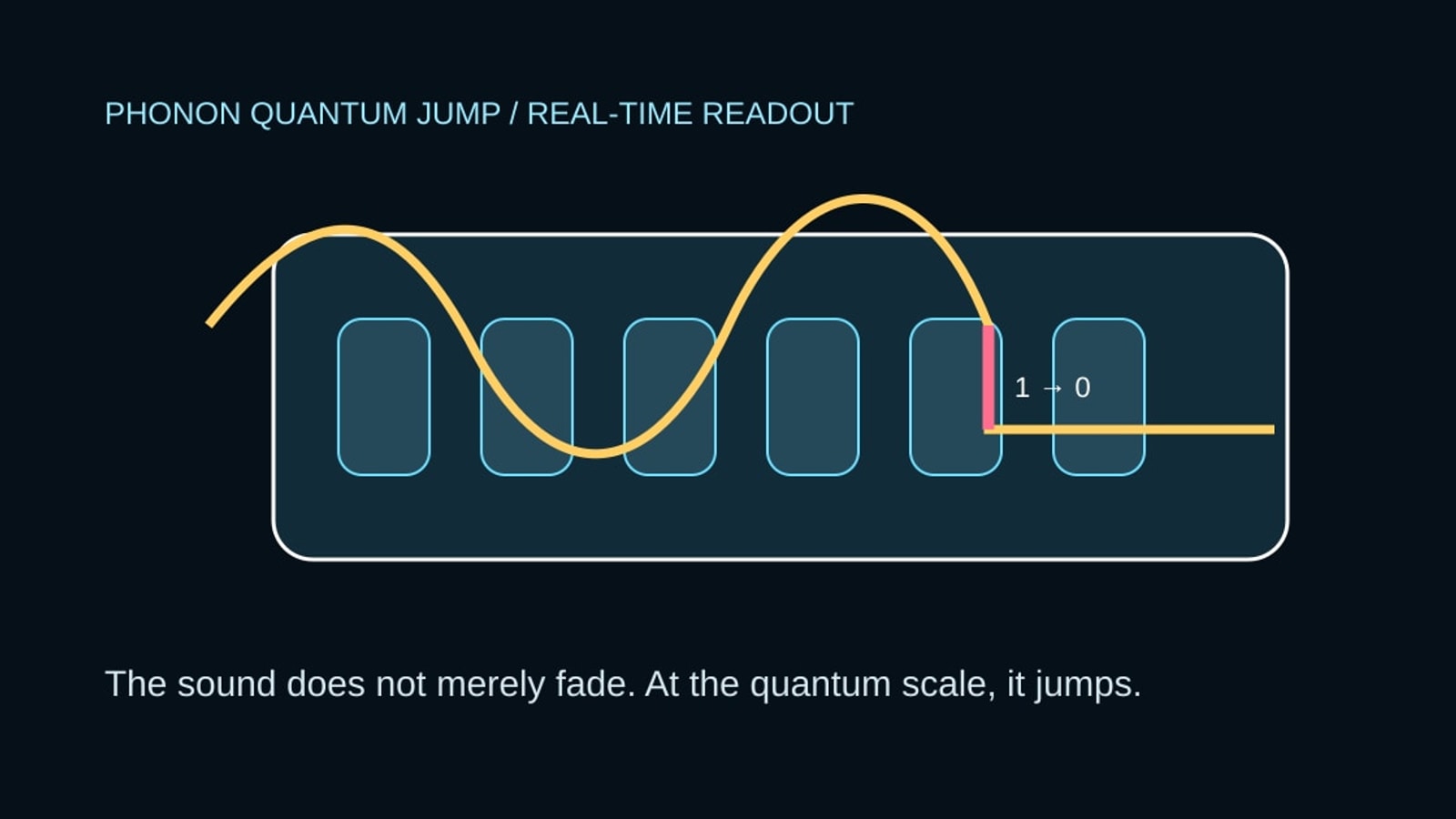
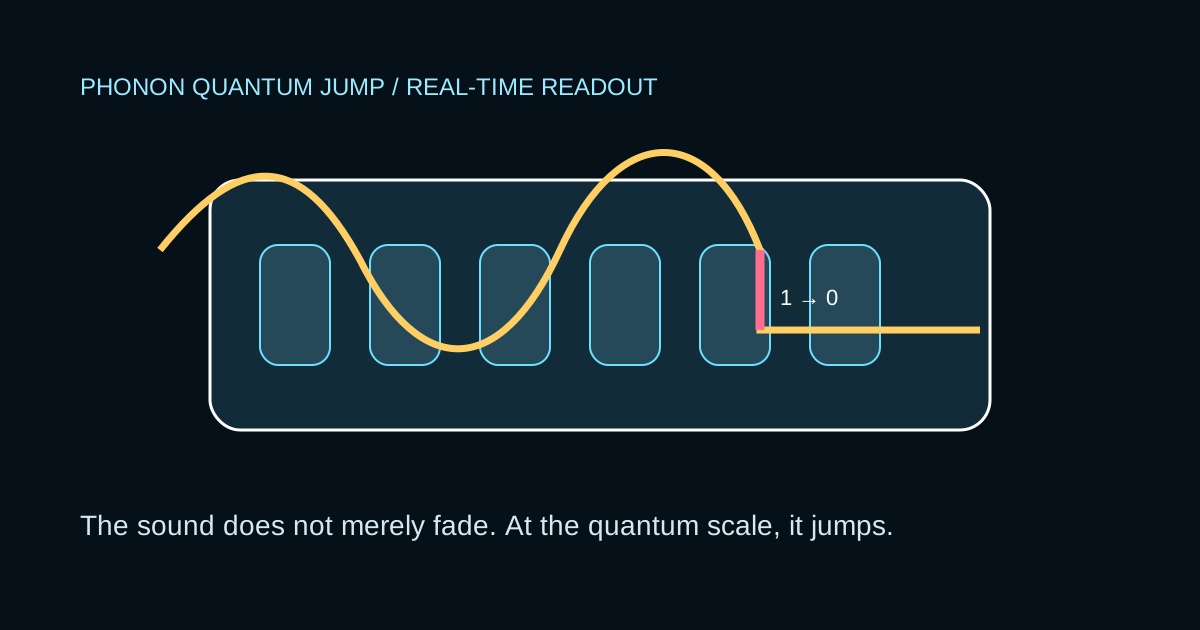
Quantum jumps are usually introduced with photons, atoms or trapped ions. Stanford researchers have now watched the same abrupt behavior happen in a quantum of sound.
The mechanism
The experiment used a microscopic mechanical resonator coupled to a qubit. The resonator could retain vibration long enough for the system to measure its state hundreds of times during a roughly two-millisecond interval.
That measurement cadence let the team identify the moment a phonon, the quantum unit of vibrational energy, moved between discrete energy levels.
The result matters because mechanical resonators are compact, fabricable and naturally compatible with sensing. They also offer another physical platform for studying errors and state changes that quantum-control systems need to detect.
Why it matters
In many quantum architectures, an unexpected jump is not philosophical weirdness. It is an error event. Detecting the jump in real time is the prerequisite for deciding whether and how to correct it.
The work also expands the category of devices that can be used as quantum sensors. Mechanical motion can couple to forces, fields and other signals that are difficult to access with purely optical systems.
Evidence boundary
What remains unknown: observing individual jumps does not establish a complete error-correction architecture, scalable quantum processor or field-ready sensor. The experiment is a foundational measurement capability.
the strange part is not that sound is quantum. Physics has known that for a century. The useful part is that engineers can now watch the jump happen while the device is still ringing.