

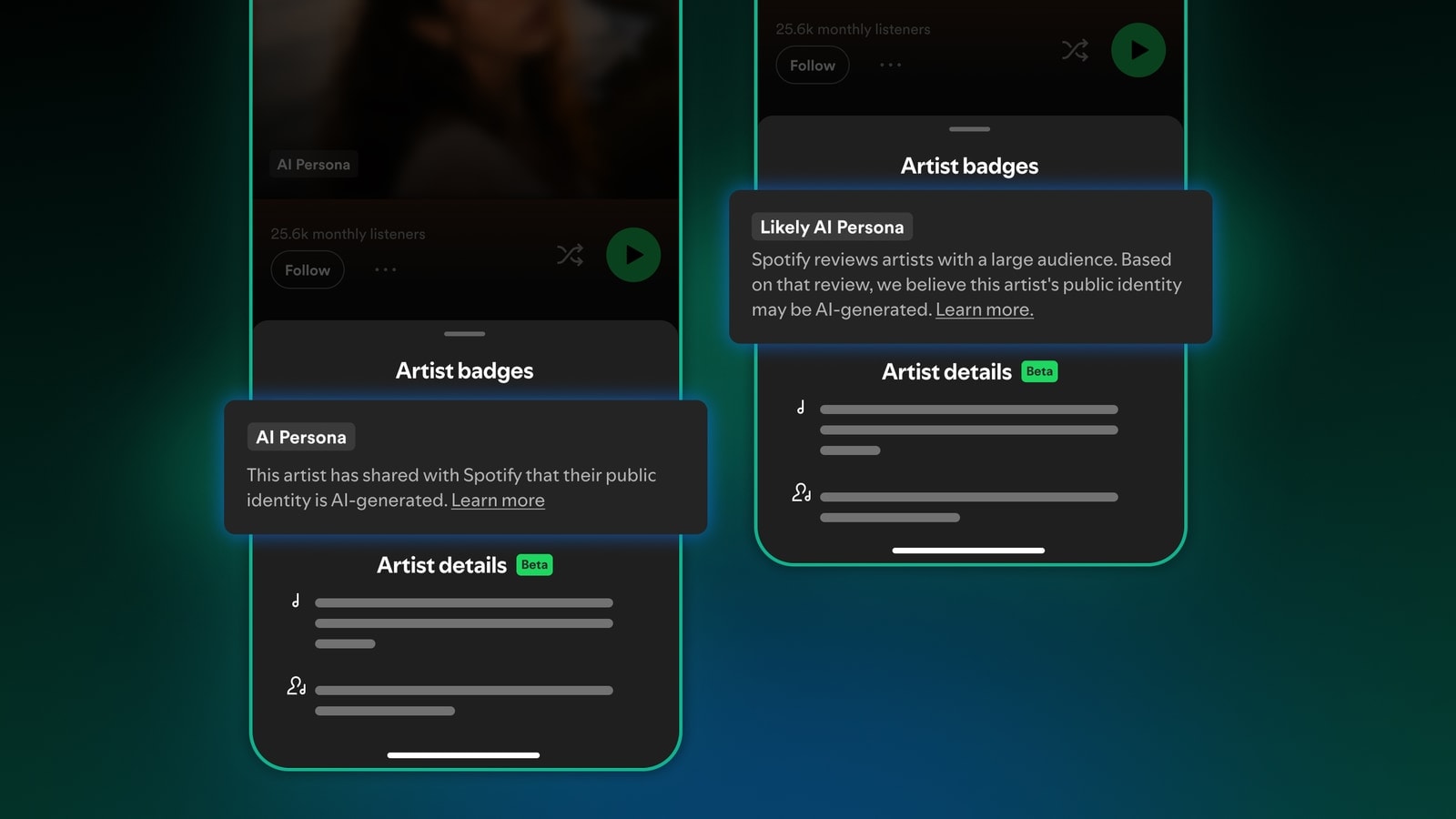
Spotify is about to put a label on artists who may not exist, and the label is the least interesting part of the announcement. Starting in mid-September, the company says some artist profiles whose public identities are AI-generated and do not represent real people will receive an "AI Persona" badge. The badge will appear on profiles, in search and alongside tracks in playlists. Artists can disclose the status themselves, but Spotify says it will also review profiles and apply the label when its teams conclude that a public identity appears to be photorealistic and AI-generated.
If this were only about disclosure, the policy would be easy to summarize. Spotify wants listeners to know when the apparent person behind an artist profile is synthetic. But the company is attaching a second consequence to that classification: by default, AI Personas will not be included in Spotify's editorial or algorithmic recommendations. Listeners who deliberately follow those personas can still encounter their music through personalized systems, but the default discovery machinery is being reserved for what Spotify calls authentic artists building careers in music.
That turns a badge into a distribution rule. Streaming platforms do not merely host music. They decide what millions of listeners encounter without searching for it. Editorial playlists, radio-style recommendations, personalized mixes and algorithmic discovery can determine whether a track remains invisible or becomes part of somebody's daily listening. A profile can technically stay on Spotify while losing access to some of the platform's most important audience-building machinery.
The distinction Spotify is making is narrower than a general AI-music policy. The company says the AI Persona badge is about the artist's public identity, not how the music was made. A real human musician who uses generative AI during songwriting, production, arrangement or sound design does not automatically become an AI Persona. Spotify points to separate systems such as AI Credits and SongDNA for information about how recordings were created.
That separation is important. It means Spotify is trying to classify two different things independently: the provenance of the work and the identity presented to the listener. Those questions used to travel together most of the time. A record had a performer, the performer had a name and face, and listeners reasonably assumed the profile represented some human being or identifiable group behind the recording. Virtual bands and fictional performers complicated that assumption long before generative AI, but synthetic photorealistic identities can now be created cheaply, continuously and at scale.
Spotify says listeners have complained about encountering profiles that appear human only to discover later that the persona was AI-generated. Its response is therefore partly a trust mechanism. The badge tells the listener that the identity on screen may not correspond to an actual person. Spotify will distinguish between profiles that self-disclose and profiles labeled after review, and artists labeled by Spotify will be able to appeal. The company also says listeners will eventually be able to report profiles they believe represent AI Personas.
The appeal process matters because identity classification is not as binary as Spotify's announcement makes it sound. A fully synthetic photorealistic pop star with no human public performer behind it is an easy case. A masked musician using an invented face is harder. A producer who writes and performs everything but uses a synthetic front-person as a deliberate art project is harder still. So is a virtual band run by a stable group of human creators. The public identity may be fictional while the artistic project behind it is intensely human.
Spotify has chosen to focus on whether the profile represents an actual human. That is administratively cleaner than trying to calculate percentages of human creativity inside every song, but it creates its own philosophical weirdness. Popular music has always contained aliases, masks, cartoon bands, stage names, anonymous producers and deliberately constructed personas. The difference now is that synthetic identity can imitate ordinary human presence rather than announcing itself as fiction.
That is probably why Spotify is starting with photorealistic identities and defined audience thresholds. It is targeting profiles most likely to create ordinary-person confusion at meaningful scale rather than attempting to classify every eccentric art project on the platform immediately. Even so, the company is building a system that will have to interpret motive, presentation and authenticity, concepts that become less clean the closer you inspect them.
The recommendation consequence raises a separate fairness question. If the goal is transparency, a badge addresses transparency. Excluding a category from recommendations goes further. Spotify is deciding not merely what listeners should know, but what its own discovery systems should favor. The company is explicit about the reason: its programming is focused on elevating authentic human artists.
That is Spotify's right as a platform policy, but it should be discussed as curation rather than neutral labeling. The company is assigning distribution value to human identity. An AI Persona can still upload music and gather followers, but it starts outside some recommendation channels unless listeners have already expressed interest. That can create a meaningful structural disadvantage for synthetic acts even if the music itself is human-written, human-produced or popular with people who encounter it elsewhere.
The policy may also create an odd incentive for AI-heavy projects to foreground a human operator rather than a synthetic performer. A producer can use generative tools extensively while presenting the project under a real human identity and avoid the AI Persona classification, at least under the rule Spotify has described. A different producer could make music with comparable levels of human involvement but put a fictional photorealistic singer on the profile and face recommendation restrictions. The difference would be public identity rather than production method.
That is not necessarily inconsistent. Spotify is openly saying identity is what this particular policy measures. But it demonstrates why the phrase "AI artist" is becoming dangerous shorthand. One project can be AI-heavy in production but human in identity. Another can be human-heavy in production but synthetic in identity. A third can be synthetic in both. A fourth can be a fictional character operated by humans in a way that looks more like animation or theater than autonomous machine creativity.
Spotify's broader 2026 authenticity push suggests the company knows these dimensions need separate controls. It points to Verified by Spotify as a signal that an artist is a real human presenting themselves authentically, AI Credits for disclosure about AI use in creation, SongDNA for contributor context and Artist Profile Protection for preventing misattributed releases. The AI Persona badge slots into that larger identity stack rather than replacing it.
From a systems perspective, this is the more important story. Streaming platforms are building provenance infrastructure because the old assumption that a profile, a recording and a person naturally map onto each other is breaking. Once that assumption fails, every layer has to be represented explicitly: who made the work, who performed it, who owns it, who is presented to listeners, what tools were used and whether the platform chooses to amplify it.
There are legitimate reasons for that infrastructure. Fraudulent profiles can exploit confusion. Synthetic identities can be used to impersonate real artists or flood recommendation systems. Low-effort mass generation can create spam at a scale human uploaders could not match manually. Listeners should not have to perform forensic research every time a profile photo looks suspiciously perfect.
But provenance systems also become power systems the moment classifications change distribution. A badge is information. Recommendation exclusion is governance. Spotify is doing both. That does not make the policy wrong, but it means appeals, consistency and error rates matter. A mistaken badge could affect discovery, not merely reputation.
Cyberdelia's assessment is that Spotify has drawn a conceptually useful line between production method and artist identity, then attached a much more consequential platform preference to the identity classification. The badge itself is sensible transparency. The recommendation rule is an explicit editorial judgment that human-presenting artists should receive default discovery priority over synthetic personas.
What would change this assessment? Evidence that Spotify applies the label to obvious fictional or virtual projects inconsistently, that legitimate human artists are repeatedly misclassified, or that appeals do not meaningfully correct errors would turn a transparency system into a credibility problem. Conversely, clear reporting on label accuracy, appeals and enforcement would make the policy easier to evaluate.
The old question was whether AI could make a convincing song. That question is becoming boring. The next fight is about whether listeners know who or what is behind the profile, and whether platforms should treat synthetic identities differently after they know. Spotify has answered both. It will label the persona, and it will keep that persona out of its recommendation machinery by default. That is not just a badge. It is a decision about who gets discovered.
Spotify's policy separates two questions the industry keeps conflating: how music was made and who the artist profile claims to represent. The transparency logic is straightforward. The recommendation restriction is a deeper editorial choice because it changes access to distribution, not merely disclosure.