


The promise is a change of timescale
Cambridge i-Teams lists Apricity as a developing heat-storage system based on a reversible chemical reaction and proprietary materials. The project targets high storage density and long duration, with potential applications in heating networks, data centres and solar heating. Its stated ambition is to move renewable energy from summer availability to winter heating demand. The Michaelmas 2026 project includes investigating markets and legislative conditions. [1]
That is a useful research and commercialization question. It is not a public record of a completed installation carrying a household through winter. The project description does not supply enough numerical performance data to calculate an installed system's size, efficiency or cost. Cyberdelia has not independently tested the material.
The engineering story is therefore an evidence gap that can be made precise. What measurements would turn a promising storage approach into a credible heating-system design? A careful answer begins by defining what the customer actually needs delivered, and then follows every conversion between the energy source and that service.
Start at the radiator
For a heating application, the service is useful heat delivered at an adequate temperature and rate, at the time it is needed. Storage capacity alone does not establish that service. A large energy inventory can still fail a cold morning if the device cannot release energy quickly enough or deliver a suitable temperature.
A design evaluation should therefore keep four quantities separate: stored energy, discharge power, delivery temperature and duration. The first describes how much is available. The second describes how fast it can leave. The third constrains where it can be used. The fourth describes how long it remains available before retrieval. A single impressive density number cannot substitute for all four.
This distinction is especially important when comparing different storage technologies. A device designed to discharge electricity into a grid and a device designed to supply a heating loop may solve different problems. Comparisons should use the same delivered service and clearly state the conversion equipment required. Otherwise, the apparent winner may simply have been assigned the easier task.
Retention is one part of the energy balance
The project describes chemical storage as avoiding thermal losses during the holding period. Treat that as an attributed design claim. It does not establish a measured zero-loss balance for charging, holding, discharge, pumps, controls and delivery to a building. Those stages require separate measurements. [1]
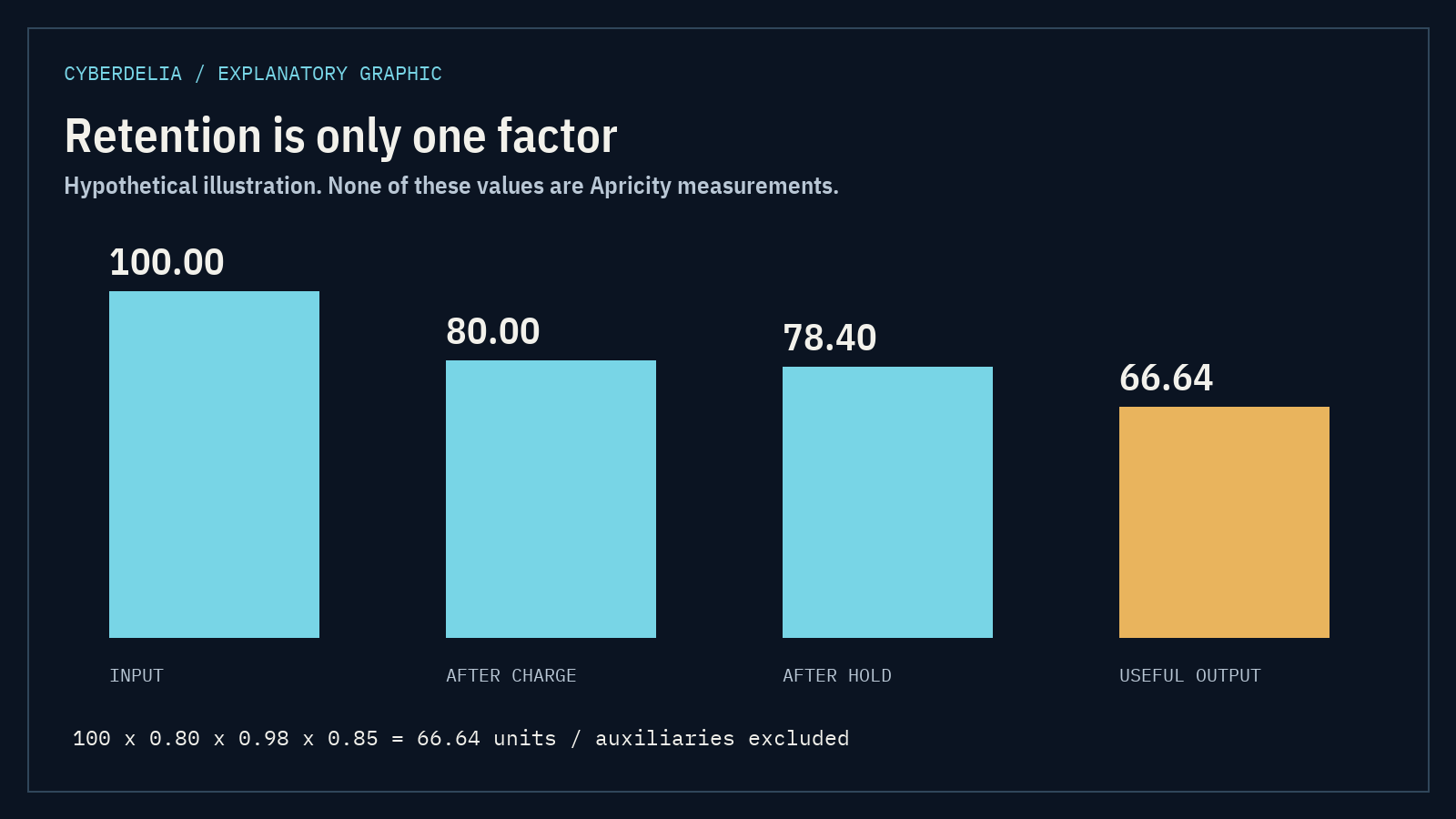
A reporting framework can express the distinction without guessing the proprietary chemistry. Let the energy entering a specified charging boundary be E. Let the charge conversion fraction be c, the retained fraction after storage be r, and the discharge-to-useful-heat fraction be d. Before separately accounted auxiliary consumption, useful output is E multiplied by c, r and d. The factors must use compatible boundaries; this is an accounting model, not an Apricity performance model.
For illustration only, if those factors were 0.80, 0.98 and 0.85, their product would be 0.6664. One hundred units entering that hypothetical system would yield 66.64 units at the defined output. Strong retention would coexist with substantial losses elsewhere. None of these example values has been measured for Apricity.
The point of the calculation is to show what a retention claim can and cannot answer. A future test should publish the boundary, the inputs, the outputs and the duration, allowing a reader to reconstruct the balance.
A winter is an energy inventory
Consider another explicitly hypothetical sizing case. A building needs 5,000 kilowatt-hours of useful seasonal heat from storage. If the fraction recoverable from an inventory at the start of winter to the useful delivery point were 70 percent, it would need approximately 7,143 kilowatt-hours in that inventory. Divide 5,000 by 0.70 to reproduce the result.
This example excludes the energy required to create the starting inventory, so it must not be called a full round-trip calculation. It also excludes a reserve for demand uncertainty. Changing the recovery assumption changes the required inventory directly. At 50 percent recovery, the same useful demand would require 10,000 kilowatt-hours at the stated starting boundary.
To convert inventory into volume, divide by an independently established usable energy density at that same boundary. No suitable public Apricity value has been established here, so we leave the volume unanswered. Substituting a laboratory material value for an installed-system value would conceal vessels, heat exchangers, plumbing, controls and any unused material.
An honest unknown is more useful than a tank-size estimate built from an attractive number belonging to a different experiment.
Peak demand is a separate test
The seasonal energy budget does not identify the required output on the coldest hour. A useful installation assessment should include a demand profile, the storage device's discharge envelope and an explicit role for any backup heater. Reporting only the fraction of annual demand supplied can conceal failures during the periods when the customer most needs reliable heat.
An illustrative comparison makes the distinction clear. Two devices might hold the same total energy but differ substantially in maximum useful output. A building could empty one slowly over many days and still need backup during a short peak. The other might meet the peak but require different plumbing, controls or capital expenditure. Neither outcome can be inferred from capacity alone.
The test should also include a partly depleted store. Performance near the beginning of discharge may not describe the conditions near its end. This is a proposed evaluation question, not an allegation of a known Apricity limitation. Public curves showing output and delivery temperature over the discharge cycle would make the comparison much more informative.
The installed device has to survive repetition
A material demonstration is one layer of evidence. An integrated device must repeat its operation while maintaining predictable behavior. Appropriate evaluation would examine cycling, contamination sensitivity, component replacement, commissioning and recovery after an interruption. The relevant failure modes depend on the actual chemistry and hardware, which the available description does not disclose in sufficient detail.
That uncertainty prevents confident claims about particular hazards or maintenance intervals. It also prevents assuming those issues have already been solved. A credible next report could identify the tested operating envelope, how capacity changed across cycles and which parts of the apparatus were replaced during testing.
Maintenance is part of system performance because it affects availability and delivered cost. A high-performing material that needs frequent service may suit an industrial site better than a home. A lower-density system with simple maintenance might suit another setting. The right comparison follows the user's constraints rather than a universal ranking of storage materials.
Product development often consists of making these ordinary obligations reliable. Calling them mundane does not make them optional.
Seasonal economics needs a denominator
A store used once per year has a different revenue and utilization problem from one cycled frequently. That observation does not prove seasonal storage is uneconomic. It means the analysis must state how often the capital asset provides a valuable service and what alternatives it displaces.
A transparent evaluation would include installation, charging energy, auxiliary consumption, maintenance, expected life and the value of useful heat delivered. If the model assumes access to cheap surplus energy, show the hours and conditions under which that supply is available. If the same device also serves weekly or monthly needs, account for those uses without double-counting capacity reserved for winter.
The counterfactual matters as much as the device. Compare against the heating arrangement the customer could actually install, including any relevant network, conversion or backup equipment. An impressive storage-cost estimate can disappear when the rest of the system is included. It can also understate value if it ignores a genuine local constraint. Both errors come from drawing the boundary around the most flattering part of the system.
The strongest case for pursuing it
The favorable case is a match between a long period of energy availability and a later period of heat demand. If a practical chemical store retains its charged state well and delivers useful heat economically, it could provide an option that short-duration equipment does not address on the same terms. That is a conditional engineering case, not a finding that this particular system already achieves it.
The skeptical case is that material promise may not survive packaging, conversion losses, operating requirements and low annual utilization. A claim of long retention does not answer those objections. A successful response would be a measured system balance, repeated operation and a realistic installed comparison.
Other seasonal-storage research cannot stand in as validation. For example, a separate 2026 study examines modeled chemical interactions in a Munich geothermal heat-storage setting. That work concerns a different physical system. Its existence broadens the research context but does not establish Apricity's performance, chemistry or readiness. [3]
Keeping these boundaries explicit allows several approaches to be interesting without allowing evidence from one to migrate invisibly into claims about another.
CYBERDELIA ASSESSMENT / What evidence earns the next headline
The next useful Apricity update would identify a test configuration, useful output temperature, charge and discharge balances, storage duration, cycling history and the uncertainties around each measurement. A pilot should then show performance against a real demand profile, including backup use and operational interruptions. Independent scrutiny would strengthen both stages.
A commercially useful result might serve a narrow market first. That would still matter. A device does not need to solve every heating application to earn a place in an energy system. Conversely, a broad list of target applications does not establish suitability for each of them.
Cyberdelia's assessment is to take the mechanism seriously and keep the performance claim open. Storing summer energy for winter is a clear objective. The publication-worthy breakthrough will be a documented chain from charging source to useful heat, across time, at a cost and reliability the intended user can live with.
Source trail
Corrections and updates
Published analysis dated October 29, 2026. Sources checked on that date. Send a specific correction with supporting evidence through the correction trail. Material changes will be identified here.