

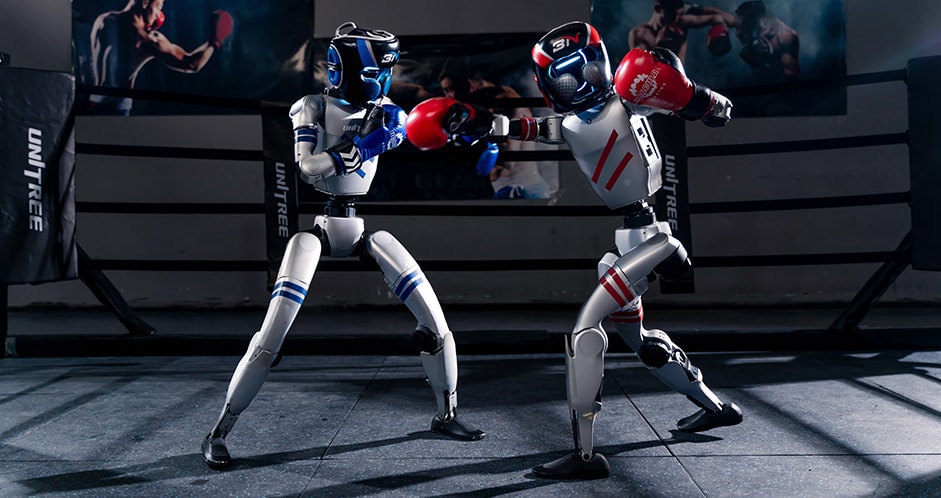
There is a moment in almost every boxing gym when a beginner discovers that the hands are not the point.
The beginner comes in thinking boxing is about punches. The coach watches for half a round and starts talking about feet. The fighter reaches and the coach talks about balance. The fighter throws harder and the coach tells him to relax. The fighter gets hit and the coach asks where his head was before the punch was thrown. The fighter complains that the other guy is fast and the coach asks why he keeps standing at the exact distance where speed matters.
This can be maddening until the pattern becomes visible. Boxing is not a catalog of strikes. It is a real-time control problem performed by two hostile bodies sharing the same geometry.
That is why boxing has carried the nickname the sweet science for roughly two centuries. The phrase is associated with the British sportswriter Pierce Egan, who wrote of prizefighting as the “sweet science of bruising” in the early nineteenth century. The contradiction was part of the point. A fight could look savage while being governed by timing, leverage, position, deception, endurance, judgment and accumulated technical knowledge.
Now put two humanoid robots in a ring.
The phrase becomes almost embarrassingly literal.
A humanoid robot must estimate position, maintain dynamic balance, manage center of mass, select actions under uncertainty, transfer force through a multi-joint structure, survive impacts, recover from failed motions, infer an opponent’s intent and make decisions fast enough that the opponent cannot simply exploit the delay. If the robot is teleoperated, the human controller and machine form a coupled control system. If the robot is autonomous, the problem becomes even stranger: an artificial agent has to make strategic decisions while every decision remains constrained by friction, inertia, torque limits, joint range, impact, latency and the very real possibility of falling on its mechanical ass.
That is not adjacent to boxing.
That is boxing, viewed through another substrate.
The machinery is different. The vulnerabilities are different. The physiology is gone. Pain, fear, lungs, concussions and courage do not map cleanly onto motors, batteries and control loops. But underneath those differences sits a class of problems boxing has spent generations learning to solve.
The question is no longer whether humanoid robots can fight. They already do.
The more interesting question is whether robotics is about to rediscover the sweet science from first principles, or whether somebody will have the good sense to ask the people who already know it.
1. The Sport Has Already Started
Robot fighting is not new. Machines have been crashing into, flipping, cutting and smashing one another for decades. BattleBots and similar competitions established long ago that spectators will happily form emotional attachments to machines built specifically to destroy other machines.
Humanoid combat is different.
A wedge-shaped robot with a spinning bar does not have to solve the problem of being a body. A humanoid does. It has feet, legs, hips, a torso, arms and a head-like sensor platform. It occupies a shape that humans intuitively understand because we inhabit roughly the same geometry. When it falls, we recognize the failure immediately. When it slips a strike, recovers its stance, corners an opponent or strings together a combination, the action is legible in a way that no explanation is required to make exciting.
In May 2025, Unitree Robotics hosted what it describes as the world’s first humanoid robot combat competition based on its G1 platform. Four teams fought with the same underlying robot model but different team-developed control approaches. The original format was human-controlled rather than fully autonomous, but that hardly makes it trivial. Teleoperated humanoid combat exposes latency, stability, recovery and control problems with a cruelty no laboratory demo can reproduce.
By 2026, the second World Humanoid Robot Games in Beijing drew more than 2,000 robots from 16 countries into a sprawling competitive program that included athletic, practical and combat events. Meanwhile, smaller fighting organizations were appearing elsewhere. REK began presenting full-contact humanoid fighting around a hybrid structure in which pilots can compete through a simulator and qualify toward operating real machines in live events.
There is also a shift happening inside research.
A 2026 preprint called RoboStriker: Hierarchical Decision-Making for Autonomous Humanoid Boxing presents a framework for fully autonomous humanoid boxing. The authors explicitly frame boxing as a difficult multi-agent learning problem because strategy cannot be separated from physical feasibility. RoboStriker separates high-level strategy from low-level physical execution, learning physically plausible human-derived boxing motions and allowing competitive self-play to operate in a constrained latent action space.
That paper matters because it recognizes that humanoid combat is not just an animation problem. It is strategic co-adaptation under physical constraints.
That is the sweet science in machine-learning language.
And once a field reaches this point, something predictable happens. Engineers begin discovering principles coaches have expressed for generations in sentences that sound almost insultingly simple.
Keep your feet under you. Don’t reach. Don’t admire your work. Get off the line. Make him reset. Don’t follow him. Cut him off. Touch him to make him show you what he wants to do.
The language is not mathematical. The underlying knowledge often is.
2. A Boxing Coach Is Carrying a Compressed Control Model
The technical knowledge inside a good boxing coach is peculiar because much of it is empirical before it is formal.
A veteran coach may watch three seconds of a fight and say, “He’s too square.” Asked to define the observation precisely, the explanation may arrive as demonstration rather than equations. The coach moves a foot, turns a hip, shifts the shoulders and shows why the fighter is exposed.
To an engineer, this can look imprecise. It is not necessarily imprecise. It is often compressed.
The coach has seen the state thousands of times. He has seen what comes before it, what comes after it, what kinds of fighters exploit it, how tired fighters fall into it, and what correction tends to restore stability. His nervous system is running a classifier built from years of adversarial data.
Boxing gyms are full of these compressed models: “He’s reaching.” “He’s falling in.” “He’s heavy on the front foot.” “He’s pulling straight back.” “He’s loading up.” “He’s waiting on the punch.” “He’s chasing instead of cutting the ring.” “He’s getting timed.”
Every one of those statements can be unpacked into measurable variables.
If a coach says a robot is “reaching,” what mechanical state generated the diagnosis? Was the base too far outside efficient striking range? Did the torso lean ahead of the support polygon? Did the rear foot fail to follow the hand? Did the robot increase endpoint reach by sacrificing post-strike recoverability?
If a coach says “he has no jab,” the engineer should not answer by adding a jab animation. The question is: what function is missing?
The jab can score, interrupt, measure distance, obstruct vision, initiate combinations, force a defensive response, freeze forward movement, occupy a guard, create a false timing expectation and act as a low-cost probe. A robot with a beautiful jab trajectory but none of those strategic functions has an arm motion, not a jab in the boxing sense.
This is where traditional coaching becomes valuable to robotics. Coaches are not merely repositories of historical techniques. The best ones are observers of interactive dynamics.
A robot team may know exactly what the machine is capable of doing. A boxing coach may know what it should be trying to make the opponent do. Those are not the same question.
Part 1 of 8 — The Sweet Science