

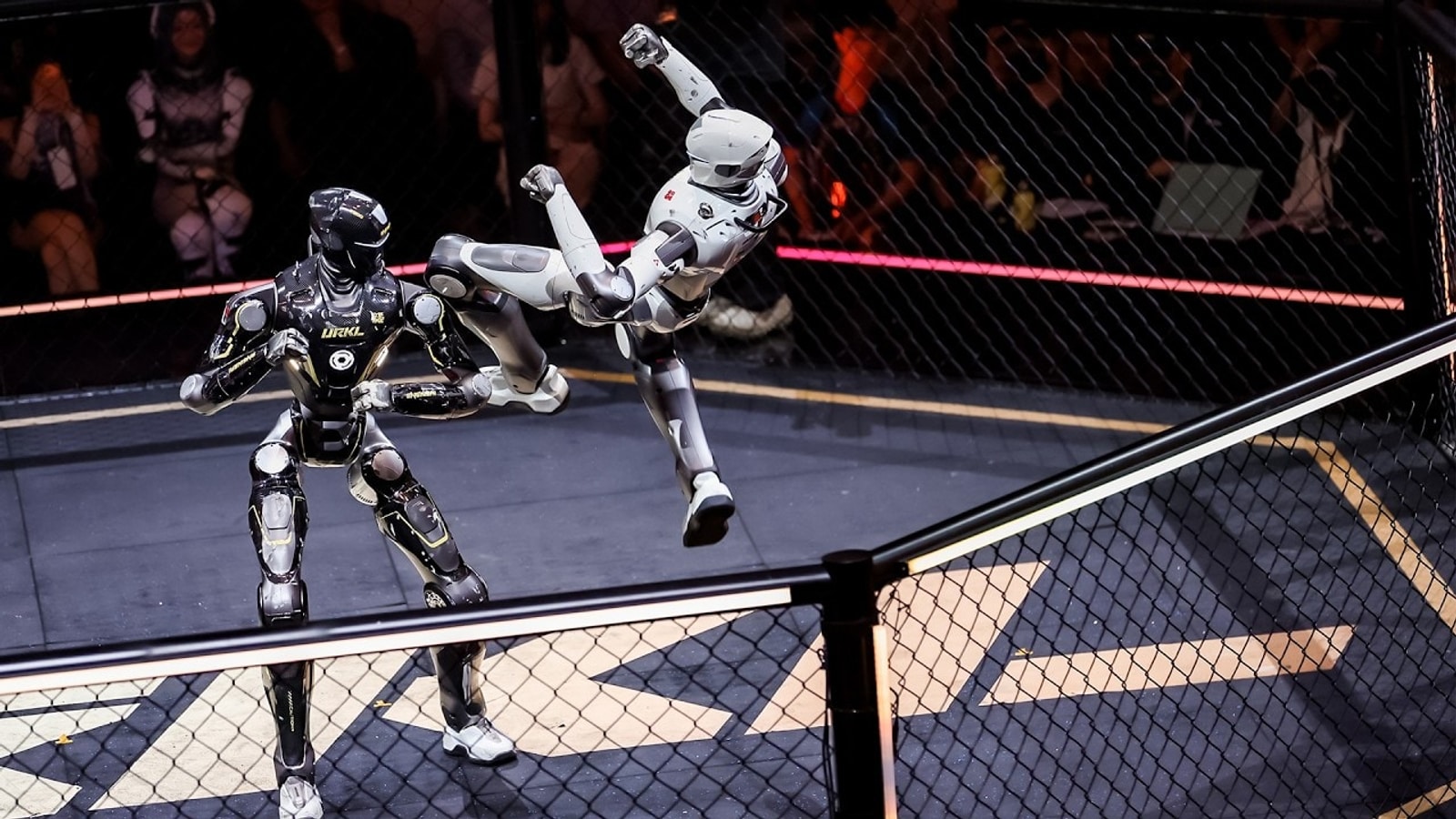
The future robot-fight broadcast should sound less like a technology demo and more like a fight.
That means someone has to be willing to call what the machines are doing in real time: who owns the range, who is getting squared, whose recovery is slowing, which robot is chasing, which one is controlling exits, and whether the apparent power advantage is being purchased with balance.
A real coach can make the machine legible.
Most audiences do not need a lecture on centroidal dynamics during a combination. They do need someone who can explain why the exchange was decided before the visible knockdown.
Boxing commentary supplies a language of causation. “He keeps backing straight up” gives the audience a pattern to watch. The technical layer can then show trajectory and boundary pressure underneath it.
The sport becomes richer when human intuition and telemetry reinforce each other.
The ring will punish fake progress.
Robotics marketing can select the successful take. Competition cannot control what the opponent does. A robot that performs a beautiful martial-arts routine may still fail when contact arrives off-axis, timing changes or the floor is imperfect.
This makes fighting harsh evidence. Not perfect evidence, but harsh.
The robot has to perform now, under rules, against something trying to stop it.
The best teams may need coaches.
As low-level locomotion improves, the bottleneck moves upward toward tactics. Engineers can learn tactics through self-play, but human combat sports already contain generations of structured adversarial knowledge.
A boxing coach inside a robot team would not write motor-control code. The coach would identify tactical problems, design drills, classify opponent behavior and help define what successful movement is supposed to accomplish.
Engineers would translate those goals into policies and measurable states.
That division of labor is ordinary in mature fields. Experts do not need to speak the same technical language if the interface between their expertise is disciplined.
Why this can explode as a sport.
Humanoid combat has an unusually low explanatory barrier. People instantly understand two bodies entering a ring. At the same time, the machines add a second layer of fascination: every failure is also an engineering failure.
Fans can follow fighters, teams, pilots and code. Technical audiences can follow control architectures. Casual viewers can follow knockdowns. Manufacturers can test hardware. Researchers can test policies.
That stack of audiences is rare.
The sweet science gets rewritten, not replaced.
The deepest opportunity is not to make robots imitate great boxers frame by frame. It is to discover why the old principles work and express those mechanisms in a substrate that can be measured at absurd resolution.
Humans learned boxing through bodies, bruises, repetition and coaching. Robots will learn through sensors, simulation, self-play, telemetry and increasingly violent field tests. The methods differ. The adversarial geometry rhymes.
Robot boxing is already moving from demonstration toward organized sport. Its next leap may come when the field recognizes that boxing coaches are not historical decoration; they are repositories of compressed adversarial knowledge. Put that knowledge beside telemetry and control theory, and “the sweet science” stops being a nickname. It becomes a research program.
Part 7 of 8 — The Sweet Science