
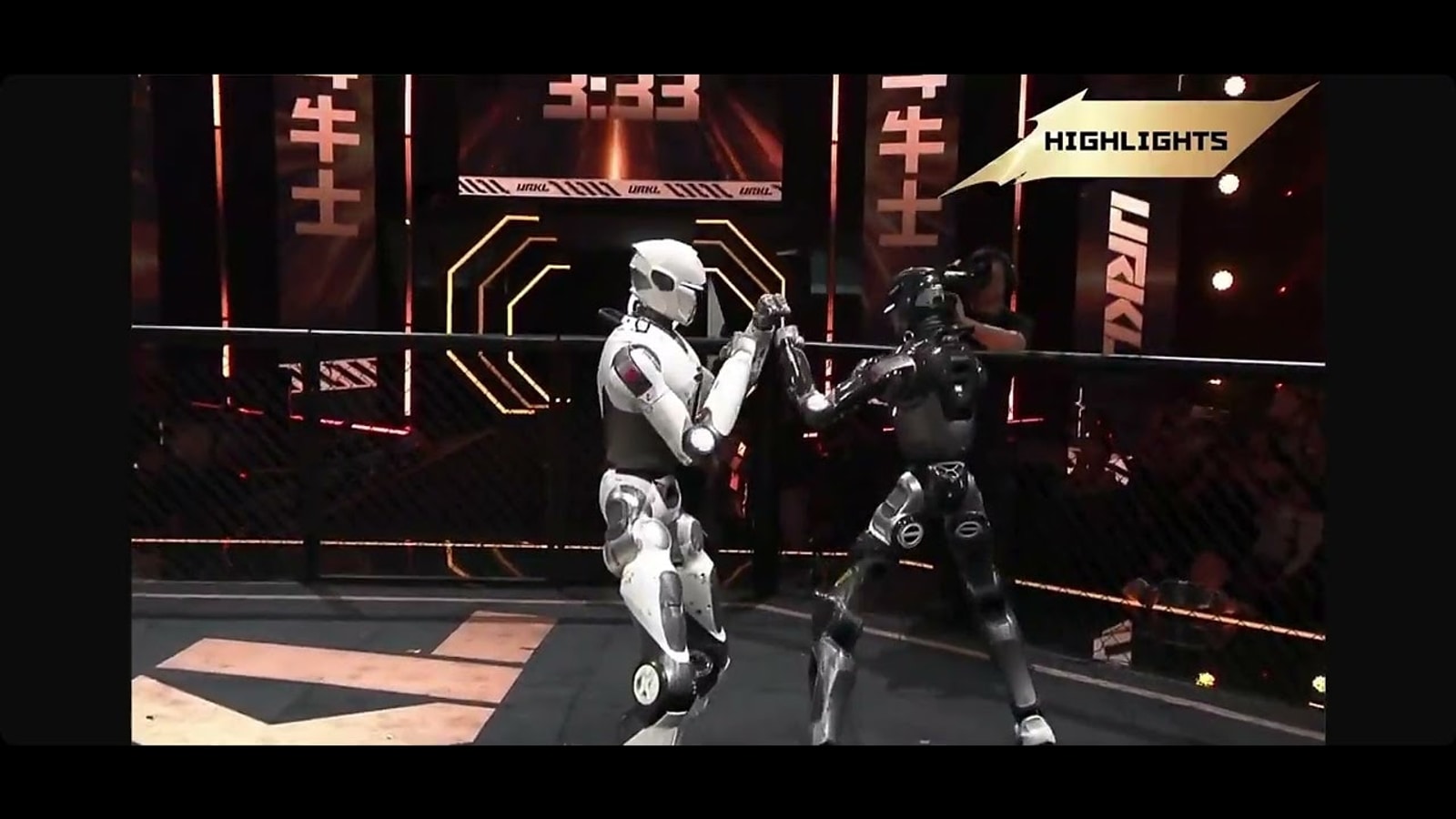
This companion turns the series thesis into an explicit research protocol: capture the coach's diagnosis, identify the implied mechanism, map it to measurable robot state, then test whether the mapping predicts outcomes.
Translation table.
“He's reaching.” Candidate variables: torso projection relative to support, rear-foot follow, endpoint extension, post-strike recovery latency, lateral disturbance margin.
“He's getting squared up.” Candidate variables: torso orientation, stance width, bilateral symmetry, rotational reserve, lateral exit availability.
“He's backing straight up.” Candidate variables: retreat-vector entropy, lateral displacement, boundary distance, opponent pursuit efficiency.
“He's loading up.” Candidate variables: pre-strike motion amplitude, action onset signature, torque ramp, preparation time, opponent prediction accuracy.
“He's getting timed.” Candidate variables: inter-action interval variance, opponent response latency, counter success conditioned on repeated pattern, pre-motion cue consistency.
“He has no jab.” Do not count jab animations. Measure functions: low-cost range probe, interruption, guard occupation, entry creation, response elicitation and information gain.
Protocol 1: blind coach annotation.
Give a coach complete bout video without telemetry overlays. Ask for timestamped observations and tactical recommendations. Do not explain the robot's control architecture first.
Protocol 2: independent engineering annotation.
Have the robotics team mark balance failures, saturation, perception faults, latency events, contact impulses, thermal behavior and recovery states without seeing the coach's labels.
Protocol 3: alignment.
Synchronize both annotation streams. Identify convergence, divergence and unexplained predictions. Build candidate measurable definitions for recurring coach terms.
Protocol 4: intervention.
Change one control behavior based on the translated diagnosis. Test in repeated matched bouts. If “stop reaching” becomes a new recovery constraint, measure whether fall rate, counter vulnerability and scoring change.
Protocol 5: preserve failed translations.
If a coaching rule produces no benefit or hurts performance, do not hide it. Record morphology, control mode and rules. The failure may define a boundary between human and machine combat.
Minimum bout dataset.
Robot configuration; control mode; software build; operator if applicable; position trajectory; actions; contacts; fall and recovery events; manual interventions; energy state; thermal limits; repairs; coach annotations; engineering annotations; outcome.
Research question.
Which principles of mature human combat remain valid when the body is mechanical, and what measurable mechanisms explain the ones that survive?
That question can support years of work without pretending robots are people or coaches are control theorists.
Coach-to-Control is the bridge: preserve expert language first, translate it into candidate variables second, test it under competition third. The goal is not to make robots look like boxers. The goal is to extract the adversarial mechanics boxing already learned the expensive way.
Part 8 of 8 — The Sweet Science