

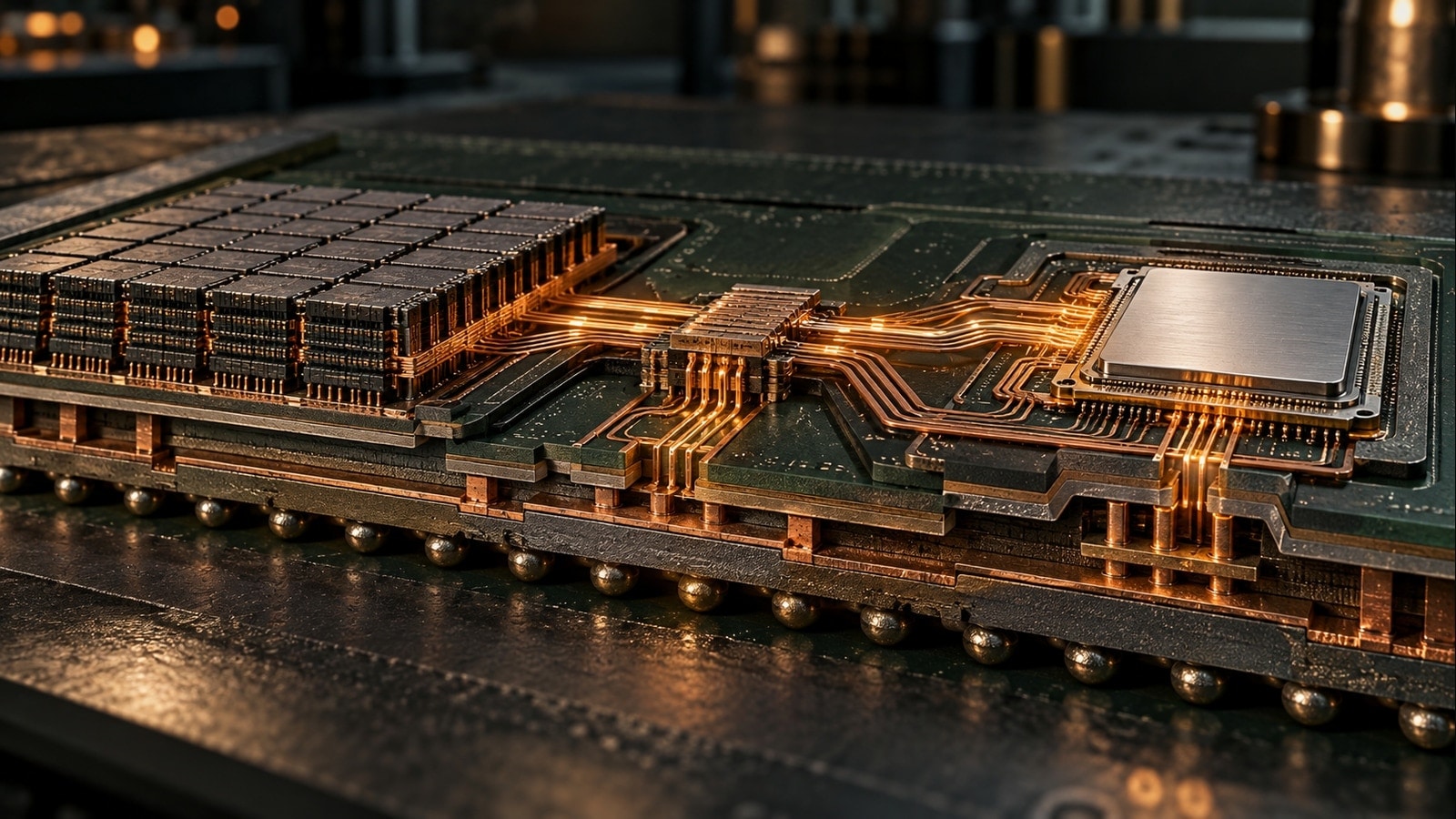
AI hardware gets introduced with numbers large enough to need their own luggage. Operations per second. Parameters. Accelerator counts. The language encourages a particular picture: intelligence is a mountain of arithmetic, and progress means bringing a larger shovel. There is real engineering behind those numbers. They still leave out a surprisingly important job the machine performs before the impressive calculation can happen. It has to find the numbers.
That sounds trivial until the same apparently trivial work repeats across an entire model. A warehouse can own an excellent cutting machine and still lose the afternoon locating stock, sorting deliveries, and carrying material to the bench. Computing has its own versions of those delays. Some happen in software, some in the memory system, and some inside the processor’s instruction stream. They deserve separate names because they require different repairs.
An October 6 paper by Ajay Kumar M and colleagues offers a timely example. Their RISC-V framework targets five compact transformer encoders. One custom instruction accelerates address generation for batch matrix multiplication, reporting a 15.39–21.74 percent improvement for that operation. The complete instruction extensions deliver roughly 1.19–1.24 times baseline inference performance; adding compiler loop-unrolling hints raises the best reported speedup to 2.19 times. Those are distinct results, not one instruction magically doubling a model. [1]
The limits matter. The main inference comparisons are instruction-accurate simulations, averaging two runs. Hardware functionality was also checked with a small hand-coded transformer on an FPGA. Full-extension synthesis increases ASIC area by 21.08 percent and FPGA area by 32.94 percent; those figures describe different implementations. The workloads use unquantized, encoder-only models, not a desktop chatbot or autonomous robot. Cyberdelia has not independently reproduced the results. [1]
Our interest is the engineering habit behind the work: inspect what the program actually spends time doing, then change the part responsible. That habit travels farther than a headline multiplier. It asks developers to account for the machinery between a model’s mathematical description and the physical execution of its instructions. A calculation on a whiteboard does not have to fetch its next operand. A processor does.
RISC-V’s base integer specification makes the distinction concrete. Arithmetic works on registers; loads and stores access memory. A load or store forms its effective address by adding a register value to an offset. Address arithmetic is therefore part of doing the job, even when it is absent from the neural-network diagram. The instruction set also defines ordinary integer additions and shifts that software can use when constructing more complicated addresses. [2]
Imagine a matrix stored as successive rows. Asking for a particular element involves its starting location, the row’s position, the row width, and the element’s position within that row. This is a simplified example rather than a description of the paper’s exact implementation. Its point is that identifying an operand can require work before operating on it. Repeating that work creates an optimization opportunity only if it consumes a meaningful share of the real execution time.
Address generation should not be casually renamed a memory-bandwidth breakthrough. Finding an address, transporting the bytes, and multiplying the values are connected activities, but they are different constraints. Making the first faster does not automatically widen a physical memory interface. Increasing the interface’s bandwidth does not automatically remove software bookkeeping. A useful diagnosis identifies which resource or dependency is holding up the actual workload.
NVIDIA’s performance documentation supplies a broader model: GPU work can be limited by arithmetic throughput, memory bandwidth, or latency. Small workloads may lack enough parallel work to occupy the processor effectively. Different neural-network operations can also face different limits. A single-vector fully connected operation, for example, is described as memory limited, while sufficiently large matrix operations can become limited by mathematical throughput. The same architecture can encounter different bottlenecks as the job changes. [3]
This is why an accelerator’s advertised peak is an incomplete description of an application. A maximum calculation rate says something about a machine under particular conditions. It says less about a program containing preparation, transfers, small operations, synchronization, and output handling. For a workshop evaluating local AI, the useful question is the elapsed time required to produce an acceptable result from the intended input. Every stage that contributes to that interval belongs in the account.
Roofline analysis provides one established way to investigate the relationship. NVIDIA’s Nsight Compute documentation compares achieved performance with computational and memory-bandwidth ceilings, using arithmetic intensity—the amount of work per byte of memory traffic. Its profiling tools can also expose different memory-level ceilings. This is a way to locate a constraint, rather than a universal recipe for removing it. A workload still needs enough detail to explain why its measured point falls where it does. [4]
For readers building embedded systems, RISC-V adds another practical dimension. Its standard instruction map explicitly provides custom opcode regions that future standard extensions will avoid. A processor designer can use those regions for specialized instructions. That permission in the specification is not a promise that every RISC-V chip already implements a particular accelerator, or that binaries using a private extension will run unchanged on another implementation. [5]
The distinction changes what counts as an upgrade. An application update can alter software. A custom hardware instruction requires a processor that supports it, along with a toolchain capable of producing the relevant code. Our assessment is that useful specialization must be evaluated as a maintained hardware-and-software arrangement. The impressive unit is the supported system, including what happens when its compiler, model, or deployment environment changes.
The authors’ public repository makes part of that arrangement inspectable. It describes a pipeline using Hugging Face models, ONNX export, and Apache TVM to produce C test cases for compact encoder models fine-tuned on sentiment classification. It also describes evaluating generated code with Synopsys ASIP Designer. Public model-generation scripts are valuable evidence of implementation work; their existence does not constitute an independent replication of all reported processor results. [6]
That is a useful boundary for the reader as well as the researcher. An open repository lets a careful outsider investigate portions of an argument that a presentation slide conceals. Reproduction may still require specific tools, designs, configurations, and test inputs. A serious review asks which steps are available and which remain dependent on the original team. Inspectability and reproducibility are related achievements, and each deserves its own evidence.
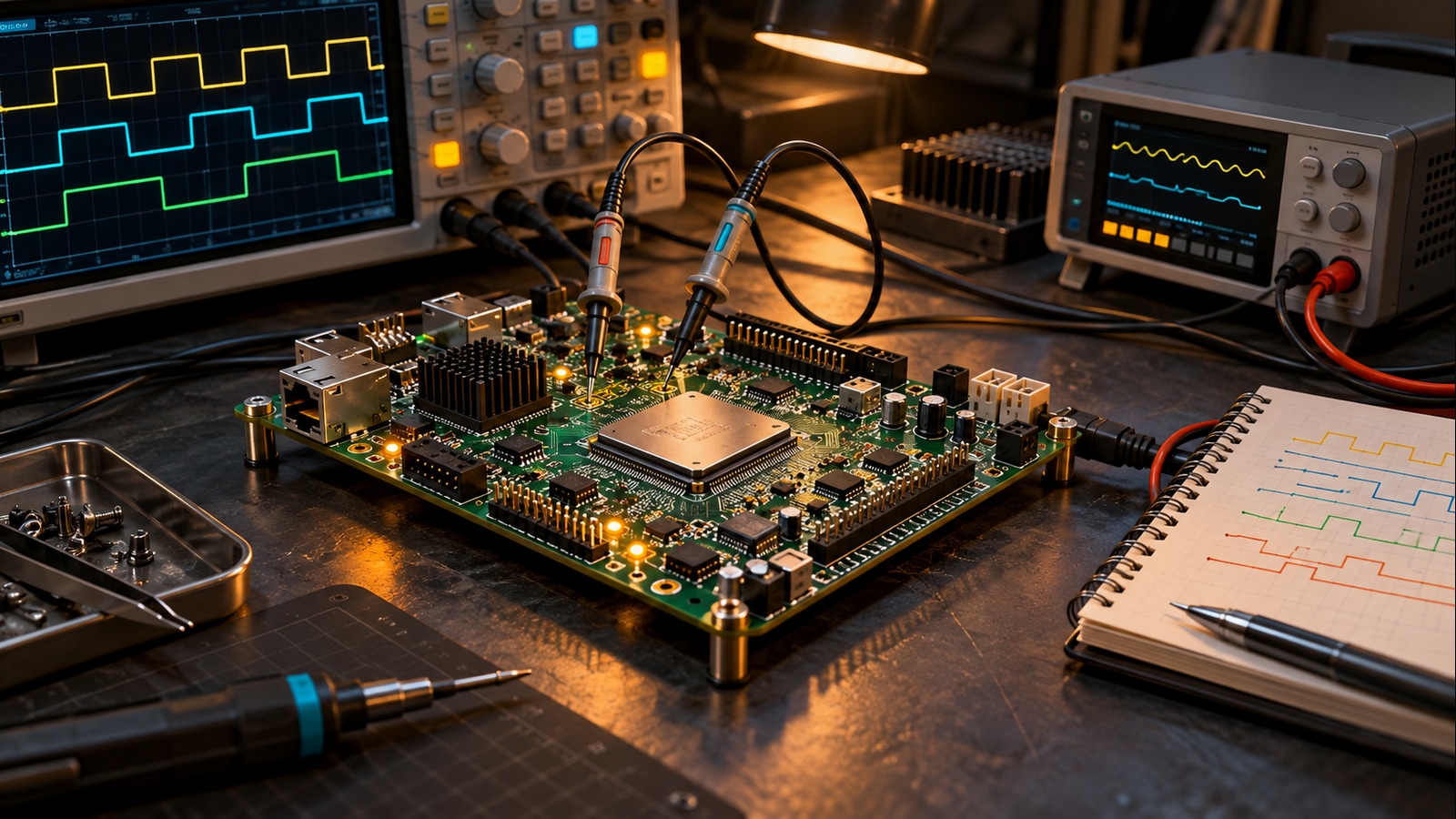
On an existing GPU system, some relevant interventions live in the application’s handling of data. NVIDIA’s CUDA best-practices guide recommends minimizing transfers between host and device, preserving intermediate structures on the device, and grouping small transfers when appropriate. It explicitly warns that transfer overhead belongs in the decision about where an operation should run. A kernel that looks slower in isolation can still help the application if using it avoids expensive transfers. [7]
This gives the hardware story a software consequence. Before deciding that a machine needs more computational capacity, a builder can investigate whether the program keeps moving the same information unnecessarily. That is a proposed diagnostic step, not a diagnosis of any particular reader’s computer. The answer could still be that the processor is fully occupied with necessary arithmetic. Measurement earns that conclusion more reliably than the shopping-cart reflex.
Tools already exist for part of this investigation. PyTorch’s profiler can record operator costs, input shapes, device activity, and execution traces during inference and training. Its documentation also notes that collecting additional information can introduce overhead. A trace is therefore an instrumented view of execution, with its own conditions. It helps identify expensive work; a separate timing run is useful when checking the application’s ordinary performance. [8]
Consider a deliberately hypothetical request taking 100 milliseconds. Suppose 60 milliseconds belong to preprocessing, movement, and output handling, while 40 belong to the model calculation. If an improvement halves only the calculation, the new total is 80 milliseconds. The calculation is twice as fast; the complete request is 1.25 times as fast. Those figures are arithmetic from our stated assumptions, not measurements of the RISC-V paper or a commercial product.
The example also explains how an honestly reported component improvement becomes a misleading product claim. Nothing has to be fabricated. The storyteller merely changes the denominator, allowing the reader to assume that a result for one stage covers the entire task. Cyberdelia’s proposed safeguard is straightforward: publish both the isolated result and the complete application result, with clear start and end points. If only one exists, say which one.
Benchmark design helps keep those boundaries visible. MLCommons’ MLPerf Inference Edge framework defines scenarios, workload quality targets, and distinct categories for available and experimental systems. Its power reporting concerns the complete system measured at the wall during performance testing. Those conventions do not validate the new RISC-V study. They illustrate the kinds of disclosure needed when comparing systems intended for different environments and different stages of development. [9]
For a small lab, our proposed evaluation starts with a boring but necessary artifact: a saved baseline. Record the input set, expected outputs, model version, runtime, hardware configuration, and measurement boundaries. Preserve the results before making the change. An optimization that cannot be compared with its predecessor is difficult to distinguish from an anecdote, particularly when several parts of the environment move at once.
The next question is whether faster still means the same thing. If the replacement produces a different class of answer, uses easier inputs, or skips a required stage, the comparison has changed its task. Sometimes that change is worthwhile: a narrower model may be exactly what a device needs. It should then be described as a different design choice, with its own acceptance criteria, rather than smuggled into a claim of identical work performed faster.
Repeated operation deserves its own test. Our suggested protocol would include startup and steady operation, easy and difficult inputs, and a sustained run long enough to reveal changing behavior. Record failures alongside successful attempts. Check the surrounding system as well: did the improvement move delay into preparation, increase memory demand, or create a new maintenance burden? These are questions for an evaluation plan, not problems we have established in the research prototype.
The strongest counterargument to our emphasis is that bigger accelerators really can solve a computational shortage. A workload that is constrained by arithmetic may benefit directly from more capable hardware. It would be just as careless to dismiss that possibility as to assume every slow application needs a new GPU. The principle we defend is narrower: the proposed intervention should match a measured constraint, and the result should be judged against the job the operator actually needs completed.
Specialization also has a carrying cost. Our concern is not merely the added silicon area reported in one study. A deployment has to support its compiler path, confirm correct execution, handle upgrades, and provide a recovery route if the specialized component becomes unavailable. For a stable, repeated workload, that effort may be justified. For a rapidly changing one, flexibility may be worth more than a peak improvement. Those are design judgments that require a deployment’s own evidence.
Evidence that would strengthen the practical case includes independent reproduction, broader input coverage, complete application timing, and sustained hardware measurements with disclosed quality and power conditions. Evidence that would weaken it includes gains disappearing under realistic workloads or costs becoming unacceptable for the intended device. Neither outcome would make the original investigation pointless. Research can identify a real mechanism without establishing a universal product advantage.
The useful future for edge AI is a collection of machines built around explicit jobs: what must be recognized, how soon the result must arrive, how much energy and memory the system can use, and who must keep it working. That is our editorial position, not a forecast established by the study. It gives performance numbers a purpose, and gives engineers a reason to care about the unglamorous instructions between the glamorous ones.
A processor’s hidden logistics will not sell many stadium-sized launch presentations. They can still decide whether an application works within its constraints. The interesting question is how much useful work the whole machine completes—and which avoidable delays remain between its components. Before adding another shovel, it is worth finding out whether the material is reaching the bench.
CYBERDELIA ASSESSMENT
The study provides a bounded example of performance recovered from execution overhead. Our practical thesis is to diagnose the complete workload before choosing an intervention. Independent replication, sustained hardware tests, and complete application measurements would determine how far the particular result travels.
SOURCE TRAIL
- Ajay Kumar M et al., A Framework for Accelerating Transformer Inference on RISC-V for Edge AI, submitted October 6, 2026; author-reported results and implementation limits.
- RISC-V RV32I base integer specification, load/store address formation and integer operations.
- NVIDIA GPU Performance Background User’s Guide, arithmetic, bandwidth, and latency constraints.
- NVIDIA Nsight Compute Profiling Guide, roofline and memory analysis.
- RISC-V RV32/64G instruction listings, custom opcode regions.
- Gen-RV-Tx implementation repository, model-to-C test pipeline.
- NVIDIA CUDA C++ Best Practices Guide, host/device transfer and memory guidance.
- PyTorch profiler documentation, recorded information and profiling overhead.
- MLCommons MLPerf Inference: Edge, testing scenarios, quality, availability, and system power.
METHOD & LIMITATIONS
This feature compares the October 6 research paper with its public model-generation repository, RISC-V specifications, first-party profiling documentation, and MLCommons benchmark conventions. The research paper and repository are related evidence, not independent replications. No hardware benchmark was run by Cyberdelia. The timing example is an original hypothetical calculation, and the evaluation protocol is a proposal. Artwork is conceptual and does not document the researchers’ hardware or a Cyberdelia build. All sources consulted October 12, 2026.
CORRECTIONS
Submit documented corrections through the Corrections Ledger. Material updates will be dated and explained.