

Biology has a recurring bad habit. When the instrument cannot see something, the textbook eventually starts acting as if the thing is not there.
Proteomics has spent decades improving its eyesight, and one result is increasingly awkward: the human proteome is not finished.
A Nature Aging study published this month examined more than 600 postmortem samples from the dorsolateral prefrontal cortex and identified 1,067 high-confidence microproteins that were not represented in the reviewed UniProtKB reference set. These are tiny protein products translated from short open reading frames that older annotation pipelines and mass-spectrometry workflows were especially good at overlooking.
A thousand missing entries in one region of the human brain is not clerical trivia. It is a reminder that the parts list itself is still under construction.
Small did not mean irrelevant. It often meant invisible.
Conventional gene annotation grew up with assumptions about what a protein-coding sequence should look like. Very short open reading frames were frequently filtered out as noise or treated as unlikely to encode meaningful products. Proteomics reinforced the bias because small proteins produce fewer detectable peptide fragments and can be hard to distinguish from background.
The new atlas combines large-scale proteomics with ribosome evidence and genomic annotation to recover those overlooked products. The researchers then compared abundance patterns between people with and without Alzheimer's disease.
Twenty-two microproteins passed a stringent false-discovery threshold for disease-associated change, with additional candidates appearing under broader exploratory criteria. That is not evidence that twenty-two new Alzheimer's causes have appeared. It is evidence that a layer of molecular biology previously absent from common reference maps changes alongside disease.
One familiar gene turned out to be making an unfamiliar dominant product.
The MKKS locus is especially revealing. The canonical MKKS protein is 570 amino acids long. In the frontal-cortex samples, that large protein was largely undetectable. Instead, the predominant detectable translation product from the locus was a 63-amino-acid microprotein the researchers call micro-MKKS63.
That is a conceptual grenade hidden inside a dull sentence.
If an analysis summarizes activity at the level of the gene, it can flatten two biologically distinct products into one label. The fact that a locus is "expressed" does not tell you which translated object is doing the work.
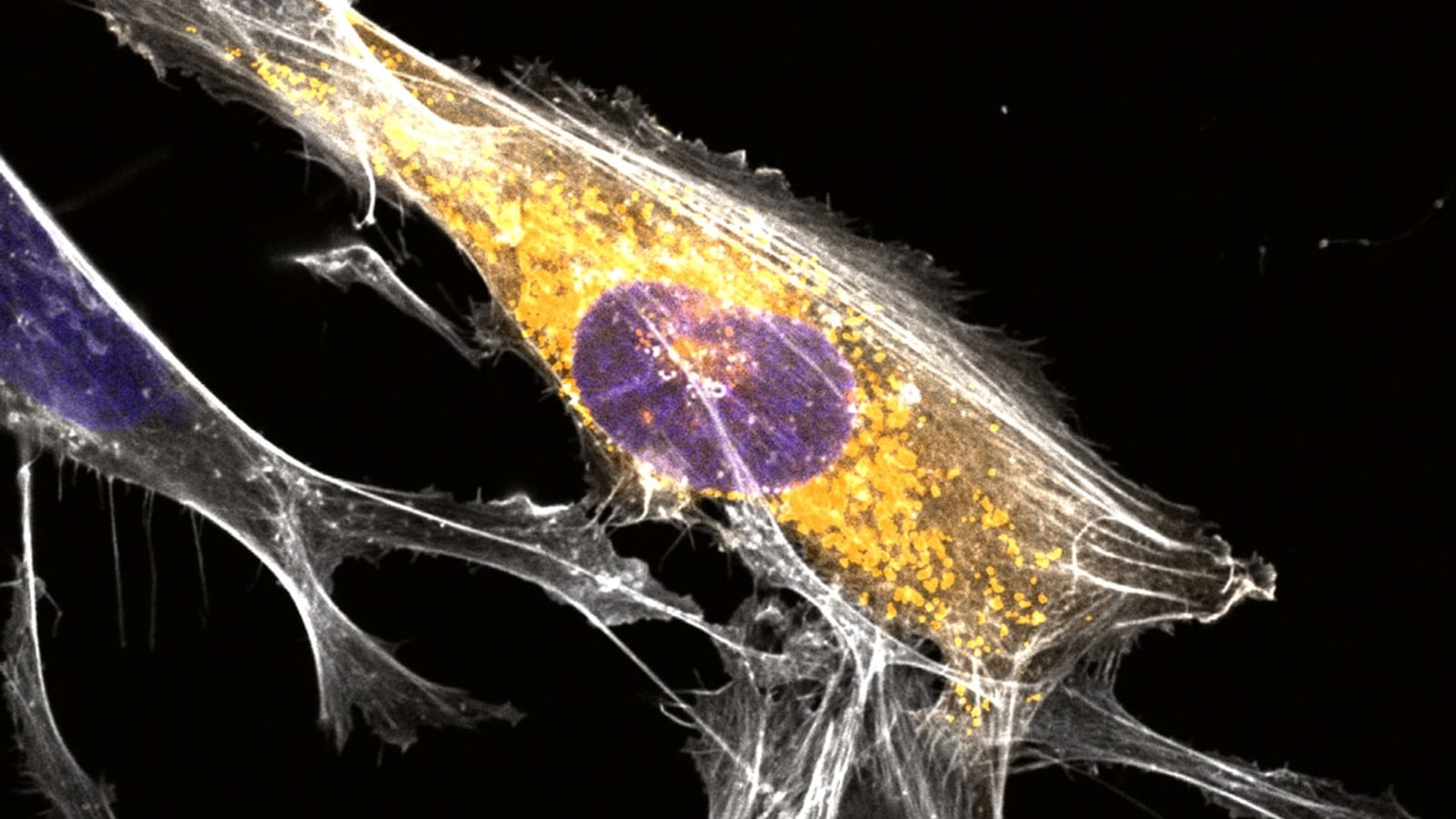
Ribosome profiling and mass spectrometry supported the existence of micro-MKKS63. Imaging placed it near mitochondria. Its abundance was lower in symptomatic Alzheimer's disease. Then the researchers went one step further and edited the small open reading frame itself while preserving the canonical MKKS coding sequence.
The tiny protein moved a real physiological dial.
In HMC3 human microglial cells, CRISPR disruption of the micro-MKKS63 coding region reduced basal respiration, maximal respiration and ATP-linked mitochondrial respiration. In other words, removing the tiny product while leaving the larger expected gene product intact changed cellular energy metabolism.
That result matters because it moves the protein out of the category of interesting sequence artifact. The microprotein participates in a measurable physiological process.
It still does not prove that loss of micro-MKKS63 causes Alzheimer's disease. The tissue samples were collected after death, and disease-related molecular changes can be causal, downstream, compensatory or coincidental. The cell experiment establishes function in a model system, not a clinical disease mechanism.
That distinction is exactly where useful science lives.
The map was missing a layer.
Genomics made it tempting to think the human biological parts catalog had become mostly a problem of interpretation. These data suggest the catalog itself remains incomplete.
That changes how researchers should think about disease associations. A variant near a familiar gene might affect an overlooked microprotein. A transcript categorized as non-coding might produce a functional peptide. A gene-level expression signal might hide multiple protein products with different locations and functions.
The practical consequence is not that every short open reading frame is important. Most candidates still need ruthless validation. The consequence is that smallness can no longer be used as a reliable reason to ignore something.
The headline is not that scientists found the Alzheimer's protein everyone missed. They did not. The deeper result is that one of the most heavily studied organs in biology still contains a shadow layer of translated products missing from standard reference catalogs. Micro-MKKS63 shows why that matters: a 63-amino-acid protein hidden inside a familiar locus can have its own localization, disease association and measurable mitochondrial function. Before biology can explain every failure, it still has to finish counting the parts.
The brain did not suddenly grow a thousand proteins. Our map finally got less blind.