
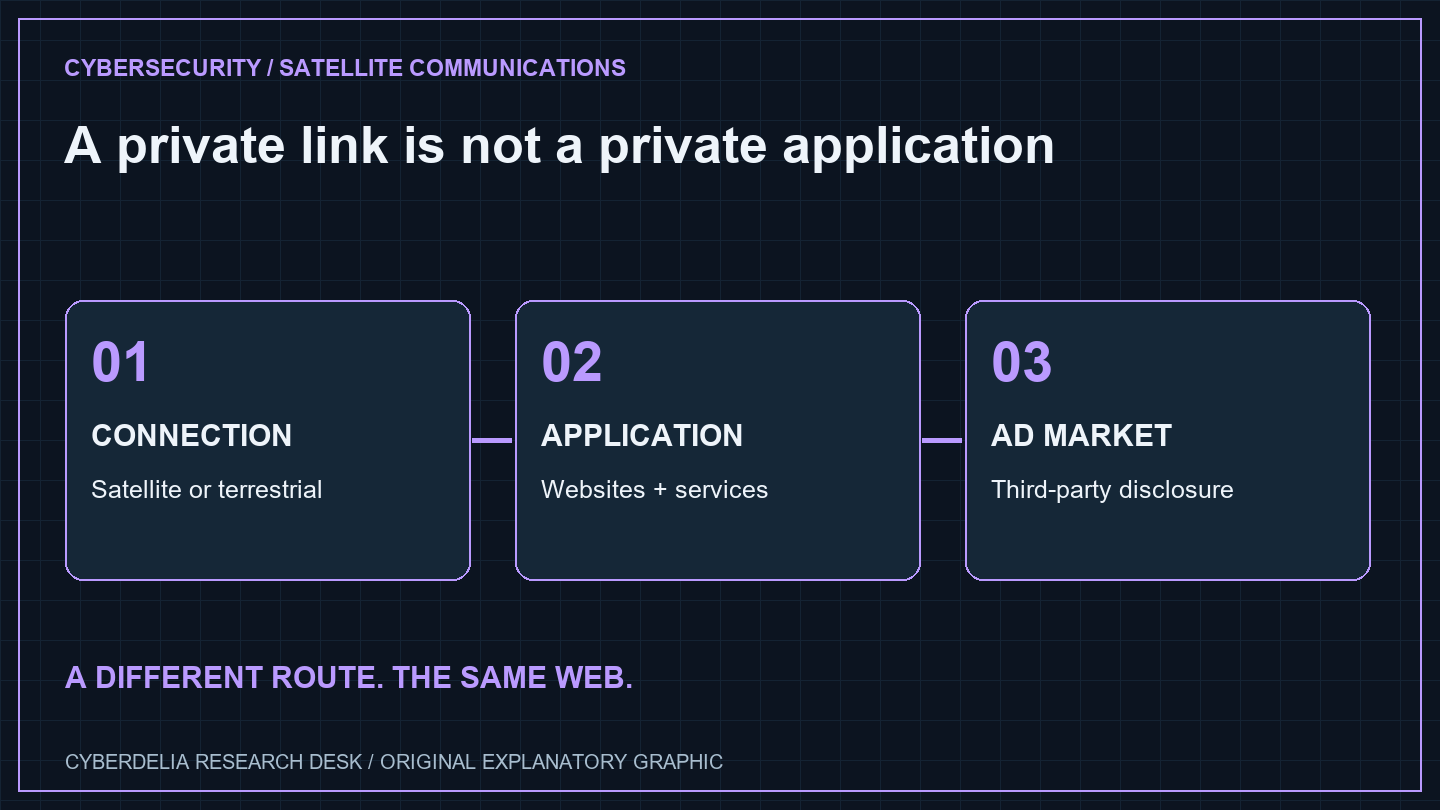
Satellite internet can route around terrestrial communications restrictions. It cannot automatically route around the advertising economy. An October investigation into the targeting of Starlink users reveals how surveillance can follow people across networks, borders, and apparently independent infrastructure.
The satellite changed. The surveillance followed.
A satellite internet terminal can solve an extraordinary engineering problem. It allows someone far from conventional telecommunications infrastructure to establish a high-bandwidth connection through spacecraft passing hundreds of kilometers overhead. In remote communities, that means connectivity where ordinary broadband may be impractical. In disaster zones, it can mean communication after terrestrial networks fail. In conflict areas, it can provide a route around damaged or restricted infrastructure. But changing how information reaches the internet does not necessarily change what happens after it gets there. The user still opens applications. The applications still contact commercial services. Websites still load advertisements. Advertising exchanges still attempt to identify and categorize the person behind the connection.
And those systems have developed an extraordinary appetite for personal information. On October 27, Reuters reported that researchers examining advertising activity associated with SpaceX's Starlink service had linked unusually extensive targeting to an Israeli advertising-technology company, Discover-Tech. The investigation concerned an advertising bidder identified in earlier TrendAI research as Shadow-Earth-79. According to Reuters, citing six people familiar with the findings, researchers had connected that activity to Discover-Tech. The bidder reportedly dominated advertising auctions associated with Starlink traffic in more than 100 countries. Some of those countries were places where Starlink service was restricted or prohibited.
That geographical pattern raised an obvious question: What legitimate advertising business would find such audiences unusually valuable? Reuters said Discover-Tech, its chief executive and SpaceX did not respond to its requests for comment. This article relies on the cited investigations; Cyberdelia did not independently inspect their raw telemetry or contact the companies. The answer has not been established for every individual transaction. But the larger evidence deserves serious examination because other investigators had already connected Discover-Tech's advertising infrastructure to targeted surveillance and spyware delivery. The significant issue is not whether satellites themselves are secretly monitoring people.
It is that the ordinary web can expose information about someone even when the network carrying their traffic is unusually difficult for a local authority to control.
Advertising is an information market
To understand the vulnerability, start with a familiar experience: opening an application and seeing an advertisement. Behind that ordinary event is a complicated market. Many advertising placements are sold through real-time bidding. An application or website offers an opportunity to display an advertisement. An exchange sends information about the opportunity to prospective buyers. Automated bidders estimate its value, submit offers, and one buyer may win the right to display its content. The process happens quickly enough that most users never notice it. The trouble is that an advertising opportunity is not merely an empty rectangle on a screen.
Information accompanying a bid request can describe the user, device, application, network, geographic context, or identifiers used by advertising systems. Exactly what is shared varies by platform, exchange, consent settings, and jurisdiction. For ordinary advertisers, that information helps determine whether an advertisement is worth purchasing. For an organization interested in surveillance, portions of the same information can be valuable for entirely different reasons. A bidder may learn something about a prospective audience without needing to win every auction. Multiple advertising identifiers can sometimes be correlated. Observations made at different times may reveal patterns that no individual record establishes by itself.
The distinction is fundamental. An individual data point may be ambiguous. A repeated series of observations can become a behavioral signature. A satellite subscriber may have no idea that an advertisement inside an otherwise ordinary application has exposed information through infrastructure entirely separate from the satellite network. This does not mean every advertiser can determine a Starlink terminal's precise location. The accuracy of network-derived information depends on routing, available identifiers, location permissions, and other variables. It does mean that communications privacy cannot be judged by the satellite link alone.
The significance of Shadow-Earth-79
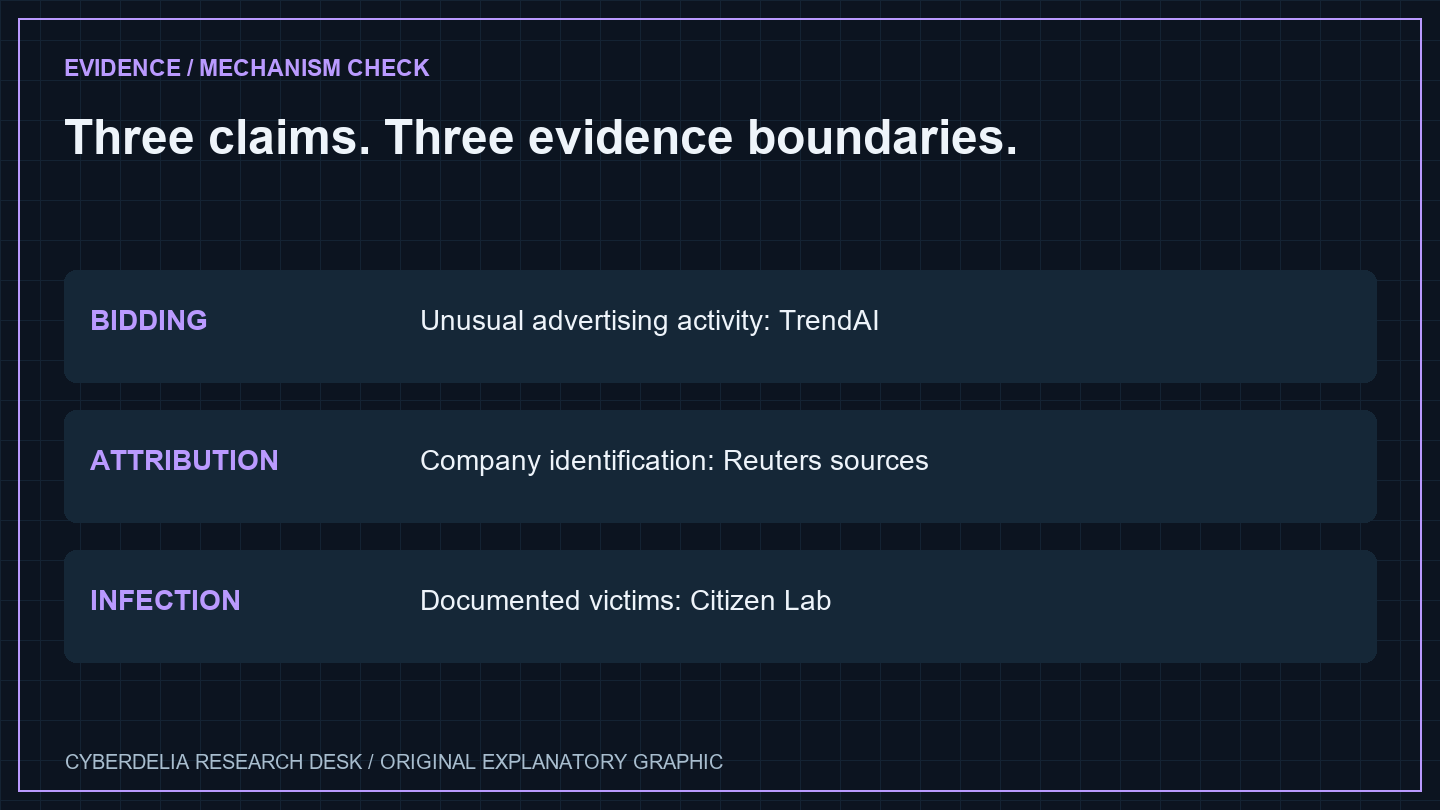
TrendAI's earlier investigation identified an unusual advertising bidder associated with extensive Starlink-related targeting. Its October research described the entity under the designation Shadow-Earth-79. The geographic reach was striking. The bidder appeared prominently in advertising activity associated with Starlink users across a very large number of countries, including places where legitimate advertising demand might ordinarily be limited. Reuters' October 27 reporting added a specific attribution: sources familiar with the research said that Shadow-Earth-79 was Discover-Tech. This matters, but it also introduces an evidentiary distinction. The observable advertising behavior is one category of evidence. The identification of the company operating that bidder is another. The intentions behind each transaction are a third.
It would be irresponsible to present every advertising bid as a verified attempt to compromise a particular person's device. It would also be irresponsible to ignore the wider body of research connecting advertising infrastructure to invasive surveillance. The question is whether the overall pattern is consistent with a normal commercial advertising campaign. A conventional advertiser generally seeks audiences likely to purchase products, install applications, or respond to marketing. A surveillance-oriented bidder might instead place unusually high value on individuals in politically sensitive locations, restricted networks, or institutions of intelligence interest.
Those patterns can overlap. Geography alone does not establish intent. But substantial concentration in unusual markets, combined with technical evidence of tracking infrastructure, creates a stronger basis for investigation.
When advertising becomes a delivery mechanism
The October 27 revelations also intersect with an earlier and more directly documented cybersecurity investigation. On October 15, Citizen Lab at the University of Toronto published research describing a technique it called AdFection. Its investigators documented targeted advertisements being used in connection with zero-click spyware infections on devices associated with Al Jazeera. That is a different kind of finding from simply observing a suspicious advertising pattern. Citizen Lab reported forensic evidence of actual compromise involving spyware from Candiru, a mercenary surveillance company. Researchers also identified Discover-Tech as part of the advertising infrastructure enabling surveillance operations.
Their investigation analyzed approximately four billion bidding records and documented advertising activity across a vast collection of websites and mobile applications. The mechanism is especially disturbing because it challenges a common assumption about digital security: that a person must deliberately click a suspicious link before becoming exposed. An advertisement can cause code or other content to load automatically when the advertising placement renders. In the investigated attack chain, the advertisement served as part of a mechanism that could direct selected devices toward malicious infrastructure. The exact exploitation sequence matters. Advertising by itself does not provide magical access to every smartphone. Successful infection still depends on vulnerabilities, targeting conditions, and supporting infrastructure.
Nevertheless, Citizen Lab's findings demonstrated that a commercial advertising channel could be incorporated into a spyware-delivery operation without an ordinary user interaction. In other words, the system built to deliver advertisements can also become part of the system used to identify and attack people. That is an infrastructure failure extending well beyond any single company.
Starlink complicates the surveillance map
Traditional telecommunications surveillance often focuses on national operators. Authorities may regulate domestic internet service providers, control cellular licensing, require network interception facilities, or obtain access to infrastructure physically located inside their territory. Satellite connectivity changes some of those arrangements. A user may connect through a space-based network instead of relying on a nearby terrestrial access network for the entire route. But applications still operate within a wider internet ecosystem. An application with advertising software may expose information through commercial exchanges. A user may authenticate to ordinary services. A device may retain identifiers across connections.
The result is a peculiar division of control. A government might find it difficult to regulate or intercept the satellite connection directly while a private advertising platform can still observe useful aspects of the user's digital activity. That is not proof that advertising platforms can replace every traditional surveillance capability. It is evidence that the apparent independence of one infrastructure layer can be undermined by dependencies elsewhere. For humanitarian workers, journalists, civil-society organizations, and people operating in dangerous locations, the distinction could be consequential. The technical questions include how advertising systems recognize satellite users, whether network classifications remain stable, how confidently identifiers can be linked, and how much location information the exchanges actually reveal.
Those questions deserve answers grounded in packet captures, advertising records, application behavior, and independently reproducible experiments.
Cyberdelia's systems test: follow the information
A serious investigation should examine the entire path from application activity to advertising-auction exposure. First, determine what information a controlled test device reveals when using a satellite connection. Repeat the same test on conventional fixed broadband and cellular networks. Second, inspect which applications and websites generate advertising requests, and which identifiers accompany them. Third, compare the information visible to an advertising bidder with the information visible to the network operator itself. Fourth, measure whether apparent geographic information corresponds to the device's physical location, a network gateway, or another location entirely.
Finally, assess whether identifiers persist when the user changes networks, resets advertising settings, or modifies application permissions. The purpose would not be to reconstruct surveillance techniques for attacking individuals. It would be to identify the boundaries where personal information escapes a network users may reasonably regard as independent. An effective protective architecture would need to address advertising-platform permissions, excessive data disclosure, identifier persistence, malicious advertising content, and monitoring for suspicious bidder behavior. Network encryption alone cannot solve every problem created by an application that voluntarily transmits identifying information to a third party.
Accountability is not just a software patch
Following the October 15 Citizen Lab findings, several advertising platforms took action against Discover-Tech. Citizen Lab reported that Google terminated the company's access to its advertising exchanges. Other advertising companies suspended or removed access. These interventions matter because advertising exchanges act as gatekeepers. They decide which organizations can bid for exposure to enormous audiences and under what conditions. But removing one bidder does not automatically eliminate the underlying possibility of abuse. A new bidder might use a different legal entity, contractual intermediary, advertising account, or technical infrastructure.
The systemic question is how much information the advertising market should broadcast to prospective buyers in the first place. One approach emphasizes detecting and excluding malicious actors. Another limits the amount of user information available during auctions. Those approaches are complementary, but they solve different problems. Detection tries to identify bad participants. Data minimization reduces what any participant can learn. The latter may be particularly important for users who cannot realistically evaluate every advertising intermediary embedded in their applications.
The next border is inside the browser
Satellite networks have changed the geography of internet access. They can connect locations once considered uneconomic, restore communications during emergencies, and complicate attempts to control information through terrestrial infrastructure. But the October investigations reveal a more uncomfortable reality. Network independence is not the same thing as information independence. A connection can cross national borders through space while its user remains exposed to an advertising market operating through familiar applications and websites. The evidence currently supports several distinct conclusions. Citizen Lab documented an advertising-enabled spyware attack against identified victims. TrendAI documented unusual global advertising activity directed at Starlink-associated traffic. Reuters subsequently attributed the bidder involved in that Starlink pattern to Discover-Tech through confidential sources.
Those findings reinforce one another, but they are not interchangeable. The evidence does not establish that every Starlink user reached by the advertising operation was infected or individually tracked. The broader engineering problem is clear enough. We have spent decades protecting communications links from interception. Meanwhile, entire industries have developed systems for voluntarily distributing information about the people using those links. The next generation of privacy engineering will have to confront both. The satellite may change where the signal travels. It does not decide what the application gives away.
Source trail
- Citizen Lab, Exposing AdFection, October 15
- TrendAI, Invasive Ads, October 15
- Reuters, Starlink targeting attribution, October 27
Corrections and updates
Published November 13, 2026. Send specific corrections and supporting evidence through our corrections page. Material revisions will be recorded here.