

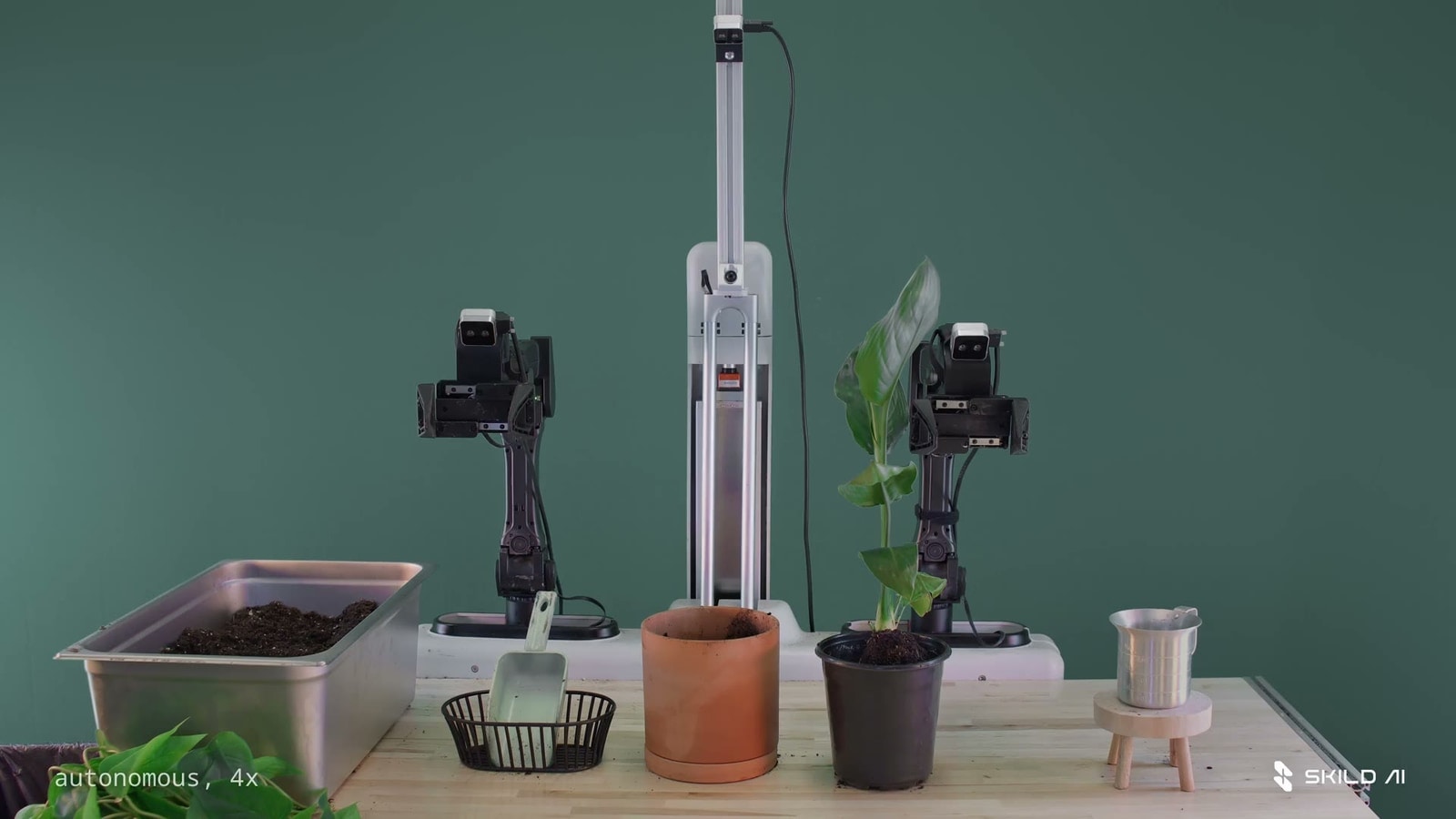
A robot watches one demonstration, waits a few minutes and then performs a task it has never seen before. No fine-tuning. No additional training run. No change to the model weights. If that description survives independent testing, it is a meaningful step toward machines that can learn work where the work actually happens.
Skild AI calls the capability S1. In its Sep. 10 technical report, the company presents four long-horizon tasks: potting a plant, cooking pancakes, preparing pour-over coffee and assembling a kit. The tasks last as long as ten minutes. Skild says the model encounters them outside its pretraining distribution and uses a single video demonstration as context for execution.
The headline is strong. The methodology is more interesting.
Buried in the evaluation description is a sentence that changes the meaning of the score. Skild says it used human intervention to recover from failures during rollouts so that all steps could be graded cumulatively. The company explains that without recovery, a vision-language-action baseline often fails early and receives zero credit for the remainder of a long task.
That choice may be defensible. It also means the reported benchmark is not a clean measure of whether a robot can complete the entire job alone from start to finish.
The claim is larger than imitation.
Most robot learning demonstrations compress an enormous amount of preparation into a polished minute of video. A task may require hundreds or thousands of teleoperated examples, a carefully prepared environment, task-specific post-training and repeated engineering runs before the camera turns on. The final behavior can be impressive while saying little about how quickly the machine can acquire a genuinely new skill.
S1 targets that bottleneck. Skild frames the system as in-context learning for physical action: the robot uses the new demonstration at inference time instead of absorbing it through another training cycle. In the plant-potting example, the company's published timeline shows recording beginning at 9:22, the human demonstration being captured once and autonomous execution starting at 9:27. Skild describes the broader setup-to-execution process as eleven minutes, with much of that interval spent arranging furniture and the workspace.
That is the right problem to attack. Real customers do not want to commission a data-collection program every time a task changes. Warehouses, laboratories, kitchens, clinics and factories are full of jobs whose details vary by station, object, sequence and local convention. A robot that can acquire those details from one competent demonstration could turn deployment from a model-development project into something closer to training a new employee.
The scale curve is the strongest part of the report.
Skild compares its in-context-learning model with a language-conditioned baseline across seen and unseen long-horizon tasks. The company uses an average cumulative per-step success rate, which gives credit as the robot completes successive elements of the task. At roughly 100,000 hours of training data, Skild reports that the language-conditioned baseline reaches only 9 percent on unseen tasks while the in-context-learning system reaches 66 percent. On seen tasks, performance at scale approaches 96 percent.
The reported curve suggests that in-context learning becomes more valuable as the underlying model and dataset grow. That would mirror a pattern seen in language models: a sufficiently broad pretrained system can use a prompt to reorganize capabilities it already possesses without changing its weights. In robotics, the prompt is not merely text. It can contain the visual sequence, object relationships, timing and action structure of a demonstration.
Skild also estimates that one demonstration provided through context can match roughly 380 post-training episodes. For long tasks, collecting that amount of teleoperation data could require 50 to 100 hours. The company's post-trained baseline eventually reaches 86 percent, but only after 2,000 demonstrations. Even if those equivalence estimates move under outside testing, the economic direction matters. Reducing the data required per task is one of the clearest routes from robotics research to usable deployment.
Then the human hand returns.
A long-horizon task is multiplicative. If a robot must complete ten steps and each step succeeds 90 percent of the time, the chance of completing the whole sequence without failure is only about 35 percent under a simple independence assumption. Early errors can also make later steps impossible. A robot that spills the coffee grounds may not get a meaningful opportunity to demonstrate its pouring behavior.
Skild's evaluation responds by letting a human recover the rollout after a failure. This keeps later steps observable and prevents one early mistake from flattening the score to zero. For a research question about whether a model has learned the component behaviors, that can be useful. It separates “the robot failed step two” from “we learned nothing about steps three through ten.”
But intervention changes the object being measured. A cumulative step score with recovery asks whether the system can perform parts of a task when repeatedly returned to a viable state. End-to-end autonomy asks whether the system can maintain that viable state itself. Those are related capabilities, not interchangeable ones.
The distinction is especially important because recovery is part of the job. A useful general-purpose robot must notice when an object slips, when a container moves, when a tool is misaligned or when an earlier action produced the wrong state. It must either repair the situation, request help intelligently or stop safely. Resetting the scene by hand can reveal latent skill, but it removes the exact error propagation that makes real deployment expensive.
This does not erase the result.
The most aggressive interpretation would say the intervention invalidates the benchmark. That goes too far. Skild explicitly reports the procedure, and the reason for it is understandable. The company says the recovery was mainly needed to obtain a useful comparison with the language-conditioned baseline, which otherwise scored zero on long unseen tasks after early failures. A benchmark can legitimately measure component progress before a system achieves uninterrupted completion.
The fair conclusion is narrower. S1 appears stronger than the published baseline at using a single demonstration to guide behavior across unfamiliar task sequences. The report does not establish that S1 can reliably complete those sequences without human recovery. It also does not tell readers, in the main result, how often S1 required intervention compared with the baseline, which failure types dominated or how success varied across individual tasks.
Those missing measurements are not clerical details. They determine labor economics. A robot that needs one reset every ten shifts is an automation tool. A robot that needs one reset every ten minutes may be a research platform with a full-time attendant. Both can produce a high cumulative step score if the human reliably restores the scene.
The next benchmark should make autonomy visible.
Skild has published enough detail to make the next questions obvious. Report uninterrupted per-run completion alongside cumulative step success. Publish the number, timing and cause of interventions for each system and task. Show distributions rather than only averages. Separate self-recovery, operator-assisted recovery and full scene reset. Repeat the one-demonstration protocol in a laboratory that did not design the model and on tasks selected after the system is frozen.
Long-run testing matters too. A handful of successful demonstrations cannot establish uptime, drift, wear tolerance or the burden of exceptions in production. The most valuable follow-up would place S1 in a changing work cell and count not only completed tasks but human minutes consumed, failures recovered autonomously and situations requiring a safe stop.
NVIDIA's account of the work emphasizes the potential for robots to adapt quickly across embodiments and environments. That is the commercial promise. The evidence needed to support it will look less like a launch video and more like an operations log.
There is a real result here worth watching. One-shot physical in-context learning could remove a major deployment bottleneck, and Skild's scale comparison gives researchers a concrete claim to test. The benchmark is not weak because it exposes intervention. It is useful precisely because that disclosure shows where the next layer of proof begins.
Skild's S1 report is stronger than a choreographed robot demo and narrower than a proof of general autonomous work. Its published data support the claim that one demonstration can materially improve stepwise performance on unfamiliar, long-horizon tasks without a weight update. Because humans recovered failed rollouts during evaluation, the results do not by themselves establish uninterrupted end-to-end autonomy. Publish intervention counts, per-run completion and outside replication next.