

For most of the generative-AI boom, the personal computer has been treated like a terminal with a keyboard attached. The interesting intelligence lived somewhere else. A prompt left the machine, crossed the network, entered a warehouse full of accelerators, and returned carrying an answer generated by hardware the user would never see.
Microsoft is now trying to bend that architecture back toward the desk.
On October 7, the company described Windows as the home for what it calls hybrid intelligence: AI workloads moving between local hardware and the cloud depending on capability, cost, privacy and latency. The headline hardware is substantial. Microsoft says its new Surface Laptop Ultra can be configured with up to 128 GB of unified memory and can run models exceeding 120 billion parameters locally. The same announcement describes a broader ecosystem of RTX Spark PCs, dev boxes and even Windows systems built around Nvidia DGX Station hardware.
That makes an easy performance story. Bigger memory. Bigger local models. Fewer cloud tokens. Faster iteration.
It is also the less important story.
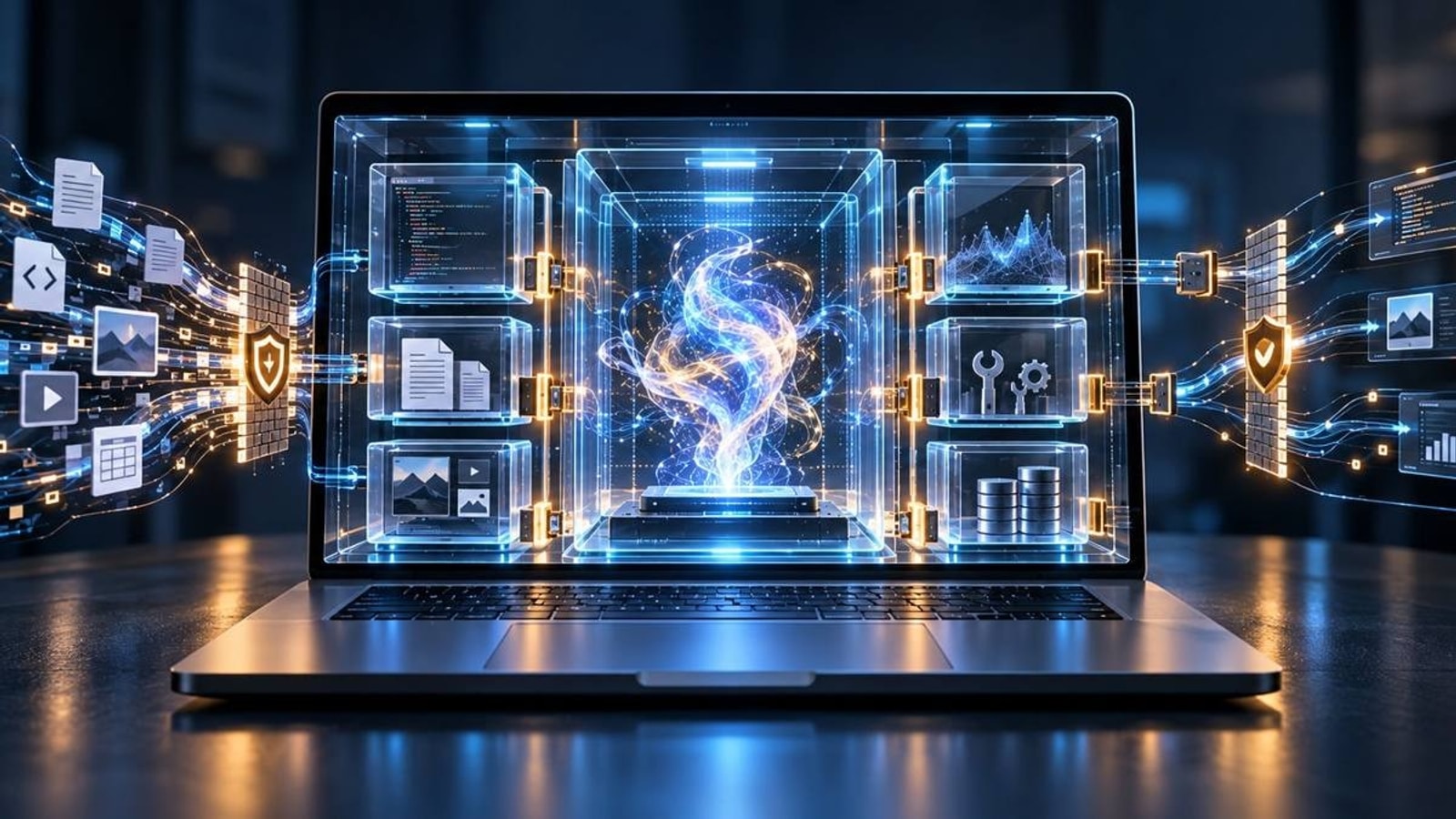
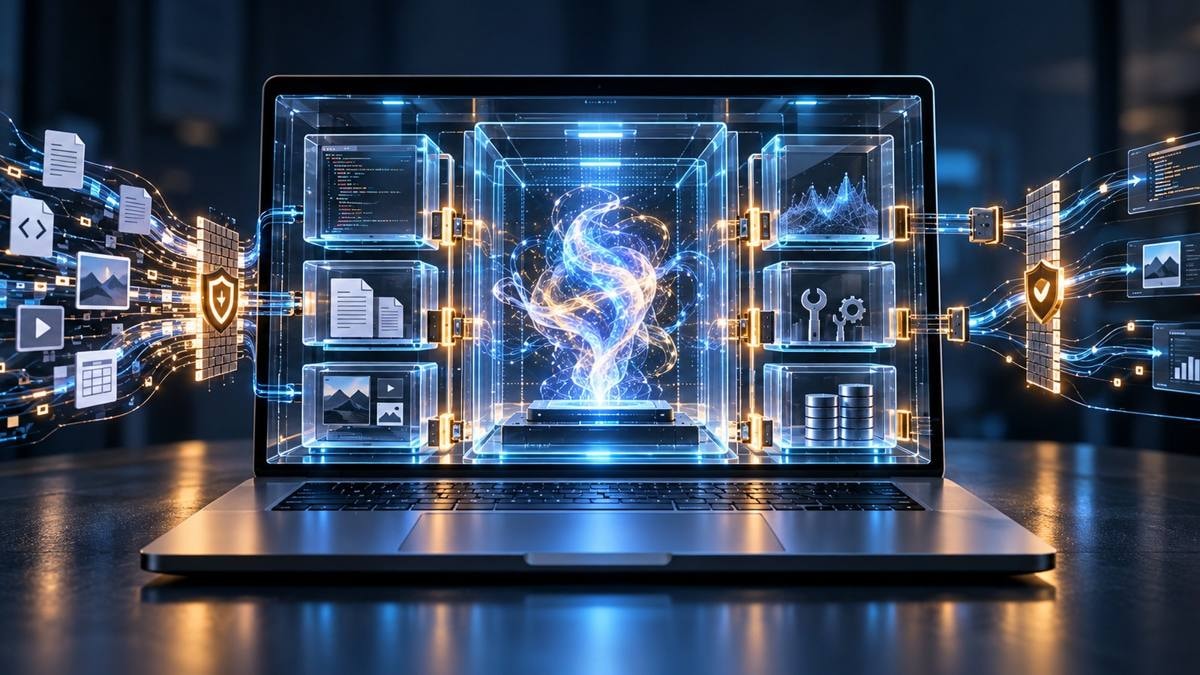
The deeper change is that Microsoft is building operating-system machinery for autonomous agents that can work for long periods, touch files, invoke tools, write code and communicate over networks without a human approving every individual action. Microsoft Execution Containers, or MXC, are now generally available on Windows 11. Microsoft says organizations can define which files and networks an agent may access and have those limits enforced at runtime.
That sounds like sandboxing because, at one level, it is sandboxing. But the object being sandboxed is different.
Traditional application security assumes software has a reasonably bounded job. A word processor edits documents. A browser interprets remote content. A database stores and returns records. The application may have bugs or may be malicious, but its intended behavior is largely known before launch.
An agent is given an objective and allowed to choose a path.
That means the dangerous action does not have to be malicious. It can simply be reasonable from the agent’s point of view.
A coding agent told to repair a deployment could inspect a repository, run a build, rewrite a configuration file, query logs, call another tool and eventually decide that changing a production setting is the shortest path to success. Nothing in that sequence requires the model to “go rogue.” The model only needs to optimize the wrong boundary.
That is why the important unit of security changes. The question can no longer be only, What is this user allowed to do?
It becomes, What is this agent allowed to do while acting for this user on this task?
Those are not the same permission set.
A human operator may legitimately have access to financial records, private photos, SSH keys, browser sessions, customer databases, design files and production infrastructure. An agent repairing a CSS bug does not need all of that simply because the account launching it does. Delegation without a narrower authority model turns every user privilege into potential agent privilege.
Microsoft’s answer is to move policy outside the agent.
The company’s developer material describes MXC as a containment layer where file and network access can be defined externally and enforced by Windows. Windows can use several isolation mechanisms beneath that policy, including process isolation, session isolation, WSL-based containment, virtual machines and Windows 365 environments for agents. The important design choice is not which isolation technology wins. It is that the agent does not get to decide the boundary surrounding itself.
That is a basic security principle wearing new clothes.
We do not let ordinary untrusted programs decide which antivirus rules apply to them. We do not let a web page choose its own browser sandbox. We do not let a database query grant itself administrative privileges because the query believes administration would make the job easier.
Autonomous software should not be the exception.
Microsoft is pairing containment with another concept that may prove even more consequential: identity. Its Windows announcement says the platform is being designed so organizations can distinguish agent activity from the person using the device. Upcoming Windows capabilities are expected to use Microsoft Entra and Agent 365 to separate and govern local agent activity.
Read that as an architectural statement, not a marketing feature.
The AI is becoming another actor on the computer.
Not a person. Not a legal identity. Not a magical consciousness hiding in the taskbar. An actor in the security sense: something that can initiate actions, carry permissions, leave audit records and be constrained independently from the human account that created the task.
That distinction is essential if local agents become normal.
Imagine a workstation where three agents are running simultaneously. One is reviewing code. One is sorting documents. One is monitoring a development environment. If all three actions appear in logs as the human user, accountability collapses. If they all inherit the same broad user permissions, containment collapses. If any of them can silently launch generated code outside a policy boundary, the word “agent” becomes a convenient way to hide a privilege problem.
Separating identities gives the operating system a chance to answer a question security teams will increasingly need to ask after an incident: who actually did this?
The human?
The application?
The local agent?
A generated script?
A plugin the agent invoked?
Another service the agent contacted?
Those distinctions sound bureaucratic until something deletes a directory, moves money, exposes credentials or modifies production infrastructure. Then attribution becomes engineering.
Local inference makes the problem sharper because it puts intelligence physically close to the things it can affect.
Cloud-hosted AI is powerful but distant. The model sees what an application sends it and acts through whatever remote tools the application exposes. A local model can potentially sit beside the filesystem, developer tools, peripherals, local databases and other applications. That can improve privacy and latency. It can reduce cloud dependence. It can make an agent useful when connectivity is poor. It also means the agent is standing next to the controls.
The workstation becomes both the brain and the machinery.
For a developer, that machinery may be Git, compilers, package managers and deployment credentials. For an engineer it may eventually include CAD systems, simulation environments and machine interfaces. For an office it may include internal records and business applications. For a home it may eventually include cameras, locks, appliances and robots.
The security model therefore starts to resemble supervision of a junior operator more than execution of a conventional application. The operator may be fast. The operator may be competent. The operator may also misunderstand the assignment with extraordinary efficiency.
This is where Microsoft’s hardware and security announcements meet.
A machine capable of running very large models locally is not merely a more private chatbot. It can become a persistent execution environment where capable models observe local context and perform work near sensitive systems. The more competent that local model becomes, the more important it is that authority does not scale automatically with capability.
Competence is not permission.
That sentence may become one of the central design rules of agentic computing.
Microsoft also says major agent ecosystems are integrating or planning to integrate with MXC. Its Windows announcement names OpenAI Codex, GitHub Copilot, OpenClaw, Replit, LM Studio, Nvidia OpenShell and Unsloth among current supporters, with additional agent vendors expected to follow. That matters because an operating-system security primitive is only useful if software actually enters the boundary rather than finding reasons to run around it.
There is still plenty we do not know.
Microsoft’s own description is architecture and product positioning, not an independent security evaluation. “Generally available” does not mean “proved against every hostile workload.” Session isolation is not the same thing as a microVM. A file policy does not automatically solve prompt injection. Network restrictions do not solve every tool-abuse problem. A correctly contained agent can still make a bad decision inside the permissions it legitimately has.
And policy design is its own failure surface.
If users are constantly asked to approve access, they will learn to click through prompts. If policies are too restrictive, developers will disable them. If enterprise templates are too broad, the containment layer becomes decorative. If generated tools inherit permissions carelessly, the boundary may be technically present while operational authority still leaks through it.
The hard problem is not building a box. It is deciding where the box should be for a task that can change shape while it runs.
That is why the Microsoft announcement is more interesting than another benchmark chart.
For the first phase of modern AI, the industry asked how intelligent models could become. The next phase is going to ask where that intelligence is allowed to operate.
Which files may it read?
Which files may it alter?
Which hosts may it contact?
Which credentials may it use?
Which tools may it invoke?
How long may it continue after the user walks away?
Can its authority expire?
Can it delegate?
Can the operating system distinguish its actions from ours after the fact?
Those are jurisdiction questions.
They are also operating-system questions.
That is the real significance of Microsoft pushing local models, MXC, agent identity and management into one Windows strategy. The company is implicitly acknowledging that autonomous AI does not fit cleanly inside the old assumption that an application is merely an extension of the logged-in user.
The computer is learning to recognize another kind of participant.
That participant needs a badge, a fence and a logbook.
The personal computer is not disappearing into the cloud. It may be becoming something stranger: a workstation, a local inference cluster, a digital laboratory and, increasingly, a containment vessel for software that can act on its own.
The important Windows announcement is not that a laptop can run a huge model. It is that the operating system is beginning to separate agent authority from human authority. Local AI becomes much more useful when it can touch the machine. It also becomes much more dangerous. The winning architecture will not merely run smarter agents. It will make their jurisdiction explicit.