

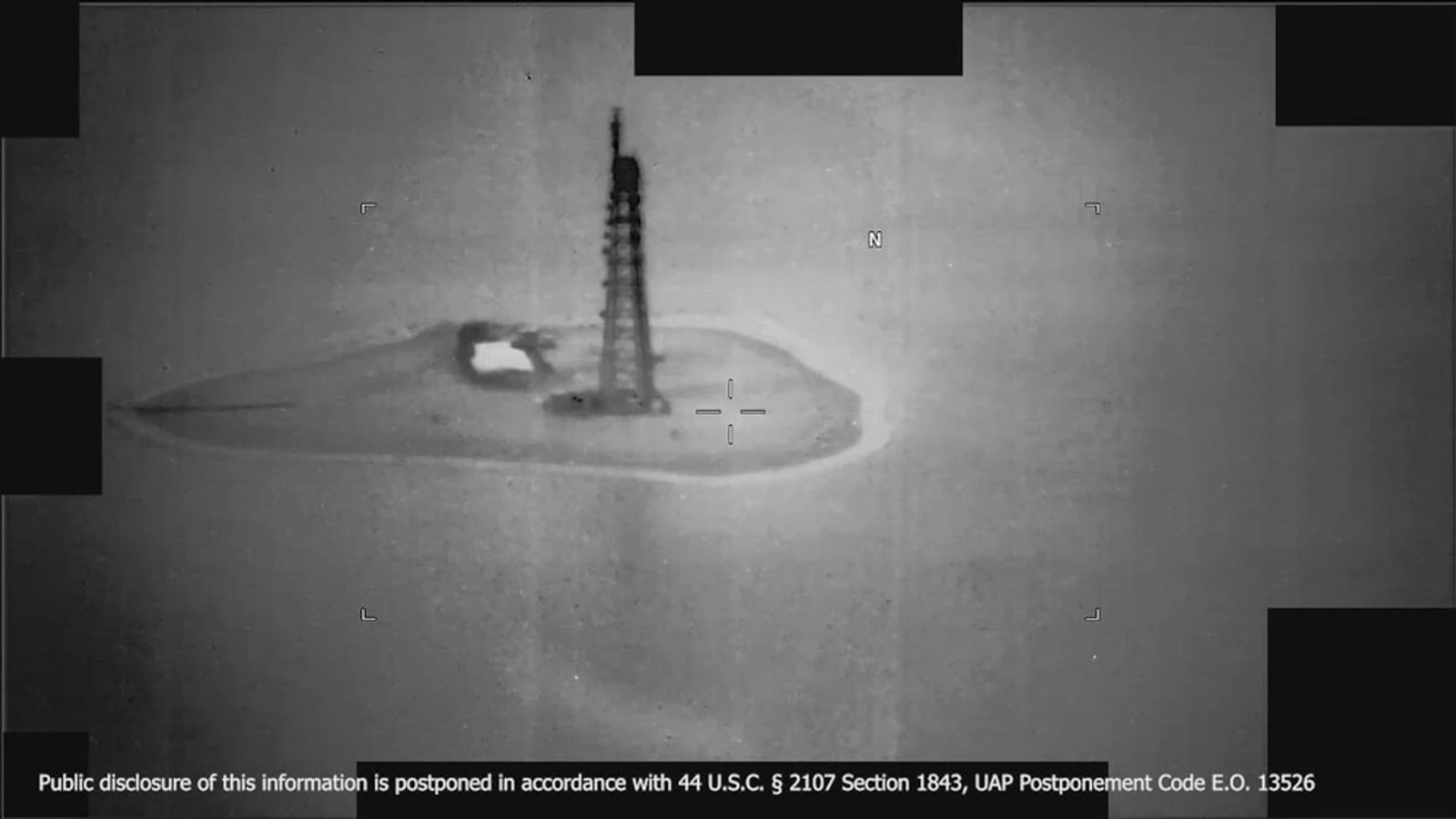
The Pentagon released a new UAP archive on Friday, and the file names alone are optimized for cognitive mischief.
There are infrared clips of small moving objects. There is a 1952 film from Utah. There is an hour-long presentation by Project Blue Book officer Edward J. Ruppelt. There are contracting documents for the Advanced Aerospace Weapon System Applications Program, or AAWSAP. There are technical papers about wormholes, warp drives, antigravity, biological effects, and the Drake equation.
Put those records on one web page and the human brain wants to turn them into one story. That is exactly the wrong move.
Release 6 is not a single body of mutually reinforcing evidence. It is a filing cabinet assembled across seven decades, several programs, different collection systems, and radically different standards of observation. The first obligation is to separate what each class of record can establish from what it cannot.
First, separate the four evidence classes
| File class | What it can establish | What it cannot establish by itself |
|---|---|---|
| Modern incident reports and sensor video | That an operator or unit recorded an event, described its motion, and could not resolve it with the released data | Object identity, origin, intent, or extraordinary performance without geometry and sensor context |
| Historical case material | What witnesses and investigators recorded at the time, plus the limits of surviving media | A modern reconstruction when calibration, custody, references, or original film elements are missing |
| Program and contract records | That an agency funded a question, defined a requirement, or commissioned work | That the premise was true or the proposed technology worked |
| Technical reference studies | What concepts authors surveyed, modeled, or considered relevant to future aerospace threats | Experimental confirmation, operational capability, or possession of nonhuman technology |
That taxonomy is less exciting than shouting “warp drive” into a livestream. It is also how the archive becomes usable.
The public inventory totals 71 files: 55 documents, 15 videos, and one audio file. Sixty-seven originated with the Department of War and four with local law enforcement. Sixty-four contain some form of redaction. The files span 1952 to 2025, and an independent release index counts 2,595 document pages.
Even the total requires a footnote. One public index currently lists 72 files and 56 documents, while the Pentagon inventory reported by CBS News and the UAP Ledger manifest lists 71 and 55. That one-record discrepancy is worth tracking. It is not a license to pretend the remaining 71 all say the same thing.
The 480-mph spheres are the strongest current case—and still incomplete
The most immediately interesting modern record is DOW-UAP-PR135, paired with mission report D108. It describes six small spherical objects observed in the Middle East in 2025. The report characterizes them as “seemingly agile,” frequently changing direction, with an estimated speed of 480 miles per hour. The accompanying infrared video runs about one minute.
That is a real record of a real observation. It is not a complete physical reconstruction.
The released material does not give the public everything needed to independently solve range, altitude, object size, wind, sensor mode, platform motion, line-of-sight rate, or the method behind the speed estimate. Redactions remove additional operational context. Bright or dark spots moving across an infrared image are measurements, but their apparent motion becomes physical velocity only after the geometry is constrained.
“Unresolved” is therefore the correct status. It means the released evidence does not support a confident identification. It does not mean every conventional explanation was experimentally eliminated, and it does not automatically upgrade an observation into exotic propulsion.
A separate 2022 Iraq report describes unidentified objects estimated at one to two meters and moving at roughly 80 to 180 miles per hour. Four local-law-enforcement videos from Colorado in 2023 show red, blue, and green flashing lights. Those records belong in the archive. Their existence is evidence that events were recorded and referred. Their interpretation still depends on the data that survived the referral process.
Tremonton contains its own warning label
DOW-UAP-PR159 is a digitized version of the famous 1952 Tremonton, Utah, film recorded by Navy Chief Warrant Officer Delbert Newhouse. The objects appear as bright points in a blue sky. The new release is useful partly because its official description states the evidentiary limitations plainly.
The film lacks fixed reference points. Its detail is limited. Those defects prevented a conclusive resolution. After roughly 55 seconds, the footage switches to unrelated sewing-machine imagery. The Defense Visual Information Distribution Service notes that the surviving print may be a composite or reused reel.
That is not a debunking flourish. It is a chain-of-custody and media-integrity problem sitting inside the artifact itself.
Film can preserve a visual event while failing to preserve the information needed to recover scale, distance, speed, or even the exact relationship between copied segments. A bright point without geometry can be faithfully recorded and physically underdetermined at the same time.
The Tremonton film matters because it is historical evidence. It also demonstrates why age and official custody do not magically manufacture missing measurements.
Warp drives prove that a study existed
The loudest headlines will come from the 37 Defense Intelligence Reference Documents produced through AAWSAP. The topics are irresistible: traversable wormholes, warp drive, antigravity, invisibility, negative mass, high-frequency gravitational waves, and biological effects.
The correct inference is that the government commissioned people to survey those subjects as part of a program looking at possible aerospace threats through 2050.
The incorrect inference is that commissioning a paper confirms the mechanism, demonstrates an operational device, or proves the government possesses one.
Government research programs routinely examine low-probability, high-consequence, immature, and speculative concepts. The value of a study can be to map a field, identify constraints, rule out pathways, or tell a sponsor what would have to be true. A statement of work is evidence of institutional interest. A literature review is evidence of what literature existed. Neither is a flight test.
The Pentagon itself describes the AAWSAP papers as reference and synthesis products rather than original research or current validation. Many versions of the same studies have circulated for years through Freedom of Information Act releases and public archives. Release 6 improves provenance and exposes some previously withheld office names; it does not transform equations into hardware.
The injury paper is not an alien autopsy
One AAWSAP paper deserves careful treatment because it can be sensationalized faster than it can be read. The document on anomalous acute and subacute field effects discusses three antenna engineers who developed symptoms after an exposure event. One case resembled radiation illness and later involved malignant changes. The paper compares the pattern with radio-frequency injury.
The source of the exposure was not identified in the released account.
That makes the paper relevant to occupational and exposure history. It does not make it proof that a nonhuman craft injured anyone. The evidentiary bridge from symptoms, to exposure mechanism, to source attribution is precisely what remains incomplete.
Medical effects are real evidence when documented. A proposed causal story is a separate claim. Conflating those two is how a case report becomes mythology.
Ruppelt's 20 percent
DOW-UAP-PR160 preserves a 1952 presentation by Captain Edward J. Ruppelt, then associated with Project Blue Book. In the recording, Ruppelt says the project had reviewed about 800 reports and that roughly 20 percent remained unexplained. He describes a need for more systematic data collection and says the available work had not established a conclusive nature or origin.
That distinction has survived seventy-four years badly.
“Unexplained” is a statement about the relationship between a case and the available data, methods, and comparison set. It is not a positive identification. A case may remain unexplained because it is extraordinary, because it is ordinary but poorly observed, because records are incomplete, or because the correct comparison was never made.
The unexplained fraction can be scientifically valuable. It points toward collection failures, recurring signatures, and questions worth testing. But a residual category cannot be assigned a cause by enthusiasm.
What the release actually changes
Release 6 matters for three reasons that do not require a saucer in a hangar.
First, it improves provenance. Official hosting, identifiers, descriptions, and downloadable records make it easier to distinguish an authentic government artifact from a cropped screenshot drifting across social media.
Second, it puts different generations of UAP work into a comparable public frame. Researchers can inspect how the vocabulary, collection technology, program structure, and acknowledged limitations changed from Project Blue Book through AAWSAP and AARO.
Third, it exposes the measurement problem. The most consequential absence across many cases is not imagination. It is geometry, calibration, environmental context, original media, and a reproducible analysis chain. Better disclosure helps, but disclosure cannot recover data that was never collected.
The National Archives is also building Record Group 615 under the 2024 National Defense Authorization Act, with agencies transferring UAP records on a rolling basis. That longer process may matter more than any single Friday file drop because it creates an archival structure researchers can revisit and correct.
Cyberdelia assessment
The Pentagon has not released 71 proofs of one phenomenon. It has released 71 records produced by different systems asking different questions.
The modern sensor incidents deserve technical scrutiny. The historical footage deserves preservation and media forensics. The administrative files deserve program analysis. The speculative studies deserve to be read as studies. None gains evidentiary strength by being stacked next to the others under a three-letter label.
The most important disclosure may be less cinematic: the government has repeatedly encountered reports that outran its collection design, then stored observations, hypotheses, and program paperwork close enough together for the public to confuse them.
The archive is useful. The pile is not the argument.
Method / evidence boundary
This analysis treats an unresolved report as an unresolved report, not as a positive identification. It separates observed imagery and operator descriptions from derived speed estimates; commissioned AAWSAP studies from experimental validation; documented symptoms from source attribution; and historical artifacts from modern physical reconstructions. Where the public release omits geometry, sensor parameters, original media, or classified context, no independent performance claim is made.
Source trail
Department of War — UAP Records Release 6, 18 Sep 2026
DVIDS / AARO — DOW-UAP-PR135, unresolved UAP report, Middle East, 2025
DVIDS / AARO — DOW-UAP-PR159, historical film, Utah, 1952
DVIDS / AARO — DOW-UAP-PR160, Captain Edward J. Ruppelt presentation, 1952
UAP Ledger — Release 6 inventory and document manifest
CBS News — Pentagon releases sixth batch of UAP records, 18 Sep 2026
U.S. National Archives — Unidentified Anomalous Phenomena Records Collection, Record Group 615
Corrections / updates
The Pentagon/CBS inventory and UAP Ledger manifest list 71 files, while one public browser currently lists 72. This article uses the 71-file official inventory and records the discrepancy rather than silently reconciling it. If the manifest changes, or additional sensor and geometry data is released, the affected claims will be updated at the sentence level. Send corrections through the site's correction trail.