


Look at the image above for a few seconds.
It looks handmade because it is. There is contact information written across the page. A Tumblr reference. "FIND ME!" in large letters. "Be: safe." "Be: SMART." "LOVE: yourself." A violin. A bicycle with an arrow pointing toward it and the words "TOO MANY WHEELS." Colored hearts, stickers, footprints, and little pieces of personality scattered around the page.
Most people would look at it and conclude that the information is obvious. It is practically shouting.
That is why it makes a useful specimen.
The image already demonstrates one of the central problems in hidden communication: different observers can look at exactly the same object and receive different amounts of information from it.
One person sees a poster. A computer sees encoded pixels and file structures. A forensic examiner may see dimensions, compression characteristics, metadata, application residue, or evidence that the file has been transformed. A person who shares private context with the creator may attach meaning to one phrase, one sticker, one position, one color, or one otherwise meaningless detail.
All of those interpretations can exist simultaneously. Nothing supernatural happened. The observers simply arrived with different knowledge.
That is the foundation of steganography.
Hiding the message and hiding the existence of the message are different problems
Encryption and steganography get lumped together constantly despite solving different problems. Encryption assumes the observer may possess the data and tries to prevent that observer from understanding it without the proper key. Steganography attempts to conceal the fact that another message exists at all.
That difference is substantial.
An encrypted blob is obvious. You may not know what it says, but you know someone thought the contents deserved protection. A successful steganographic carrier ideally looks like nothing worth investigating.
The two approaches can be combined. Hidden information can also be encrypted, so discovering the presence of a payload does not automatically reveal its meaning. But combining mechanisms does not eliminate failure modes. It creates a system with more of them.
Now the hidden data has to survive transmission. The carrier has to remain plausible. The hiding process must avoid creating conspicuous artifacts. The recipient needs a way to recover the payload. Both sides need whatever shared information makes recovery possible. And the observer may not need the payload anyway if the surrounding behavior reveals the relationship.
Welcome back to systems engineering.
A digital picture contains more than a picture
When you open a JPEG or PNG file and see an image, your viewer is presenting the part humans normally care about. The file may contain much more.
There can be metadata describing when or how the image was created. There can be color profiles, thumbnails, application-specific structures, and other fields. The visible image itself is represented as numerical information, and compressed formats may describe that visual information in ways that look nothing like a simple grid of colored dots internally.
Those regions offer different places where information can theoretically be stored. They also have very different survival rates.
A hidden message tucked into a metadata field may survive an ordinary file copy perfectly. Upload that same file somewhere that strips or rewrites metadata and the carrier can remain visually identical while the hidden information disappears.
This is the kind of failure that makes hidden-channel demonstrations so useful. The picture still exists. The message does not. You cannot judge the survival of hidden data by looking at the picture.
Social platforms do not owe you your original file
This is where a lot of simplistic steganography demonstrations fall apart. Someone hides data in an image, saves the file, recovers the data successfully, and declares victory.
Then the image gets uploaded somewhere.
The platform may recompress it. Resize it. Convert it. Generate a derivative. Modify the color representation. Strip metadata. Create a thumbnail. Return a new file that looks close enough to the original for human purposes while being very different at the bit level.
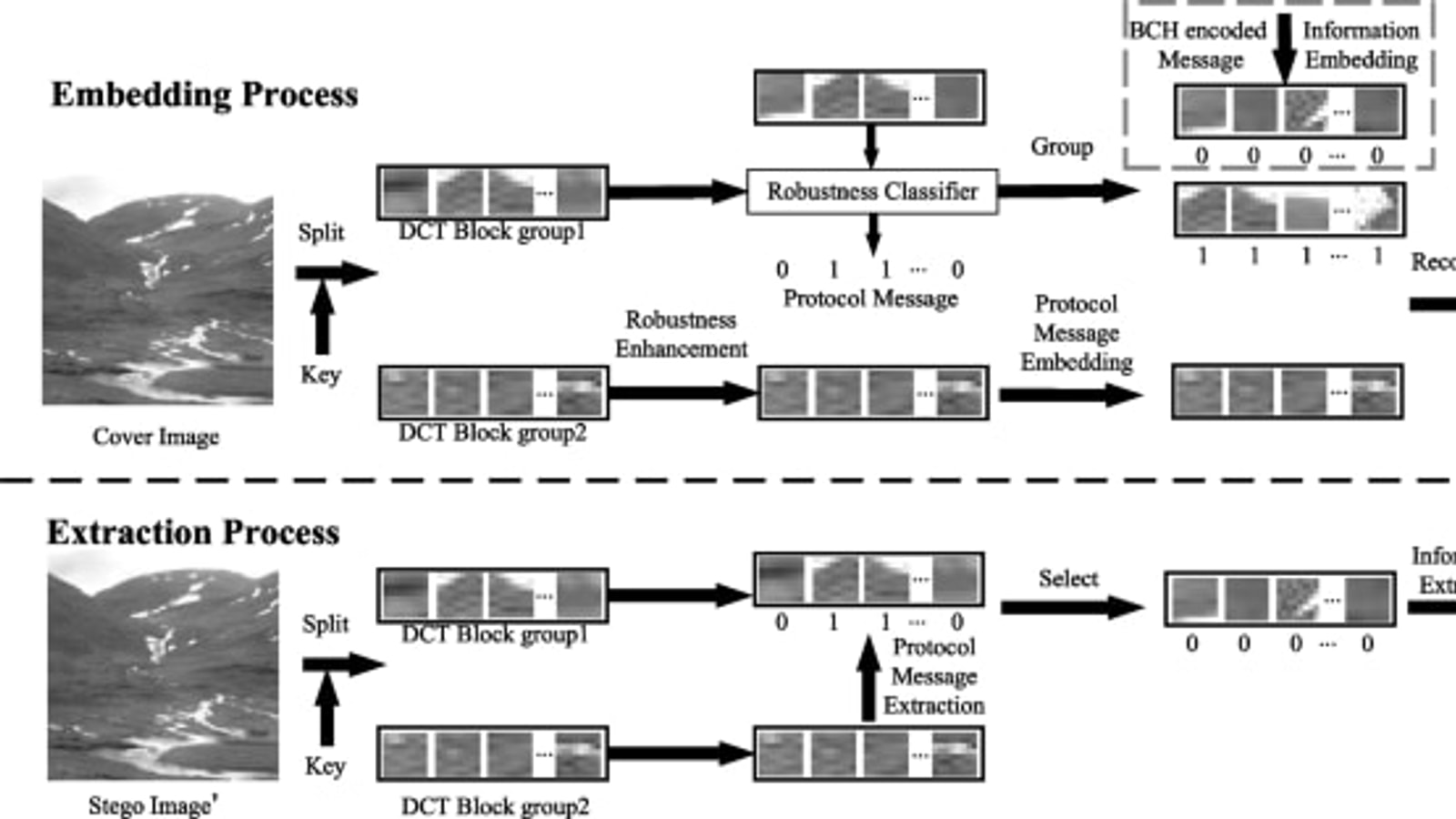
Research into robust JPEG steganography exists precisely because social-network recompression changes the underlying data used by many hiding techniques. A 2023 open-access study in the EURASIP Journal on Information Security describes the problem directly: JPEG recompression on social networks changes DCT coefficients, so a method that works in an error-free channel may fail after the image travels through a lossy one.
A 2026 Mathematics paper approached the same general problem from a different direction, designing image steganography specifically around the distortions introduced by online social networks. The particulars differ, but the engineering lesson is the same: the carrier cannot be designed independently of the route.
The platform is part of the communication system.
You do not test the method in the environment you wish existed. You test the route it actually travels.
The obvious hiding place is inside the pixels
One of the oldest demonstrations of digital image steganography involves changing tiny portions of pixel values. A digital color value is represented numerically. Altering a very low-value portion of that number can sometimes create a change so small that the human eye does not notice it.
Make many tiny changes across an image and those changes can collectively represent information. This is the basic idea behind least-significant-bit, or LSB, hiding.
It is elegant. It is educational. It is also a wonderful way to learn that invisible does not mean durable.
Resize the image and new pixel values may be calculated. Crop it and parts of the carrier disappear. Apply filters and values change. Convert it into a lossy format and the exact low-level values may not survive. The picture still looks like the picture. The hidden message may be confetti.
That is why robust steganography often works with the structure of compressed media instead of assuming exact pixel values will remain untouched. JPEG research frequently operates in transform domains because recompression changes image data in ways that matter to recovery.
The interesting lesson is not which algorithm wins some academic bake-off. The lesson is that robustness, capacity, and detectability pull against one another. You want to hide more information? You may have to modify more of the carrier. Modify more of the carrier and detection may become easier. Make the changes subtler and capacity can fall. Design for aggressive transformations and you may introduce structures an analyst can recognize.
There is no free space inside the image.
This particular picture is useful because it is messy
The poster at the top of this article contains handwriting, uneven texture, edges, stickers, shadows, marks, colored objects, and large areas with very different visual characteristics.
That messiness matters. Highly textured regions often tolerate small alterations perceptually better than perfectly flat areas because the human eye already expects variation there. That does not make the image magically safe for hidden data. It means it is a good teaching object.
It also demonstrates something purely technical treatments sometimes miss: camouflage has a social dimension.
A carrier has to make sense where it appears. The most statistically careful carrier in the world can attract attention if there is no plausible reason for it to exist. A completely ordinary image can attract almost no attention if it naturally belongs in its environment.
Context is part of the channel.
Sometimes you do not need to modify the file at all
The most interesting hidden channel may be semantic.
Suppose two people already share a private interpretation. A phrase that looks meaningless to everyone else can have a specific significance to them. A particular image may mean something because of an old shared reference. A sequence, color, position, or timing pattern may carry meaning only because the participants agreed on the interpretation beforehand.
Nothing has to be hidden inside the binary structure of the file. The hidden layer exists in the minds of the participants.
That kind of communication can survive transformations that destroy fragile digital steganography because the visible carrier remains legible. A platform can recompress a photograph without changing the meaning of a visible sentence written on the sign. It can strip metadata without removing a shared joke. It can resize an image without necessarily destroying the significance of a recognizable symbol.
This is semantic camouflage. It is also where the bootstrap problem walks back into the room.
For a private interpretation to exist, the participants need some shared context. How did they establish it? Who else knows it? How stable is it? Can the meaning be changed? Can old material be decoded retrospectively if the shared reference becomes known later?
Every hidden channel inherits history.
Public does not mean meaningless
There is a strange intuition that if information is public, it cannot be private. That falls apart once you separate access from interpretation.
Millions of people can possess the same object while only one of them understands why a particular detail matters. A chess board can be public. A weather report can be public. A photograph can be public. A classified advertisement can be public. The important distinction is not always who can see the carrier. It can be who knows what to look for.
That can be powerful. It is also fragile.
Once an observer learns that a hidden convention exists, the same public availability that provided camouflage can provide a perfect archive for retrospective analysis. Past material does not need to be seized if it was publicly available the entire time.
Again, historical secrecy and operational secrecy diverge. A method can work during the period that matters and still become obvious later. That is neither automatic success nor automatic failure. It depends on the objective.
Hidden content does not hide relationships
This is one of the easiest mistakes to make. Suppose the concealed information is flawless. Nobody can recover it. Now suppose the same person visits the same unusual page every time a new carrier appears. Suppose another account becomes active immediately afterward. Suppose those events repeat.
The content can remain secret while the behavioral pattern becomes obvious.
You solved the content problem. You did not necessarily solve the relationship problem.
This is why reuse matters. One strange event is an anecdote. Twenty similar events are a dataset. Repeated timing, access behavior, device movement, and communication changes can become more informative than the hidden payload itself.
The observer may never need to know what the picture said. Knowing who reliably reacts to it can be enough.
Steganography does not cancel metadata. It simply moves the problem.
Hidden does not mean undetectable
There is an entire field devoted to finding hidden information. Steganalysis asks whether a carrier contains evidence of concealed data. Analysts may look for statistical anomalies, suspicious structures, inconsistencies, differences from an original file, or patterns associated with known embedding methods. Modern research also applies machine-learning approaches to the problem.
This is another arms race. Embedding improves. Detection improves. Embedding changes. Detection adapts.
The lesson is not that steganography is useless. The lesson is that there is no eternal invisible ink. There are methods with different detection characteristics under different conditions.
That is a much less exciting sentence. It is also true.
So we test it instead of arguing about it
Cyberdelia has an advantage here. We can build controlled experiments.
We do not need somebody's secret message. We do not need to romanticize espionage. We need a known payload, known source files, and known transformations.
For the lab, a harmless test string works perfectly: CYBERDELIA-LAB-001: THE MANUAL IS NOT THE MACHINE.
Take controlled copies of the same carrier. Use different classes of information storage and hiding. Pass the carriers through ordinary transformations: direct file transfer, cloud storage, email attachment, a messaging application, a social-media upload, a screenshot, resize, crop, and format conversion.
Then compare what came back. Did the visual image change? Did the dimensions change? Did metadata survive? Did the file hash change? Did the payload survive? Did recovery require the original? Did the transformation make detection easier?
That is a useful experiment because the result is evidence instead of mythology.
The job is not to declare "steganography works." The job is to ask: which method survives which transformation under which conditions?
That is a real question.
Stop using six different words as if they mean the same thing
Encryption protects meaning. Steganography tries to hide the existence of hidden information. Obfuscation makes interpretation harder. Camouflage makes something resemble its surroundings. Anonymity tries to prevent association with an identity. Pseudonymity creates an alternate identity that may still be trackable over time.
None of those guarantees the others.
A message can be strongly encrypted and trivially attributable. A hidden message can be easy to decode once discovered. An anonymous sender can transmit plaintext. A pseudonymous account can remain nameless while developing a perfectly recognizable behavioral pattern. A public image can contain information only one person understands.
Security starts becoming intelligible once we stop treating those properties as one mystical substance.
Look at the picture again
Nothing about it changed while you read this article.
You did.
At first it was a handmade sign. Now you can see several possible information layers: the visible text, the social meaning, the file, the metadata that may or may not exist, the platform that may transform it, the possibility of hidden digital data, the possibility of shared semantic meaning, the behavior of people who interact with it, and the historical record that may remain afterward.
That is the point.
Hidden communication is not magic. It exploits differences in what observers know, what they can measure, and what they think deserves attention. A message can be present and still be invisible to someone who does not possess the right frame.
Which brings us naturally to the next problem. Before two people can use a private frame, they have to share one. Somehow they have to do that for the first time.
That is the bootstrap problem. That is where Part III begins.
The carrier is only one layer. A hidden-data method has to survive the actual transformation route, remain plausible in context, resist or at least account for detection, and avoid confusing content secrecy with relationship secrecy. A locally recoverable payload proves almost nothing about the real channel until the platform has had its chance to mangle it.